Showing posts with label Medical. Show all posts

Thursday, February 13, 2014

The Child Trauma Kit

A commercial tourniquet on five year-old's arm.
Too big!
Thankfully, major trauma to children is not common. Even less common is major trauma to children due to violence.

However, since we are in the interest of being prepared for the eventuality of all disasters, we might as well cover the horrid reality of violent trauma to your child.

In my Realities and Legalities of Child Snatching series I touched on the possibility of your child being injured in an altercation between a parent and a kidnapper and that commercial trauma kits do not often account for the size differences and special needs of children.

First, in the interest of brevity I'm going to skip talking about trauma kits, what is in them and how to use them. For the purpose of this blog I'm going to assume you have one and have been trained in its use. If you don't have one and don't know how to use it I highly recommend you seek out a combat medicine class.

I want to talk specifically about children and at what ages your trauma kit and skills might need a little adjusting.

Soon after children hit puberty, while they are technically and legally still children, their bodies develop quickly into adult capabilities. While medical dosing and treatment might be different, for trauma management your average junior to senior high school students may not need any specialized equipment. That may not be the case for every child so assess your own child and what you might need for him or her but for the most part you can use a standard trauma kit on post-pubescent children with adequate results.

Prepubescent and adolescent children (called pediatrics in the medical community), on the other hand, are not miniature adults. They can handle some traumas well but not others and their bodies are often not able to compensate for injuries like an adults.

They have different blood pressures, pulses and breathing rates. They cannot take the blood loss an adult can and their lungs often give out far faster than an adult's. Depending on the age, their lungs also cannot handle aggressive positive pressure from artificial ventilation like an adult. When children suffer major traumas they need specialized care and quickly.

The number one cause of heart failure in a child is respiratory distress (they cannot breathe). So a child that is struggling to breathe can deteriorate quickly into a child who's heart is not beating.

Taking those things into consideration let's consider an absolutely worst case scenario:

Your child has been shot. Be this an active shooter event, a shooting at a school function, etc, you are now the sole provider for your child until paramedics arrive.

You have your trauma kit. A lot of the products in that kit such as gauze, surgical sponges, duck tape, occlusive dressings, will directly apply to trauma in children but let's talk about what may not and what you might want to keep an eye out for and add for your child.

Tourniquets:
Make sure your fingers at least touch
around a child's extremity for best results.
Many people who carry trauma kits buy them prefabricated off the internet. These kits often come with easy-one-hand-use tourniquets such as the CAT or SWAT-T. While many of them may be adjustable down to pediatric sizes some are not and you may spend too much time trying to adjust the tourniquet that you could be spending getting the bleeding under control.

Alternatives:
Your hand.

An adult's hand is often the perfect tourniquet for a young child. Encompass the fingers 1-2 inches above the wound and squeeze while applying pressure on the wound with the palm or heel of the hand. The combination of pressure and squeezing off blood flow can get bleeding under control quickly or buy you time to adjust your other tools or direct someone in adjusting your equipment or improving a tourniquet. To see if your hands are big enough, try to encompass your child's arms or legs at their thickest points (the thigh and the upper arm). If your fingers don't touch at the back, know that you may need to improvise a tourniquet for that extremity.

A triangular bandage is quickly applied to
this tiny 2 year-old's arm.
Triangular bandage.

A triangular bandage can make a great tourniquet and can often be applied faster than some commercial products. I recommend carrying at least two or three triangular bandages in case you need more than one tourniquet (think Boston Bombing) and they come in handy for many other purposes. You can buy boxes of twelve off of Amazon for less than $10.

Pressure Bandages:
As with tourniquets, pressure bandages often come in trauma kits and can be too big for some little bodies or take too much time to apply with all the excess material.

Alternatives:
A fantastic alternative to a commercial pressure bandages is gauze and Coflex or Self-Adherent Stretch Sensi-Wrap. It can be torn to size and provides very good pressure (even to tourniquet tightness if you wrap it tight enough). It comes in different widths and is a fantastic thing to throw in any trauma bag even for adult trauma.


Things to Consider Adding:

A nasal and/or oral airway kit.


As I said before, the number one reason for cardiac arrest in children is respiratory distress and children's lungs often give our faster than an adults. After you've controlled bleeding, if the child is quiet, gasping for air or seems to not be breathing well you may have to preform CPR on that child and breathe for him or her at any moment. Take time to consider the normal breathing rate for your child so that you can better gauge what it is too fast or too slow. Children's airways are small and while an oral or nasal airway is not as good as intubation, it will at least keep the tongue out of the back of the throat and keep the mouth slightly open while you preform breaths for the child.

A good tip to remember is if a child is crying, he's breathing. The sounds of your child screaming in such a situation should be music to your ears. A quiet child that is injured is one you need to watch very carefully for respiratory distress and heart failure.

Pediatric airway adjuncts are not big but they do take up space. Many people who carry them prefer to carry the whole kit in case they need to help others. If you are strapped for space, however, you can pick out the airways that will fit your children and put those in your kit. Whether you carry the whole kit or not, it's still a good idea to measure out the airways for your children so that you don't have to take time measuring them under duress.

Click this link for step-by-step instructions on measuring and inserting an oral or nasal airway and when to use one vs the other.

Things to Tell 911:
When you call 911 be sure to specify that there is a pediatric child on scene. If someone else is making the call be sure tell them to specify "Pediatric" or "Child." Give the age, weight and injuries and what you are doing to help that child. Specifying the weight will allow paramedics to start calculating possibly needed doses for medications they may have to give on scene. If CPR is in progress be sure that is made very clear to dispatch.

Some ambulances have separate pediatric bags and med boxes they need to grab and they often will not grab that bag or box unless they know a pediatric patient is on scene. If it's a mass casualty scene they may have a larger jump kit with pediatric tools included but don't count on it. Knowing there is a pediatric on scene in advance will save time from someone having to run back to an ambulance and get the correct med box or bag.

Training You Need:
If you have a child you should know CPR. This is a must. Given choking hazards and other medical emergencies, CPR should have been something you already have been trained in. If not, get it.

If your CPR class does not include practice on inserting oral and nasal airways, ask them if they have them available to try on the dummies. Many places that teach CPR will at least have them on hand and might be willing to allow you to practice and critique your technique.

Organize your kit:
My supplies for my children are in a separate MOLLE pouch on the side of my bag vs buried with all of the other trauma stuff in the main compartments. It gives me peace of mind knowing exactly where they are and that they are easily accessible. Even if you can't make separate kits for your kids vs yourself, have them accessible and well labeled. You might not be the one using them or you might have to direct someone else in their use if you are too injured to do it yourself.

Again, thankfully, traumatic injuries to children due to violence are rare but it's better to have it and not need it than need it and not have it. That goes for tools AND skills.

Skills:

Tourniquet with hand.
1. We're going to assume the blue X on this five year-old's arm is an aggressive hemorrhage.
2. Cover it with a dressing.
3. Place the heel of the hand on the dressing and apply pressure while you wrap your fingers around the arm about 1 - 2 inches above the wound. Make sure your fingers touch to stop all blood flow and squeeze.
4. If bleeding is stopped I can apply a pressure bandage with Coflex self-adhesive tape or a triangular bandage.
The smaller size Coflex might work better for such a small arm.


Tourniquet with triangular bandage.

Friday, August 30, 2013

Childbirth, Self Confience and Leadership

I am a great follower.

What I mean by that is if there is an individual present who I perceive to be in authority I yield easily him or her. This has served me well in many instances with good leaders. It has also served me very poorly as there have been times I have followed the commands of "authority" knowing it wasn't the best course of action.

There is a lot of safety and comfort in not making decisions for yourself or anyone else. Being able to point at someone else and say, "I'm just doing what he told me to," is a safety net I enjoyed in my youth. It got me off the hook many times.

But it's really no way to live a life. Yes, there are times when you need to know how to follow orders completely and without question. There are other times when you need to stand up to authority and say, "I'm not doing that." There are also other times when you have to step up and be the leader no one else can be in the moment.

My first role as a leader was as a high school drama team leader. There were four teams and ours came in dead last. It made me never want to be a leader again and I avoided leadership roles as long as I could.

But leadership roles have found me and life is nothing if it isn't a series of things you have to do that you may not want to do.

As the movie quote goes: Sometimes I do what I want to do. The rest of the time, I do what I have to.

I've gotten more and more comfortable in a role as leader. When I instruct I take my role as leader very seriously. I am fun and we have a good time but I have no problem getting authoritative when it comes to certain things like safety.

I have not been given the opportunity to be a leader as an EMT. I've always been under the supervision of paramedics or senior EMTs and, much to my own surprise, I really want to be lead! I feel very confident in my skills as an EMT and I feel as though I would do a decent job... at least until I got more experience and then I would rock it!
 

Previously, even if I was on the correct path, being in a leadership role would make me panic. The higher the stakes the more the panic. It put a knot in my chest and I would doubt myself constantly. I was constantly on the edge of freezing up entirely and that scared me more than not knowing what to do.

I'm finding that EMT training has helped my self confidence more than anything else I have ever done to date. It has given me a sense of self awareness and preparation that makes me feel confident and ready for almost anything. It has given me far more confidence to look at someone and say, "You! Do this!.. You! Pick that up!... You! Start doing this... You! STOP!"

That being said, I've seldom been tested on my own. I've always had a safety net of other experienced people around me. When I have been tested has been in relatively low-stress environments.

Then I got a phone call at 6:30 on a Sunday morning.

My friend and neighbor was having a home birth and, trusting my skill as an EMT to recognize a dangerous situation and being close friends, she had wanted me at her birth.

Her midwife lived an hour away and so I knew that there was a good chance I would be the only caregiver for quite some time. If something went wrong or the birth was exceptionally fast it would be on me to make decisions and lead the family in the correct course of action. As honored as I was to be trusted in that role I was worried I wasn't ready.

But when her husband said, "It's baby time," I sprang into action.

I was at their house in less than five minutes and a little surprised at just how calm I was. Mom was doing well, laboring well and I took a moment to recognize what was going on and orient myself to what needed to be done.

We'd gone through childbirth in EMT training and having had two children of my own the process was not new to me but this would be the first birth I would be attending as a caregiver and not a mother in labor.

I realized that dehydration and a lack of energy is a huge complication in labor. I asked Mom what she'd had to eat or drink that morning. I got her drinking water as her husband set up the birthing area.

Between contractions we made a game of figuring out baby's position so I knew I wasn't dealing with a surprise breach. During contractions I was her support and couch.

When I recognized she was going through transition and the midwife still wasn't there I waited for the panic to come but it didn't. I moved Mom to the birthing area and started thinking about what needed to be done if baby came and there was no midwife.

Mom started pushing in earnest and still the panic didn't come. I started mentally going through the check list of things to do to assess both baby and Mom.

I made sure we didn't have parts of the baby coming out first that weren't supposed to be coming out first and told her to do whatever she felt her body was telling her to do.

I was ready... totally and completely ready to deliver that baby on my own with no hesitation when the midwife finally walked through the door.

Baby was born about fifteen minutes later into mine and the midwife's hands.

One of the most incredible moment in my life aside from delivering my own children.

Afterward, my job was to continue monitoring Mom's vital signs and assist the midwife. I fell back into the role of assistant, taking instruction from the midwife. Handling the blood and relative gore of the afterbirth was a breeze though when it came to that part everyone else was more than happy to leave me and the midwife to ourselves.

Delivering a baby may not be as stressful as some things people find themselves facing. But it was a crystal clear moment to me of how far I've come in my ability to handle stressful situations and leadership roles. I had a lot of responsibility resting on my shoulders. I was completely alone as a caregiver and trusted to make the right call when it came to the health of both Mom and Baby. I had no tools except my EDC bag, a stethoscope, a blood pressure cuff and a telephone. And I rocked it.

The best moment of the day for me was when a friend of the family arrived, looked at me and said, "Who are you?"

Mom said, "She is my birthing assistant. She was here for an hour before the midwife got here and I don't know what I would have done without her. She was helping me so much. She was amazing!"

That's right.

I was amazing!

Thursday, August 8, 2013

The Sights And Sounds of Trauma

I've never shot anyone. I've never seen anyone who has been shot. I've never witnessed, first hand, the sights and sounds of battle.

I know people who have and the consensus is unanimous: it's hell.

It's something very few people are prepared for. It's something that not many people attempt to prepare for.

This morning Greg Ellifritz posted an article about the Ross Township shooting in Pennsylvania. A reporter at the scene said that some of the people were off to the side throwing up. A comment to the blog expressed concern that one might find himself in a similar position if forced to deal with a mass shooting type of situation and having to face the sights and sounds of the carnage going on around them instead of responding or helping.

How do you prepare for that? How do you ensure you aren't the one curled in a ball and expelling your breakfast or passed out when you should be seeking cover or fighting or helping? Is there a way?

The commentator's concern resonated with me because I had the same concerns when I entered EMT school. I'm not a needle person. I fainted while my blood was being drawn in high school. I nearly passed out watching other people get shots. I was horribly afraid that I would get to the scene of an accident and pass out or throw up and not be able to preform my job, nevermind getting into a self defense situation where blood and stress were free flowing.

I was not a veteran, soldier or police officer. I was just an average civilian woman. But I was determined to find a way over my own aversion to trauma not only so that I could do my job as an EMT but so that I could also withstand the sights of trauma if ever in a self defense situation and forced to treat myself or those I care about effectively.

I started to do some searching on the subjects of getting over the fear of needles and getting over the shock of seeing blood and how emergency responders get over the sights, sounds and smells of horrific scenes.

Hypnosis and other suggestions aside, the two pieces of advice I found most helpful were:
1. Stay hydrated and well fed
2. Exposure therapy

The advice to stay hydrated and well fed kind of surprised me but it made sense as I started to learn about what goes on physiologically when you pass out or become ill from traumatic sights.

When presented with something traumatic your body goes into psychogenic shock which manifests itself physiologically. Your blood pressure plummets, pulse increases, skin becomes pale and clammy and light-headedness, dizziness and nausea can follow along with unconsciousness. There are many theories on what actually makes you pass out but, it's theorized that, your body shuts off your consciousness to get you prone in attempts to ease profusing your entire body (particularly your brain). Nausea is a by-product of psychogenic shock and often accompanies passing out though not everyone who vomits passes out and vis versa.

The more hydrated and energized your body is the better it can handle fluctuations in blood pressure, particularly quick decreases.

Also, the people at the scene of the Ross Township shooting were treating themselves well without knowing it. Vomiting usually makes people double over and forces blood to the head. When feeling the effects of psychogenic shock the best thing to do is get blood to your head. Lie down, get your head between your knees, scrunch up in a ball, do whatever you can to keep blood in your head so you don't pass out. Vomiting is helpful. If the vomit is coming, don't fight it.

But, of course, the goal is to not have any of those side effects to start with. Even if you know how to treat yourself if you feel like you're going to pass out or become sick you are in a bad position, especially if you are still in danger or, in the case of a responder, expected to do one's job.

In which case there is no better way to prepare yourself than by exposing yourself.

In EMT school, during the trauma section we were shown dozens of pictures of the most horrific accidents one can witness or respond to. Decapitations, crushed bodies, missing limbs, the most gruesome disfigurements, protruding eye-balls and burns. I forced myself to look. When everything inside of me didn't want to see what I was seeing.

We were encouraged to put aside the shock of the trauma and look for ways to treat. If it was an obvious traumatic death what would we do? If it was the loss of a limb what would we do? The key was to stay focused on what can be done. We were assured that every responder who works in the field long enough will vomit at least once in his/her career and maybe even pass out. It toughens him for the next, harder call.

While doing my clinical time in the ER the first time I heard someone was getting stitches I asked if I could go in and watch. I had to leave because I almost passed out. The second time someone came in for stitches I was able to stay through the entire procedure. The third time someone came in for stitches I was holding him down and the stitches were being preformed right under my nose. I was watching the subcutaneous tissue being washed and pulled together and then needled and sewn. I didn't so much as blink. Helping start IVs used to terrify me. I now hold arms and comfort patients while the needle goes in.

I went from getting woozy at the sight of blood to walking into a room covered in blood spray and holding a vomit bag for a boy who was vomiting large amounts of blood and not having a moment of hesitation or feeling the slightest bit unstable. Disfigurement was always a really hard one for me so I forced myself to be involved when the orthopedic surgeon was setting bones.

I have yet to go to a scene that requires me to actually put my hands into blood or bodily fluids (though I have held many a vomit bag and treated moderate cuts and bleeding injuries) or deal with traumatic death but I feel much more confident in my ability to stomach the sights and sounds of trauma than I did a year ago. Even thinking about some traumas used to make me feel sick. Now my thought is on how to best treat them.

It's not easy to get exposed to trauma these days. Unless you work in medical fields or as a police officer or are deployed to combat you will likely never see a major trauma. What's worse is that if you try to expose yourself without being in these fields you are considered weird or gross. This is what compounds the problem. Having never witnessed trauma, if/when we come across it, it is a complete psychogenic shock. Hunters, farm hands who assist in birth or slaughter of their animals, people who work in slaughter houses, all have at least some exposure to the blood and smells. Pictures help but, as macabre as it sounds, nothing completely prepares you for the blood and body fluids of a human like the blood and body fluids of a human.

That being said, even the most experienced and hardened individual can be overwhelmed and everyone has their limit. For some it's children. The sight of a wounded child is too much for many people to stomach. I've read stories from even the most battle-hardened veterans who still cannot get over the smell of burning bodies or the sight of brain matter. For some it is excrement or vomit or intestinal organs. For some, the worse trauma in the world to witness is childbirth. The worst part is that you won't know what effects you most until you see it. I do not look forward to finding my new limit.

Be aware that self defense that progresses to a physical fight will never be pretty. Disfigurement, body fluid, blood, broken bones, screaming are likely going to happen. Be aware that it might even be your blood, bodily fluids and disfigurement that you are going to have to deal with. Knowing is half the battle. At least you won't be completely shocked if it happens. But think about what/if you are prepared to handle it.

Once again, I'm no combat veteran. I don't have a long list of traumatic experiences that I've endured that have toughened me to the point where I know beyond any doubt that I can withstand every trauma out there. I was (and am) a very vulnerable and sensitive individual and I had/have to actively seek out ways to desensitize myself to trauma.

If you can't expose yourself to trauma (or even if you can) at least follow these steps:

Have a plan. And the first step of that plan should be to think about how you are going to get to safety or make your area safe. The use of cover, getting to a safe exit, ending the conflict, etc, should be your first priority.

Think about certain scenarios and how you are going to deal with them. If it's an active shooter and someone beside you gets wounded what are you going to do? If you are at home and your child is injured what are you going to do? If you are in a car accident and find yourself bleeding what are you going to do? If you are robbed at gunpoint and suddenly shot what are you going to do? The lack of a plan sets you up for psychogenic shock because you are overwhelmed and your mind wants to check out of the trauma. If you are injured yourself and if you are bleeding any delay might surpass psychogenic shock and you might be dealing with hypovolemic shock. A combination of psychogenic and hypovolemic shock could very quickly turn deadly.

Know how to treat. Setting your mind in motion as to the steps to take to treat a traumatic injury can distract you from the traumatic injury enough to not be so affected by it.

Once it's adequately treated, cover it. Not only will you protect the wound but you will also protect your psyche from having to stare at it or get distracted by it.

The biggest indicators that you are about to lose consciousness are tunnel vision, light-headedness, dizziness and nausea or a queasy feeling. You might even feel hot or flushed and find yourself sweating. Don't try to fight through these feeling. Get blood to your head. Get your head lower than your heart. The last thing you want to do is lose consciousness in a self defense environment.

Get help on the way and stay busy getting out, seeking cover, treating, escaping. Learn the steps of patient reassessment so that you can keep your mind active.

Talk to yourself. Freezing at the sight of trauma is pretty common. Even if you know what to do, getting yourself to actually do it can be the hardest part. A common tactic I have seen employed by experienced medics is talking to themselves, running themselves through the treatment steps or their plan of action.

How do you think you would respond to sights and sounds of trauma?


Monday, August 5, 2013

Fight Like A Girl And Other Lessons From A Stabbing

Angela Champagne-From
A few weeks ago I saw this story on my Facebook feed. A woman, Angela Champagne-From, was assaulted in a Minneapolis parking garage. A man put a knife to her neck and told her to get in a car with him. She had no way of knowing he was a serial sexual predator. She chose to fight him. She used techniques she learned in a self defense class to defend herself and got stabbed in the process. Her attacker was later caught and she has since made it her mission to encourage more women to fight back.

The story is an amazing one and I encourage you to read it. But the lessons are so vast I couldn't help but reiterate them in this blog post. I was so inspired to learn all I could from her story I sought out further information and news reports that led me to her contact information. Angela agreed to talk to me and I had an hour and a half long phone conversation regarding the incident, her mindset, self defense and the like. She is an amazing woman and I hope one day to shake her hand and tell her in person how much I admire her spirit.

I am, in no way, condemning any of Angela's actions. She knows this and I want you to know it, too. She did what she could and she survived. She also uses her experience to empower others. She is a strong woman! But that doesn't mean we can't learn more from her experience to help prepare ourselves.

As I read her story and spoke with her the lessons kept rearing their heads and I found myself grouping them into categories. Though the incident itself was fluid it was not hard at all to breakdown into what could be considered the categories of any self defense situation.

The Mindset
Mindset is a huge bite to chew in a short blog post. A fighting mindset encompasses a variety of things including the awareness that bad things happen and can happen to you, the seeking of defensive training, the willingness to use that training in the time of need against your fellow man and the fortitude to continue training, preparing even through the lull of everyday life and variations therein.

When it comes to self defense most people fall into one of a few categories:
Unaware and unprepared.
Aware and unprepared.
Aware and marginally prepared.
Aware and prepared.

The problem with being aware and marginally prepared is that a lot of people don't know how much they don't know. They will take a self defense class, carry a defensive tool and believe themselves prepared. While they are better prepared than someone who has neither of those things there may be things lacking from their training. Most people will never need the defensive training they take and many are okay with that. Taking additional training becomes a balance between risk, reward, finances and time. But in the time of need the training they are lacking can become evident.

When I spoke to Angela on the phone I asked her about the details of the self defense class she took and why she took it. She kind of laughed. It was a high school class that spanned over the course of a semester and she thought it would be an easy A. She didn't take any further self defense classes after high school but was aware that bad things happened. It wasn't something she worried about but she knew it could happen.

That self defense class, though taken casually, had a huge impact on Angela's mindset. She said had she been attacked as a teen she wasn't sure she would have the fortitude to fight back but after graduating from high school (and subsequently that self defense class) she developed stronger boundaries and was more sure of herself. She had more confidence and more will to stand up for herself.

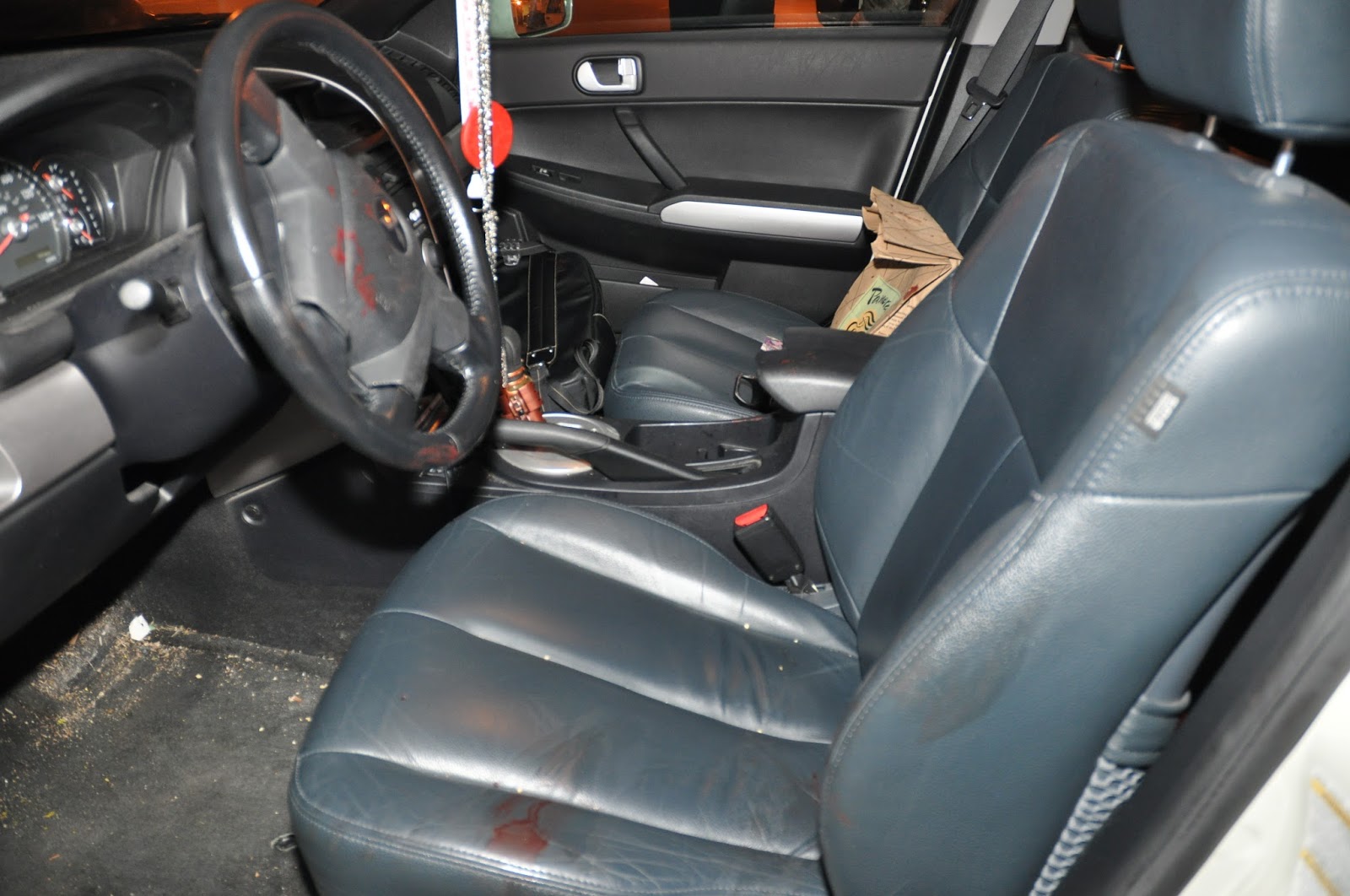
The inside of Angela's car.
That mindset did not protect her from being attacked. It only helped her make the decision to fight once the attack happened.

Even with that fighting mindset she was taken by surprise. Rushing from work to school she was emailing her boyfriend when she walked into the parking garage. She threw her bags in her car and was about to get in herself when she felt something at her neck. Thinking it was a joke she reached up and grabbed at the item and cut her hand on the knife. At that moment she knew it was no joke and immediately began to kick and scream and fight. Her attacker then stabbed her in the abdomen.

Jeff Cooper's color codes of awareness are as follows:
White: Unaware and unprepared.
Yellow: Aware and alert for potential danger.
Orange: Alerted to a specific, potential threat.
Red: Threat identified.
Black or Triggers: A fight is imminent unless circumstances change.

No matter what self defense blog you read or website you go on you will be bombarded with the reminder to live your life in condition yellow. To be alert and aware and to keep your head on a swivel. People are so passionate about condition yellow that I've even seen bracelets marketed to women with beads to remind them to be in condition yellow.

It's said that one can operate in condition yellow as long as he or she is conscious. I believe that to be more of a goal than an actual accomplishment. I don't care how aware you think you are, if you are honest with yourself you will admit that you slip into condition white from time to time. Whether it's an unexpected phone call, trying to remember when your kids next pediatrician appointment is or looking at the legs of the hot chick who just walked by you will occasionally find yourself slipping into condition white. Maybe you've gotten so comfortable in your routine that you live in condition white.

I will not criticize anyone who gets taken by surprise in an attack. Angela shared with me that she was sent a note telling her that if she hadn't been on her phone she probably wouldn't have gotten attacked. First, that couldn't be known. And that kind of blame shifting irritates me to no end. Checking your email does not mean you deserve a knife in your belly. Yes, you should be aware and alert but if you aren't and are caught by surprise that does not make you culpable.

That being said, of course one should try to remain aware or in that condition yellow. Look up and around. Be aware of who is near you and what is going on. And don't be in denial.

Angela had a brief moment of denial that what was happening was real.

A few weeks ago, Greg Ellifritz posted an article by Marc MacYoung titled Best Way to Get Attacked. One of the points was "Don't Deny It's Happening."
Violence is a rarity. Many people can go their entire lives without ever having been involved in a physical fight. ...
People from lifestyles where violence is common immediately recognize when it is happening and react accordingly. All other priorities fall away.
...
Whereas people for whom violence 'doesn't happen' or they haven't been in a physical conflict since they were kids, there is huge denial factor.
She was initially surprised by the attack but she soon recognized it for what it was and then adjusted accordingly. She set her boundaries by determining she was not going to get into a car with him and she acted on the training she had received. She had a mindset to fight. And fight she did.

The Pre-Attack
There are no details of the pre-attack in the article posted. When I spoke to Angela and asked her if she was aware of her attacker before the knife she said that she may or may not have seen him but if she did he did not register as a threat and she doesn't remember alerting to him.

Her first real indication that there was any threat was him putting the knife to her throat.

Because she did not see him we have no knowledge of pre-fight indicators in her case.

We don't know how he approached her or what his demeanor was like. We know that a man with a knife can often cover a quite a bit of space before an average individual with a gun can draw and fire and so we can't get too high and mighty about him being able to close distance and get a knife to her throat. However, we can't help but wonder what went on between her entering that parking garage and a knife being pressed to her throat.

If she had seen him approaching could she have been made aware an attack was imminent through pre-fight indicators? Would he have asked a question? Would her guard have been down because he was dressed nicely and it was the middle of the day? Would she have gotten a gut feeling that something was off? Would she have seen something in his hand? Perhaps his hands would have been hidden? What, if any, pre-fight indicators would he have been displaying?

Of course we can only speculate in this case because we don't know but we can be aware that pre-fight indicators exist and we should be aware of them. We should listen to our gut and watch for hands and weapons and not let our guard down for a nice suit.

Again, this isn't to shift blame onto Angela, but to learn from her experience.

There are not as many resources on pre-fight or pre-attack indicators as you'd think. Because I don't have a lot of experience with pre-fight/attack indicators, I did some searching and this is one article I found: Police One: Pre Attack Indicators: Conscious Recognition of Telegraphed Cues 

I plan to do more research into pre-fight/attack indicators in the future.

The Attack
Angela's attacker put a knife to her throat and said, "We're going for a ride."

The wound to Angela's hand.
Angela made a bold decision. With a knife to her throat she chose to fight. She wasn't some sort of martial arts master. She took a self defense class and she chose to use what she had learned. She set a boundary that she wasn't going to cross and she fought. It was that simple.

It did not, however, mean that she was going to get out unscathed.


I'd like to point out that many people have different opinions on what it means to be victorious or to win in self defense. Some think that you only win if you walk away unscathed with a dead bad guy at your feet. I believe that kind of mindset sets one up for failure--if not personally than legally.

I prefer to follow the examples of Rory Miller who said,
"It is better to avoid than to run; better to run than to de-escalate; better to de-escalate than to fight; better to fight than to die. The very essence of self-defense is a thin list of things that might get you out alive when you are already screwed."
Self defense is a lose/lose situation. Even if you win, you've lost. You have been attacked or victimized in some way. All of your attempts at avoidance, evasion and deescalation have failed. You've already lost your battle to some level and now the goal is to lose less and survive. Maybe you'll lose your wallet, some blood or a little pride. Accept that loss so that you do not get hung up on it.

People who get hung up on that loss die over their car or the twenty dollars in their wallets or their pride over something someone said about their girlfriend or mother. Maybe they die cowering in the back of a van because they were afraid they'd get hurt if they fought and it was better to just "go along" with it than possibly lose a little in a hand-to-hand fight. Yes, there may be a time to feign compliance but those are decisions you have to make in the moment. Don't get hung up on what you might lose lest you lose your life.

And, no, that doesn't mean you should think getting hurt or losing is no big deal. I have often heard people say, "Expect to get cut" (or hurt) in a fight. Yes, have a realistic viewpoint of what a fight for your life might be but don't accept it to the point where you don't work to defend against it or think it no big thing. Acknowledge that it can happen, defend against it as best you can, but don't stop fighting because you weren't able to prevent it.

Angela reached up and grabbed the knife at her throat and immediately cut her thumb. She could have defeated herself and given up at that moment and thought, "I'm cut. It's over. I lost." She didn't. She accepted that she lost a little but was determined to accept that loss in favor of saving her own life.

She fought!

The article says, "she stomped his feet, clawed at his face, bit his hand and jabbed at his crotch, kicking and screaming."

In the end she gained her life and her attacker walked away with the words, "You're lucky you're a fighter!"

What an amazing testament to her, her mindset and her effort! She didn't kill him. She didn't beat him. She did not overpower him and keep him from hurting her. While she inflicted at least some injuries to him there is no indication that they were anything severe or life-threatening. But she kept him from taking her and from killing her. She lost the battle but won the war for her life! That is self defense at its finest!

I asked her if at any time she felt that compliance was the better option. She said no. She told me that despite the injury her actions ultimately led to his capture and conviction and stopped him from attacking anyone else. Yes, she was injured but she stopped him and therefore it was worth it.

The Defensive Weapon
It bears mentioning that Angela had a self defense tool. She had pepper spray. She said that it was in the zipper pouch in her purse and she tried to get to it during the fight.

A self defense tool is only as good as your access to it and its state of readiness. If we know this we don't always practice it. Sometimes we think just having the tool means we will be able to use it in a time of need. We are often unaware that getting to a defensive tool can sometimes be the hardest part of a fight.

I don't care how many times you've practiced grabbing that little canister of spray out of your purse while you are comfortably standing in your living room or how many times you practiced getting that gun out of your bag or racking a round into an empty chamber.

When you're rolling around with a knife buried in your belly the situation changes quite a bit. The ability to use your self defense tool will directly relate to how accessible it is (i.e. on your body in an accessible location) and its state of readiness (loaded and ready to fire). If you cannot, for whatever reason (attire, personal preference, vocation, local legalities) have a weapon accessible and ready than you must accept the fact that you may not be able to use it and must plan accordingly.

I don't know how long she fought to get into her bag for her pepper spray. The fight lasted about three minutes from start to finish. That's a very long time in a fight. At some point it became clear to her that her pepper spray was not a viable option. I'm sure if the situation changed so that she could have used her pepper spray she would have used it.

Many people use the excuse of "well, I carry a gun (knife, pepper spray, taser, etc) everywhere I go" as an excuse as to why they will not take hand-to-hand training or train with other defensive systems. There may very well be a time when that tool is not available.

Angela had some hand-to-hand training. She used what she had and it may have saved her life. If you carry a self defense tool, have it accessible and have it ready to use but also be prepared for the possibility that that tool may not be available, or functioning.

If you choose to carry a defensive tool, get training with it. Run some scenarios with a trainer and a willing partner. Be realistic about its access and state of readiness and have a backup for it it's not available.

The Call
What stirred me to search out more information on Angela's story was the 911 tape. I wanted to hear it.

I found it in a radio interview with Angela and was shocked and enraged at what I heard.

Angela pleads for help and the dispatcher asks her where she is located. Angela tells the dispatcher and the dispatcher says, "I don't know where that is."

At that moment Angela ran. She was already starting to get a little delirious with blood loss but felt she needed to find help and that staying where she was would mean her death.

The toll booth at the bottom of the parking ramp
where Angela collapsed

She was attacked on the fourth level of a parking garage. Throughout the call you can hear Angela running down the ramp and giving the dispatcher her location and pleading for help. The dispatcher keeps saying she doesn't know where that is and doesn't know where to send help. At the end of the call you hear Angela speaking to someone else. She'd reached the bottom of the parking ramp and was speaking to the person in the toll booth. The dispatcher says, "I'm disconnecting now," and disconnects the call.

It was later discovered that a separate 911 call from someone else at the scene was what actually got responders moving. Even so she found out later that the ambulance drove right past her and had to double back. Had she stayed where she was and relied solely on her 911 call she probably would have died.

Be aware that while we have an amazing system of response it is not infallible. In this area the difference between saying 3rd avenue and 3rd street could be the difference between the north side of town and the south. Even if your phone is equipped with GPS the call center you are calling into may not have the capability of accessing that information.

Even if dispatched to the correct location road blocks, construction, street set up and so much more can complicate responders reaching you in a timely fashion.

Take stock of where you are and be prepared to have an address be the first thing you say when connected with 911 operators. At least you got that out there. Whether or not the responders know what to do with that information is entirely on them.

Which brings me to my next point.

The Injury
Angela's 10" deep stab wound and scar
from surgery.
Angela was lucky to survive that attack. Through the course of the fight she was cut in the hand and stabbed in the abdomen. She lost so much blood at the scene that a homicide unit was called to take pictures. She lost half of her blood volume. Most of it pooled in her abdomen due to internal bleeding. It is amazing that she survived.

The attack ended at 4:03 in the afternoon (according to time stamps on surveillance footage). She was rolled into the emergency room at 4:28.

Many people who are interested in self defense do not carry medical supplies. They operate under the assumption that in the unlikely event they will get attacked they will not only survive but if they suffer injuries the injuries will not be sufficient to kill them. Most people who run scenarios through their heads never postulate that they may be injured and if presented with a scenario that begins with an injury they often have no response or admit not having a good option.

A deep abdominal puncture wound like Angela's would be hard to treat outside of the hospital. You can't just put on a tourniquet and wait for paramedics. Applying a dressing on the top of the wound might be sufficient to keep some of the blood inside the body but the internal bleeding would continue. I searched high and low for advice on how to treat such a deep abdominal puncture wound and while one trauma doctor said he would not hesitate to try to pack the wound with something like QuikClot combat gauze, without being able to see the injured blood vessel it would likely not be as effective. Others I talked to reaffirmed his statement.

She needed surgery or she would have died. As it was it is a miracle she survived. But not all wounds are as severe as hers. And even if they are severe, many otherwise fatal wounds can be sufficiently treated outside of the hospital temporarily.

Do you have the skills and supplies to treat such wounds?

If not, why not?

If your interests really are in saving your own life, learn how to save a life. Get medical training and carry the equipment with you. You may not be able to treat everything but what you may be able to treat may save your life or the life of someone you love.

I asked Angela if she was aware of how severe her injury was. She said no. She said she knew she'd been stabbed only because she felt a warm sensation in her abdomen but did not know the extent of the injury and there was no pain. She was able to function and fight even while losing so much blood. While that should encourage us to fight even when injured be aware that the same is true of your attacker.

It's often said that stab wounds don't hurt. They feel like punches and many times people do not know they've been stabbed until they see blood. The pain does not come until later and even with severe injuries the ability to fight is not necessarily hindered. If you use a knife for self defense know how to target areas that will incapacitate not just cause pain or bleed. Get defensive knife training.

Fitness
Yes, fitness.

Take a look around at the fitness levels of people around you. Maybe even take a look in the mirror. We Americans are chronically out of shape and overweight. Middle-age and big-bellied has almost become the cliche image of gun totters. Many even cite the fact that they carry a gun as an excuse as to why they don't get in shape.

Angela fought for roughly three minutes (an eternity in a fight). She was stabbed and while bleeding internally she ran down four flights of a parking garage to help.

Many Americans would not have the physical stamina to make it through half of that.

I didn't have to ask Angela about her fitness level. She brought it up all on her own. She told me she was a runner and took her fitness seriously. She told me that she strongly believes her level of fitness helped her fight, survive and recover from her injury.

Take your fitness seriously. Stop making excuses. If you have a previous injury or ailment, acknowledge it but do what you can to improve the fighting condition of your body. Get out there and strength train, endurance train, it may very well be the difference between life and death.

The Conclusion
Angela's story is an amazing example to those of us in the self defense community. Her strength and determination to fight are inspiring. Take inspiration from her but also learn from her.

Be aware. Be aware of your surroundings and those around you. Be aware of pre-fight indicators.

If you carry a defensive tool train with it. Have it accessible, ready to use and in good working order.

If your defensive tool is not available or not functioning be prepared to fight without it.

Be prepared to give an exact location to responders but don't rely solely on that to save you. Run, move, treat, seek alternative sources of help at the scene.

Have the skills and tools to treat injuries to yourself and others.

Be fit enough to fight. 

Fight!

Fight and survive!

A special thanks to Angela for her willingness to speak with me and share her story and pictures with me. Thank you for the inspiration!

Angela's mission is to inspire women to fight. Check out her Facebook page at Angela's Story: Fight Like a Girl.

Monday, June 17, 2013

When You Hurt Yourself

I stole a second to actually browse the recommended videos YouTube had for me on my page today and was caught by the title of a video called, "I got stabbed:( and some sweet knife porn !!"
I wanted to hear the story of this one so I clicked on the video and started to watch.

If you would like to watch, here it is:


Before I go any further I would like to say that this isn't a blog to bash on this guy. To my knowledge I've never watched one of his videos before nor have I interacted with him. I really don't even know what his channel is about other than knives. So, all that being said, I have absolutely nothing against this guy.


To my knowledge he's neither stupid nor ignorant. He just happens to be someone who posted a video about his experience and I happened to come across it and thought it would make some great talking points. And so here we go..

He starts the video explaining about how he accidentally stabbed himself in the leg.

While working on a Spyderco Cat (with a 2.438 inch blade) he dropped the knife.

Some of you may remember this status update I posted in April:


He had lapse in judgment.

Again, he probably knew better. According to him, he's used to trying to catch screws and tools with his legs so his trained response upon dropping anything in his shop was to close his legs and catch said object in his lap.

What he caught was a 2.438" blade in the thigh. Hilt deep.

He then pulled the knife out, went upstairs, called his father-in-law, went to urgent care, got ten stitches (five internal and five external) and lived to make a video about it.

My first point should be pretty obvious.

1. Don't try to catch knives or guns. Or get in habits that would condition you to do so.

Really and truly! Sometimes those of us who work with guns and knives get a little complacent. We get so used to handling them that we take them for granted. We do silly things with them and while we may not break any specific rules we may think we are above being extra cautious. It can happen to anyone of us and it's a credit to the responsible people in the gun/knife communities that it doesn't happen as often as you'd think.

This individual trained himself over and over and over again to catch falling things with his legs. When he dropped a knife he did what he trained himself to do. I suspect that conditioning will stop after this and he will find a way to capture falling screws and tools without assistance from his thighs.

2. Have some medical knowledge and think before you act. 

I'll admit. The EMT in me was just about having a fit when he said he pulled the knife out and THEN ran upstairs to call his father-in-law and get help. She was screaming, "You NEVER remove a penetrating object!"

But the regular gal in me shrugs and says, "Shut up! You would have done the same thing and you know it!"

The negotiator between the two sides says, "Now girls, stop fighting! We all know that she would have assessed the wound and made an educated decision as to whether it was wise to remove the knife or not."

I don't know how much the author of the video knows about knife wounds, treating them and so on. I don't know what kind of assessment, if any, he gave himself before pulling the knife out. I won't speculate. I only know that my first reaction is to say that pulling out the knife was a dumb thing to do. There's a lot of vital stuff running through the thigh and many times the impaled object acts as a plug to the wound and keeps lots of blood from being lost. That's the textbook EMT talking.

The practical individual in me says that as long as I was able to look at the wound, where it was located and the vitality thereof, a razor-sharp knife in my own thigh would probably be coming out sooner rather than later so that I could get pressure on the wound and not have to worry about accidentally cutting myself further as I tried to move around and get help. Yes, I'd probably get the same speech at the hospital I am giving you now but I know I have at least some knowledge in treating myself.


In an absolutely worst case scenario I could always have grabbed my EDC bag and thrown a tourniquet on myself.


That being said, if this were you, would you have the knowledge and skill to assess your own wound and determine whether or not you would remove the knife yourself and how you might treat it if it didn't stop bleeding?

If you chose to leave the knife in place would you know how to stabilize it? 

Would you know the danger signs of arterial bleeding vs venous? 

Would you know how to treat yourself for potential shock?

What if this had been a firearms accident? Do you know how you would assess yourself for a gunshot wound?

3. Don't underestimate your wound.

I can't say whether or not this individual underestimated his wound or not. I didn't see the wound. But, he called his father-in-law and his father-in-law was who took him to urgent care. He even expressed in the video how this was better than the ER. It very well could have been. However, we have 9-1-1 for a reason. We have ambulances for a reason and we have an ER for a reason. They can be more expensive but don't let saving money be a reason for not calling for more immediate help.

That being said, he's not the first individual who has had an accident like this and not called 9-1-1. My own brother had a firearms accident that was very serious and he drove himself home. Once he got home my father drove him to the hospital. In retrospect, he should have called 9-1-1. Or, at very least, my father should have called 9-1-1 the moment he found out that my brother had accidentally shot himself.

While it did turn out okay in the end, that's a perfect example of someone underestimating the severity of their own wound and not opting for the paramedics with cool drugs in the vehicle that can legally go through stop lights coming to pick you up vs trying to be a man and drive himself. He could have passed out on the road, bled out in the car, all sorts of bad things. There is a time to say, "Hey, I think I need to call 9-1-1."

4. Learn from the experience.

How did you end up hurting yourself? Was it an accident? Was it negligence? Was it someone else's negligence? Was it a bad habit? Was it poor or faulty training? What can you change to make sure something like that never happens again?

Can you learn something else?

The author of this video noted that the entire incident didn't hurt until much later. He said he figured getting stabbed in the leg would hurt like crazy but it didn't at all. We can apply that knowledge to everyone out there who tries to rely on pain compliance for self defense. A lot of times, due to adrenaline and other factors, there may be no pain. Pain compliance is a lousy self defense tool. Can it be used? Absolutely! But it has its time and place and often should be nothing more than a by-product of you doing serious damage to someone.

My brother said getting shot felt like getting stung by a few bees. Like the author of this video he said he didn't really start to hurt until the next morning. And as I remember it he spent several days laying on the floor because it hurt to much for him to even try to get up onto the couch. The day of the incident, however, he was as mobile as though nothing had happened.


It's not impossible that we may have accidents and hurt ourselves. We avoid threats and danger because we don't want to have to use our tools of self defense. But, just in case, we plan for a lot of "what if's." Accidents should be one of them. Plan for them. Avoid them. But plan for them.

Saturday, July 7, 2012

Carry a Gun and a Bandaid

I get more inspiration and help from my Facebook (FB) friends than I do from any other source. They ask questions that not only keep me thinking and learning but also prompt me to explain some of the things I do and talk about.

I recently announced that I have been in school to become an Emergency Medical Technician (EMT). It has been something I have been interested in for a long time for many reasons. I did not go into those reasons until someone on my FB page posted this:

"What is the connection between, EMT, CCW and first aid kits? Really? Enlighten me please."

Carrying a gun and emergency medical training have two really big things in common: They are both centered around the idea of being ready for the worst case scenario and saving lives.

Now some may question how firing upon someone is "centered around saving lives" but the truth of the matter is that many violent criminals do not stop being violent until they are taken down with force. It very well may be that the only way to save your own, a loved one's or even a stranger's life is to use deadly force.

I have often said that one should put at least as much effort into learning how to save a life as they put into learning how to take one.

It's my own personal belief and philosophy and here is why:

1. You're far more likely to die of a medical complication than from a violent attack.
I'm not going to go hunting for statistics here but heart disease is still the #1 killer in America and many accidents such as drowning and falls come before shootings on the CDCs list of causes of death in America. So you got that pea-shooter strapped to your belt everywhere you go, ready to save yourself or your family in the event you get jumped by some criminal. But, at your annual Christmas get-together your father starts complaining of difficulty breathing and chest pain and suddenly slumps to the floor and stops breathing. Or, while on vacation your kid falls into a pool and upon dragging him out you realize he's not breathing. What are you going to do?

You've invested time and money and training in and with your firearm to keep your family safe from the unlikely. Yet many completely ignored preparing for the likely. The fact of the matter is, medical training is going to save more lives than firearms training in the civilian sector. And if your goal is to save lives, it makes sense to get some medical training.

2. If you get into a violent encounter to where your firearm is necessary, your medical skills and equipment could be just as instrumental in saving your life as your firearm.
Let's take any number of mass shootings as an example. You are in class or in the mall and someone starts shooting. Before you can even orient to the situation you are hit. You are able to return fire and stop the threat. But there are ten other wounded individuals around. You have no medical knowledge or training or tools available to stop your own bleeding. Medics are called but it takes fifteen minutes for them to arrive and then they are instructed to wait outside of the scene until it is secured by law enforcement. It's now been twenty minutes before medics are even allowed into the scene and once they get there they still have to triage. Another two minutes are spent triaging and by the time they get to you it has now been twenty-two minutes since you were injured.

What if you couldn't get your bleeding under control in that twenty-two minutes? What do you think your chances are of still being alive once medics got to you? On the other hand, what if you carried a pressure bandage or a tourniquet? What if you knew how to make one with tools on hand? What if your spouse was hit and has a sucking chest wound? Would you know how to treat it to keep him or her alive until medics arrive and can begin treatment?

Sure, your firearm can be instrumental in keeping you from getting wounded multiple times or more severely but sometimes you can't avoid being hurt by violence and having some skills or tools in your back pocket can be just as important as the gun and ammo in your front pocket.
Supplies for about 3 good-sized blow out bags

3. Accidents happen.
Firearms accidents happen. It is true. It is the elephant in the living room that no one likes to talk about. No one likes to admit that sometimes we gun owners make mistakes and we get hurt with our own guns. Worse, sometimes we do something stupid with them that results in injury. You don't have to look far for evidence, either. Just type, "man accidentally shoots himself" into your favorite search engine.

Of course many other accidents happen as well where some basic medical knowledge would come in handy but I'm not going to list all of those and just leave it at being a little gun-centric.

Having the knowledge, skills and tools to treat a gunshot wound when you own a gun is comparable to learning how to change a tire if you drive a car. It doesn't mean it's going to happen. It doesn't mean you want it to happen, but if it does happen you are ready for it.

This doesn't mean that everyone who carries a gun needs to be an EMT, but there are some basic training you can take and tools you can incorporate into your Every Day Carry.

Training:
I am a big believer that everyone should learn CPR, basic wound management and shock treatment. The information available for these skills is not hard to find nor is it expensive or difficult. Many firearms training facilities will have combat medicine classes available. Often times combat medicine is included in some firearms classes. If it hasn't been included in any of your training the list of written resources is vast.

Do a book search for "combat medicine," "tactical medicine," "gunshot wound care," etc and you will be overwhelmed with resources.

Tools:
The term used in the gun community is "blow out bag." It's basically a first aid kit with equipment instrumental in treating more substantial traumas such as gunshot wounds.

There is no exact list of what going in a blow out bag. There are commercial blow out bags you can purchase or you can do what I've done and make your own and it can be as big or small as you want it to be. Furthermore, there are many everyday things you can use in lieu of actual medical supplies if you are caught without a blow out bag and the goodies therein.

There are many conflicting ideas of what makes a good blow out bag so I'll just throw out everything and the kitchen sink and you can decide what you would think would be useful for your own kit/bag. Everything I'm about to show you and talk about I took from my own bag that I carry with me everywhere I go, so it's not impossible to carry all of this stuff.

Nitrile (non-latex) gloves in a plastic bag
Safety:
Gloves! ~ I carry a small sandwich bag filled with two or three pairs of nitrile (non-latex) exam gloves. Granted, if I were treating myself, my husband or my children I would probably not concern myself too much with isolating myself from their body fluids as I know their medical history but if I chose to treat someone else I am not going to take the chance of getting infected with something like Hepatitis or HIV. Besides, that little plastic bag can have a secondary purpose (more on that later).


Medical:
81 mg chewable "baby" aspirin
Aspirin ~ I carry 81 mg chewable "baby" aspirin for two reasons: small aches and pains that do not involve bleeding and possible heart attacks. Because it is chewable it dissolves very quickly and therefore gets into the blood stream and starts working faster. For potential heart attacks, aspirin thins the blood and can keep clots from forming. Chewing 4 "baby" aspirin at the onset of chest pain upon suspecting a possible heart attack can be lifesaving. Always remember to tell responders about anything you took, including aspirin.

Obviously, you would not want to use this for anyone who has an aspirin allergy. Also, because aspirin is a blood thinner you would never want to give it to anyone experiencing blood loss no matter how much pain they are in. Just say "no" to giving aspirin to trauma victims.


Trauma (Mild to Moderate):
Artificial tears/sterile saline ~ One thing I use more often than anything else in my bag is my artificial tears/sterile saline. You can find boxes of individually packaged and wrapped containers or a multi-use bottle. I have the bottle for my house, the individual containers for my bag. Not only can you irrigate your eyes if need be but you can also do light irrigation of wounds and small burns.

Bandaids ~ I am a little bit of a bandaid freak. I carry many different sizes and types. Waterproof, large, small, finger, cartoon, if it's out there, I have it and I probably carry it with me, too. That and a little neosporin and I'm ready for any superficial scrap and mild cut life has to throw as me or my kids or anyone around me.

4x4 surgical sponges
Dressings and Bandages ~ When a bandaid isn't enough to stop bleeding or isn't big enough to cover the entirety of the wound it's time to step it up to dressings, gauze, tape and/or other bandages (Just so we get our terminology straight I'd like to point out that a dressing is what goes over the wound and a bandage is what holds the dressing in place). You can use any size of surgical sponges/gauze pads you want as a dressing and cut them to size but the preferred size seems to be 4x4 surgical sponges. They are big enough to be big but small enough to carry in mass quantities. They can be piled on top of each other, lined up, folded over, wrapped, whatever. You can also keep piling them on top of each other if bleeding doesn't stop.

Thin Cinch pressure bandage
If bleeding doesn't stop it's time to get a little more aggressive and the first step is pressure. Manual pressure is pressure you apply yourself or have someone apply with their hand or you can get or make your own pressure bandage. Any type of wrapping with some stretch to it can make a very decent pressure bandage. Ace bandages and self adhesive bandages commonly used in sports medicine are good options. But if you are pressed for space and time and/or treating yourself with one hand, you might want to go ahead and carry a pressure bandage that is already prefabricated such as an Israeli bandage or Thin Cinch. It has a sterile dressing already attached to some sort of elastic bandage.

Bandages can also be used to stabilize sprains and hold splints or injured joints in place. A good, all-purpose bandage is the triangular bandage. Not only can it be used as a bandage but as a sling and even a tourniquet.

Trauma (Moderate to Severe): 
CAT tourniquet
Tourniquet ~ If bleeding still hasn't stopped in a limb with the application of pressure then it's time to move up to a tourniquet. It is a myth that the application of a tourniquet automatically means the loss of the limb. The truth of the matter is that tourniquets save lives and limbs. The best thing to use as a tourniquet is an actual, no-foolin' tourniquet such as the Combat Action Tourniquet (CAT).

If a commercial tourniquet is not available, however, makeshift tourniquets can easily be fabricated provided you do it correctly. Always use something with a wide surface area such as a belt or a broadly folded cloth. The point is to tighten the tourniquet to the point it cuts off blood supply and applying that much pressure to something thin like a shoelace, wire or zip tie encompassing the limb will end up cutting the flesh and underlying tissue causing more trauma (which is bad).
Compressed, sterile gauze

Sterile Gauze ~ If the wound is on the body vs the limbs a tourniquet will not work. Use sterile gauze to pack wounds and soak up blood. The texture in gauze helps to promote clotting. You can buy it in sterile rolls that are not compressed but they take up more space. Compressed gauze is vacuum sealed and a lot can be found in a very small package. Gauze can also be used as a loose bandage on wounds where you do not want to apply pressure. Head and neck wounds are wounds that you want to wrap just tight enough for the dressing to stay in place. You don't want to put so much pressure on a neck wound that it cuts off blood supply to the brain. In head wounds, if there is bleeding there is a good chance of increased inter-cranial pressure (pressure building inside of the skull). A pressure bandage to the head can keep the blood building up inside the skull or shift bone fragments or fractures that results in putting undue pressure on the brain and causing brain damage. A non-pressure dressing and bandage can protect the wound and help stop the bleeding without increasing the pressure. 

QuikClot Combat Gauze
Antihemorrhagic agents ~ If bleeding on the body is arterial (bright red and spurting) and cannot be controlled with a tourniquet (because it cannot be applied) or dressings and pressure than it may be necessary to use an antihemorrhagic (hemostatic) agent such as QuikClot. There are other types of hemostatic agents out there and their use is controversial. They come in either sponges or gauze that is coated in chemicals that activate coagulation (clotting) and constrict blood vessels. They do a fine job of stopping major bleeding but they can induce allergic reactions in some people and can be difficult to remove when the time comes. They are reserved for moments when death from blood loss is imminent and the risk of allergic reaction or further trauma from the removal are secondary to loss of life. They are expensive and do not last long past their expiration date but are life-savers from massive uncontrollable blood loss.

Occlusive Dressings ~ Occlusive dressings are those that do not allow the passage of air or fluids through the dressing. There are four basic wounds where occlusive dressings are indicated: neck wounds, open chest wounds, an evisceration (a wound wherein the organs of the abdomen spill or are pressed out of the body) and burns.

Petrolatum Gauze
The neck has a lot of important stuff running through it. Large blood vessels that get nicked (the jugular, let's say) can suck in air like a vacuum hose. That air can travel to the heart or lungs and cause death. Yes, you have to stop the bleeding but in a way that air cannot enter the neck. Apply an occlusive dressing--plastic wrap, the baggie for your gloves (there's that secondary purpose), part of your gloves taped down, a pantie liner taped on all sides, anything that does not allow air to enter the wound.

Our lungs are kept inflated by negative pressure and are protected by our ribs. That being said, if a hole is created in the chest wall so that the negative pressure is compromised we may get what is called a pneumothorax (collapsed lung) and/or "sucking chest wound." In order to reestablish that negative pressure a three-sided occlusive dressing needs to be applied. The occlusive dressing keeps air from being sucked into the wound and collapsing the lung and the one way valve allows  the trapped air already built up in the cavity to escape. It will also allow for the escape of blood should it begin building in the area. You can use petrolatum gauze or that baggie for your gloves (baggies make great occlusive dressings). Apply it over the wound and apply tape on three of the four sides. Duct tape is a good tape to use in traumas.

Large occlusive dressing
An evisceration is a pretty nasty thing and not all that uncommon in knife attacks. The knife cuts the skin and the muscle and the guts that were held in by them spill or are pushed out. There are two very important things to remember when dealing with an evisceration: decreasing pressure on the abdomen (so you don't end up losing more guts) and protecting the organs that have spilled out. You protect those organs with an occlusive dressing--preferably a large occlusive dressing. The large pads you can buy for potty training pets work well. They are not sterile but they will keep your insides protected. If you do not have an occlusive dressing any dressing that is large enough will work but the organs that are normally nice and moist might start to get a little dry with the air flow of a non-occlusive dressing. Either way, it's very important to cover them up and keep them protected and provide a new barrier that they cannot escape from now that the skin is no longer doing that job. Never try to put the viscera back in the abdomen. Leave that for the surgeons. If at all possible have the victim lie down on his or her back with the feet flat on the floor and knees up. This will take pressure off of the abdomen and gravity can help keep stuff inside the body where it belongs. Apply the dressing and tape around all four corners too keep air and debris out and moisture and bodily fluids in.

In burns, occlusive dressings help keep the pain down and protect the burn from irritation. Plastic wrap is great for burns but depending on the size and severity whatever you have an hand will have to do.

Improvised tools ~  There are a number of things that can be used in a medical pinch. T-shirts torn into strips make great bandages. Feminine hygiene products such as pads are phenomenal at stopping blood and all of them are occlusive if applied correctly. Tampons can be used for gunshot wounds as they can be inserted into the wound tract or even unfolded and used as a dressing. Definitely throw a few of those into your blow out bag! Diapers are also fantastic improvised dressings. They have a large surface area and they can absorb a lot. They are semi-occlusive as well. Pads and diapers also have saturation points, keep them to show to responders so that they are made aware of how much blood the patient has lost.

Tension Pneumothorax Decompression Needle
Pneumothorax Decompression Needle ~  I'm only putting this in here because I carry one. According to some and depending on state law you need a prescription to even get one. A tension pneumothorax is a condition wherein a lung is compromised and air is now filling the chest cavity but there may or may not be external wound. These injuries are common in blast injuries. The air has nowhere to go as it cannot be exhaled and continues to build in the chest cavity until it puts pressure on the heart and the remaining (and presumably undamaged) lung. If the pressure is not relieved death will soon result. The signs of a tension pneumothorax can be hard to diagnose but major two are pain and difficulty breathing. Loss of lung sounds on the affected side and hyper-percussion are other signs but hard to diagnose without training and a stethoscope. A major but very late sign of a tension pneumothorax is tracheal deviation.

But herein lies the rub: Using a pneumothorax decompression needle is considered a surgical procedure and one can get in trouble for practicing medicine without a license. If things go wrong and you are sued (and even if they go right and you are sued) you will be hung out to dry. You must also know where to insert the needle so as not to puncture a blood vessel and cause more damage and bleeding and turn a pneumothorax into a hemopneumothorax. This needle is a tool I got and was almost afraid to put into my bag. I will do almost anything I can not to use it and will never use it on anyone but myself or an immediate family member.

Now, I'm no doctor. I'm not even an EMT yet (hopefully that will change in two weeks (wish me luck)). All the advise I've just given you on tools and wound management is as a lay person so take it at your own risk and do your own research. But I hope you can see how having a few of these tools and the knowledge and skills to use them could be instrumental in saving a life while waiting for medics to arrive or triage and transport.

Medical training and tools do go hand in hand with carrying and training with a firearm. If you haven't looked into medical training and tools for yourself, what are you waiting for?