Showing posts with label TDI. Show all posts

Monday, October 21, 2013

Appendix-Inside The Waistband Carry: Practical vs Hype

I've been in the firearms community for well over six years. While appendix carry (the practice of carrying a firearm inside the waistband, forward of the hip bones) was around back then I couldn't give you the name of a single person I knew who carried that way. Then, again, perhaps my circle of gun-totting friends was a lot smaller back then.

Today, appendix carry (or AIWB) has risen in popularity and gained quite a foothold with many long-time shooters and trainers. The last two trainings I've attended had several AIWB shooters in them, my husband carries AIWB and several of the well-known instructors I have been following over the years carry AIWB.

AIWB is not a new method of carry by any means. For as long as people have been carrying guns they have been sticking them down the front of their pants. Hand a dummy gun to someone who's never carried a gun before in his or her life, tell them to hide it on their person and a good majority of the time you will see them attempt to AIWB carry it. It's even the preferred method of your average bad guy (sans the holster). It's a very logical place to carry and hide a firearm.

For a long time (and still in certain circles) the AIWB carry method has been demonized as unsafe or as a "gangsta" way to carry. It was purported that those with training and "in the know" carried behind the hip and only those who were careless and didn't mind being viewed as a "bad guy" carried AIWB.

But while the nay-sayers blasted well-meaning carriers with threats of blowing off manhood and bleeding to death from a negligent femoral artery shots, those who are willing to judge the method dispassionately and have confident handling of their firearms are finding it a valid and possibly ideal means of carry.

The benefits of AIWB have been well-established but in case you may have missed them here they are:

- Ease of access
Our arms, though capable of reaching behind our hip, are not naturally inclined to reach there. Our natural work space for our hands and arms is in front of our hip bones. We are strongest and fastest when we work in that area and we can better handle and access items kept in that area.

- Time
Because we are stronger and faster when dealing with things in our arms natural work zone (in front of the hip bones) it stands to reason that we can work things faster in that area as well. The draw (or presentation from the holster) is often faster when we only have to reach down a few inches vs back several inches. Many long-time shooters and competitors have reported faster draw times from appendix vs hip carry. Some have seen no or very little difference in time.

- Concealment
Greg Ellifritz illustrating poor concealment
carrying behind the hip on a bicycle

This seems to depend a lot on body type, gun carried and holster. While some find appendix carry to be far more concealable, others find it less concealable. Some find it more concealable in certain situations like bike riding where behind the hip carry would be far more pronounced. Others find it difficult to conceal double-stack firearms but not single-stack. Sometimes a thick holster can make concealment harder in AIWB vs behind the hip. It cannot be denied, however, that some people have far better success concealing AIWB than other carry methods.

This also applies to concealment of the draw stroke. It's a lot easier to sneak a gun out of the holster in the AIWB position than behind the hip.

- Comfort
Again, this seems to vary widely with body type and the type of gun carried along with holster selection. I've spoken to some that find AIWB to be extremely comfortable and some that find it extremely uncomfortable. One friend of mine finds behind the hip carry to mess with her gait and cause problems in her strong-side leg. She finds AIWB to be far more comfortable and easy on her legs because the weight of the firearm is more centrally located on her body. Some find that the muzzle of their firearm in AIWB will press uncomfortably in certain locations, especially when bending or sitting. For some this depends entirely on the size and length of the gun and holster.

- Ease of retention
Because the area in front of our hips is our natural work zone it is easily accessed by both of our hands. Because of that we can put two hands on a firearm that we are fighting to retain when it is carried in that area. From behind the hip we are limited to the hand closest to that firearm. We also have more strength when our hands are working in that natural work-zone vs stretched behind the hip.

- Ease of presentation
Anyone who has trained hard knows that in a fight for one's life it's very likely you may not be standing straight and in the ideal stance. You may have to draw from seated, from your back on the ground, from your side, etc. And, again, because your arms are working in a natural work zone they can better access an AIWB position than a behind the hip position from certain positions.

My attempt at concealing a double stack HK P2000SK AIWB
I don't like to give opinions about things until I've tried them myself and for a very long time I've been fooling around with AIWB.

I am a very small female and I like larger fighting guns (the Glock 19 being my regular carry gun). That particular combination does not seem to do be very conducive to AIWB. No matter how hard I tried I could not conceal a double-stack firearm AIWB. The thickness of the firearm and the holster would press out the front of my clothing and make me look at least a couple of months pregnant or clearly trying to conceal something large.

I was not willing to go to something so small as a .380 unless it was as a back up gun. My own personal standards are that my primary carry gun will be a 9mm, have a full size grip and good sights. Many of your pocket .380s obviously do not fit those criteria and finding a thin, single stack 9mm meant I had to give up the capacity I've grown to love in my 19.

Because carrying behind my hip had never been a problem for me I never prioritized AIWB carry.

Glock 19, 4 o'clock
S&W Shield, AIWB
at ECQ
But after making a plea on Facebook to try AIWB again, an instructor friend of mine and gunsmith, David Bowie, from Bowie Tactical Concepts and instructor at the Tactical Defense Institute offered to let me borrow his S&W M&P Shield in 9mm and AIWB holster for the duration of the Extreme Close Quarters gunfighting class I took the first week of Oct.

I arrived on the first day and he had the gun and holster waiting for me. My immediate instinct was to put the firearm dead-center on the front of my body, right below my belly button and directly beneath my belt buckle.

After getting the gun and holster on I covered it with my shirt and went to show the instructors, Greg Ellifritz and David Bowie. While I was already seeing a huge improvement in my ability to conceal the single-stack 9mm they helped me adjust it to the right of my belly button and into the natural hollow just inside my strong-side hip bone. I was concerned that the grip would print more in that location but it was not an issue.

I was also immediately impressed with how comfortable it was. The gun was short and small enough not to press on the crease of my thigh when I sat or dig into my ribs when I bent over. Immediately, I ran through some deep squats, bends and twists to check for comfort and found it to be exceptionally comfortable.

I definitely wanted to try this new method of carry throughout the course of the class, however, it was not how I normally carried. It seemed counter-productive to do a whole class with a method of carry and gun I didn't use so I kept my Glock 19 behind my hip where it normally would sit. I decided to run the whole weekend with both guns, splitting each drill and exercise between the two guns and carry methods.

The holster I was using was a modified Comptac 2 o'clock holster that had the sweat shield cut off and a c-clip instead of the loop. It was a decent holster and did well but the c-clip was not as secure as I would have liked due to it being a little big for my belt. The gun tended to tip in throughout the weekend and while it was never a problem I found myself having to readjust after any rigorous activity. I don't think I would have had that problem had my belt and the c-clip been better fitted to one another.

Yes, I looked a little paranoid running both guns all weekend (including spare magazines for each and a TDI knife) but it was a great experience!

Bowie's modified CompTac 2 o'clock
with an M&P
Before class started I took Greg aside and asked him to give me a really quick crash course in drawing and holstering from AIWB so I did it safely as, though I'd tried AIWB before, I'd never actually done live-fire from the position nor had any real-world experience with it.

He reminded me that the most dangerous and important part of safely carrying AIWB was re-holstering (which is true of behind the hip carry as well). Because of where the gun is located, a careless reholster could mean a bullet in the inside thigh with potential of hitting the femoral artery. I also wanted to make sure that I didn't have the tendency to draw the firearm and sweep everyone to my left by pulling the gun in an awkward manner before pointing it straight down range. Greg watched my draw a couple of times, patted me on the back and called it good and we started class.

Getting to work both methods of carry simultaneously allowed me to immediately compare their methods. Interestingly, the hardest part of the weekend was remembering which spare magazine to reach for when I needed to reload with either firearm. There were at least two times I tried inserting a Glock 19 magazine into the the single-stack Shield.

The ECQ class was a great environment wherein to try AIWB for the first time and to compare it to the traditional behind the hip style of carry. In addition to shooting (which can be the least difficult part of using a firearm in self defense) we worked gun retention, drawing and shooting from unusual positions, one-handed operation, contact shooting, fighting to the gun and so much more. There really was no better way to directly compare both methods of carry.

I started immediately liking AIWB carry. It was easier to defend and very comfortable. It was concealable and the draw was quick and easy. I have strong confidence in my gun handling so I did not have a moment of fear or hesitation on either the presentation from or return to the holster.

I did not, however, like my depleted ammo supply. I found it very frustrating to have to reload the Shield so often and at one point, while clearing a jam in the Shield, I discarded a partially full magazine, reached for the spare and realized that had been my spare. I quickly switched to my Glock but felt that rush of heat knowing had that been a real encounter and I was limited to the one, low-capacity gun, I'd be out.

I liked shooting the Shield. It was comfortable and it was accurate and it had already had a trigger job so it was just as good to shoot as my Glock. It's low-profile top did not lend itself to easy one-handed operations like racking the slide but a new pair of rear sights would fix that. My Glock felt more familiar every time it was in my hand solely for the reason it's been my training and carry gun for far more years than the Shield. Even so, I could see myself picking up a Shield in the near future.

When Sunday rolled around and it was time for the force-on-force scenarios with Greg I offhandedly joked that I would continue to carry both guns. At which point Greg said, "Good, twice and many chances to disarm you."

I realized that it might be time to choose a single method of carry. I thought about it hard and, after sizing Ellifritz up a few times, opted for the Shield in the AIWB position.

During the first scenario he didn't attempt to go for my gun. We ended up on the ground with myself on my back underneath of him. I kicked him off of me, draw the Shield from AIWB and simulated shooting him in the chest and head.

I watched the video later and wondered if the Glock carried behind the hip would have been easier or similar in that particular position.

I had good distance. I had pushed him away with my feet. I would have had to have rolled a bit to my side to gain access to my Glock but I don't think it would have been much of a hindrance. I believe I would have been able to get a similar shot off had I been carrying behind the hip vs AIWB.

Below you can watch the first scenario.


In the second scenario we started on the ground with Greg on top of me. The point of this exercise was to illustrate that even if you have a lethal force tool and are completely justified in using lethal force, you may have to fight quite a bit before you can access that tool.

Greg later admitted to cheating. The rules were that he was only supposed to go for your gun if he saw it but he decided to go for my gun anyway. He didn't remember which carry method I chose and was reaching behind my hip. Watching the video later there is at least one moment where he probably would have been able to take my gun if I'd been carrying behind the hip vs AIWB. Carrying AIWB I was able to use his body as a means of retention. When I felt him trying to reach for my gun I would drop my hips below his or lay on top of him, pinning my gun between us so that he couldn't access it. It worked very well and even though I wasn't able to access the gun during the fight, I was able to get to my knife and cut him in the groin and get out of the situation.

I thought long and hard how that scenario would have been different had I been carrying behind the hip. He may have been able to take my Glock away from me easier but I may have been more aware of that and tried harder to keep it away from him instead of finding security in his inaccessibility to my AIWB carried Shield.

Below is the video of the second scenario.


The bottom line is that I felt AIWB would be easier to retain and that is why I chose that method of carry when I ran those scenario vs behind the hip.

If I could conceal my Glock 19 AIWB I would switch methods of carry tomorrow. I have been convinced of the superiority of that method for certain situations, particularly retaining the firearm and I see no benefit of behind the hip carry over AIWB other than possible concealment and comfort issues with less-than-ideal body types. 

For me, my hesitation rests only in the fact that it would require me to downgrade to a lower capacity firearm to successfully conceal AIWB and I am very hesitant to give up my 16 rounds of 9mm in a gun I know I can conceal well behind the hip for 7 or 8 carried AIWB. I have not been able to decide if the benefits of AIWB outweigh the drawbacks of the low capacity.

I find what Todd Green said in this article regarding capacity to be quite accurate regarding my own feelings: 
Bullets are opportunities. They’re options. Having more of them is always better than having less, even if you don’t need them.
I may find myself switching between the modes of carry in the near future as I am saving up for a S&W M&P Shield. And when I get said gun I will be carrying it AIWB. Who knows, maybe I'll carry both. There really is no quicker reload than grabbing a fresh gun!

Thursday, October 10, 2013

The Shot That Breaks The Legal System's Back

When people work self defense scenarios or force-on-force training the question of legalities--always so black and white on paper--present themselves in a hazy variations of muddled gray.

And if you add the stress and excitement of working a scenario you very well find out that a split second of irrational thought could be the difference between justified self defense and aggravated assault, manslaughter or a variation thereof.

Over the weekend I had the opportunity to take a class that's been on my short list for three years: Extreme Close Quarters at the Tactical Defense Institute.

On the second day of the class, attendees are invited to participate in two force-on-force scenarios. You can choose to participate in one, both or neither. The point of the scenarios is to let you work the techniques you've learned over the weekend and to put them into the context of a physical assault.

Something unique about the scenarios is that you are also supposed to think about the legalities of your actions. Class attendees who are watching the scenario act as a pseudo jury and opine as to whether or not they believe your actions were justified as you fought.

The first scenario is a "stand up" scenario which usually begins with some sort of interview process. Deciding when and how and what level of force to use can be much more tricky.

In the second scenario, it is assumed you have been hit and rendered unconscious. You come to with your attacker already on top of you, beating you. It assumes lethal force is already justified. The point of the scenario is to illustrate that even though lethal force is already justified you may have quite a bit of fighting to do before you can get to a lethal force option like a knife or a gun.

I was the first student in this scenario. I laid down on the mat and the lead instructor, Greg Ellifritz, got on top of me in the mount and said, "Go!" while wrapping his hands around my neck.

I worked the ground fighting techniques we'd learned over the weekend and in Krav and while he was trying hard to get my gun off of me I was able to adequately defend it. However, towards the end of the scenario I was feeling as though I was running out of time. He grabbed my left hand and pulled me across him so that he had access to my waistband. I felt him grab at my magazine carrier/knife sheath. I heard something hit the floor, looked and saw he had successfully taken away my spare magazine.

I realized that, given enough time, he'd get my gun or knife and making space for me to get to my gun without having better control of him would mean he might be able to take it away from me.

I needed to make a move, now!

I dropped my hips below his to take away his reach and with my right arm pressed under his chin, trying to choke him with my forearm I drew my knife and buried it into the inside crease of his right leg and groin. I twisted it a couple of times simulating a deep wound and when I felt his legs loosen from around me I darted back and away.

While falling back from him I drew my gun, aimed in on his head and started pressing the trigger.

He was sitting up by now and staring at me.

I was surging with adrenaline and still had my knife in my off-hand. I wasn't even thinking about legalities. I was only thinking how scared I was at how close he came to getting my knife and how lucky I was that I got it first.

I can't tell you what stayed my hand but I didn't shoot. I screamed at him to stay back and the scenario was over.

I holstered my gun and deescalated. I didn't think about the scenario again until I watched it later on video my husband had recorded.

Between the time I cut him and my gun aimed at him is about 3 to 5 seconds. In that time I'm pushing myself away from him, making my way to my feet and drawing my gun. I've also put about 10 feet between us.

In that time a lot changed. I'd already used lethal force against him and with the type of cut I made it would be very likely that he would be bleeding to death. However, the dynamics of the scenario had changed.

If you are a student of self defense it's important to become familiar with the principles of AOJP in order to use lethal force.

A = Your attacker has to have the Ability to cause death or great bodily harm.
O = Your attacker has to have the Opportunity to cause death or great bodily harm.
J = You have to believe your life or limb is in Jeopardy.
P = There has to be no other reasonable option for you to remove yourself from that scenario or defend yourself. This is known as Preclusion.

In that scenario the AOJP was satisfied enough for me to be entirely justified in using lethal force as a means of self defense initially.

My attacker had the ability. He was a healthy, large, fully-functioning man.

He had the opportunity. He was sitting on top of me.

I was certainly in jeopardy. I was beneath him with his hands around my throat.

There was no preclusion. I had no other reasonable options. Despite how I tried I was not able to get away from him until I cut him in the groin.

There was also some disparity of force and position going on. Lethal force was justified.

And in 3 seconds the scenario changed drastically.

My attacker may still have had the ability to cause me death or great bodily harm (at least until he passed out from blood loss) but he no longer had the opportunity. Depending on how badly I cut him he may not have been able to use his leg to come after me. While I certainly could have felt like my life was still in jeopardy I now had reasonable options of escape. I didn't need to shoot him. I could leave.

I wasn't thinking about those things at the time. At the time I was feeling a mixture of fear and relief and I was putting pressure on a trigger beneath the barrel of a gun pointed directly at his head.

The threat was over and had I put another pound of pressure on said trigger I would have been stepping beyond the boundaries of self defense. The AOJP would no longer be satisfied.

If it had been real would I have been charged given the nature of the scenario? I don't know.

Would I have been convicted? Again, given the nature of the scenario, I don't know.

But the fact of the matter is, those 3 seconds and the smallest press of my trigger finger could have landed me in a serious mess of legal trouble I couldn't begin to comprehend (much less afford) if the scenario had been real.

There will be some that will argue that I would still have been justified in taking the shot. There will be some that will argue that I would not have been. I anticipate getting private messages from now until kingdom come with differing opinions. And it will all go to illustrate one thing: that that shot would not have been clear-cut self defense.

And therein lies the importance of thinking about these scenarios and attending force-on-force and the kind of training we worked over the weekend. Until you are there and experiencing the adrenaline and wondering what you are supposed to do and afraid and, yes, a bit panicked, you have no idea how well you will judge the scenario, when to use lethal force and when it may no longer be justified.

These classes not only help you learn about techniques of self defense but set you up to better judge situations. You learn how you can work them and when they may be over while also preparing you to continue to fight if need be or search for more threats. They construct patterns of behavior that are within legal boundaries (or at least they should!) and help you identify lethal force moments.


They also help you identify when you have fought yourself to a position of no longer needing that force.

If you haven't taken a class like that yet, I recommend you go out there and find one!

And if you want to watch the scenario for yourself here is the video. Watch between the :44 and :58 second marks. 


Saturday, April 13, 2013

A Funny Thing Happened At Partner Tactics

In May of 2012, my husband and I loaded up our gear and took the longish journey down to the Tactical Defense Institute (TDI) in West Union, OH. We'd taken the trip a few times before for Handguns 1-3 and for Defensive Knife but this was the first time we were going to do some training for the collective us. We'd wanted to take a partner's tactics class for years and we were finally doing it.

TDI's Partner Tactics class is hailed as one of the funnest classes to take. I can't speak for everyone but it was a lot of fun, very relaxing, enjoyable weather and some great company. We got to see old friends and meet new ones or meet old friends' better halves. While the class is designed for any kind of partner dynamic, be it military, police or otherwise, the majority of the students were husband and wife duos which made the class a sort-of pseudo marital retreat. Many couples had been to the class several times, making a sort of romantic holiday of it.

The three day course consists of partner movement drills while also communicating with him or her both verbally and non-verbally. Something a lot harder to do in practice than in theory. We learned partner room clearing, up and down stairs, around corners, through hallways, etc. We learned escaping vehicles, cover, concealment, group settings, partner rescue, leap-frogging and all sorts of other great tools for partners who need to work together with guns.

Attending the class for a second time was an older couple we will call Bill and Jane. Bill was in his late seventies and Jane in her late sixties. She was about as hyper as I am and three times as talkative. No matter where she went she left a sea of smiles behind her because of her propensity to suddenly jump off a flight of stairs or say something completely off the wall but hilarious. At the same time she was deathly serious about everything making it that much more entertaining and endearing.

They were dressed far more for comfort than for any semblance of style. They both wore large frame glasses and she wore a blurred patch over one eye to help her with eye-dominance issues. Their hat wear looked as though it may have come from an advertisement for an African Safari and they both wore tan shooting vests with more pockets than military utilities. But not to be threatened with appearing average, she would don a different colorful scarf or otherwise bright and colorful oddity to remind the world she was still very much young at heart.

While doing stair-clearing drills with unloaded firearms she had us all cracking up with her "PEW! PEW!" sound effects. While doing the walk through of the shoot houses, you could find her skulking around corners, crawling around obstacles and using her finger as a pistol while things were being explained.

Her husband was a quite a bit more serious and took her shenanigans in stride. Always by her side he rarely opened his mouth unless they were on the firing line and needed to communicate as that fighting team. At which point, he communicated ceaselessly...

"Firing! Changing! Moving! What's the condition of your gun?! Check your world!"

The couple had their own lingo they had brought with them to the class ("green" meaning the individual had a loaded and functioning firearm in the fight, "red" meaning the firearm was not functional and needed his or her partner to cover) and it worked well for them. They were both so serious about everything and seemingly completely unaware of the joy they spread to the rest of the group.

On the second day we all went up to the upper range to practice shooting our way out of vehicles and then using partner tactics to get to safety.

The scenario starts with the partnered pair sitting in an old, beat up van, seat belted and doors locked. On the command of "fire" or "gun" the pair was to engage a number of targets on both sides of the van (and hidden around other cars), egress from the vehicle and move to safety.

Everyone had their turn and next up was Bill and Jane.

Jane got in the driver's side and Bill got in the passenger's side. They strapped themselves in, shut the doors and waited. The instructor yelled, "GUN!!!" and it was on.

Except nothing happened.

We were all sitting a few yards to the rear of the van, waiting for gunfire, the doors on the van to bust open, anything!

Nothing. The van didn't move. The doors didn't open. There seemed to be absolutely nothing going on. The instructor, who had moved to the rear of the van to stay out of the way, peeked around the corner with the same look of confusion as the rest of us. He took a step forward, presumably to see what the hold up was and the driver's side door flew open.

Jane rang out a long, blood-curdling war cry, "DIE!!!!!!!"

And all hell broke loose. Gunfire broke out from each side of the van as Bill and Jane fired and everyone else broke down laughing.

They moved down the sides of the van screaming at each other ("MOVING TO THE REAR!") and their targets.

When they finally made it to the back we were nearly in tears from laughing so hard.

Jane got in what was fast becoming her classic squat. Legs wide spread, squatting down until her butt nearly touched the ground, arms stretching her gun out in front of her leaning from side to side like some skinny, oddly dressed creature out of a Lord of the Rings movie with a gun. She was screaming, "GREEN!"

Bill, standing more erect, was comical only in the absence of his wife's erratic, bouncy and sometimes sporadic movement answered with, "GREEN! Are you alright?"

"I'M ALRIGHT! GREEN!" she answered.

"CHECK YOUR WORLD!"

"CHECKING MY WORLD! CLEAR ON THE RIGHT!" Her body bounced right to left like some strange ape while he stood over her merely looking side to side.

"CLEAR ON THE LEFT! TAC RELOAD! RED"

Jane, "GREEN!"

But no matter what, we could not get over the hilarity that was this sixty-some-year-old woman, dressed in a safari hat, colored scarf and tactical vest, throwing open the car door and screaming, "DIE!" at the top of her lungs.

Even though I wouldn't be laughing if I had to face the both of them in a gun battle. They were an effective pair!

Friday, July 6, 2012

TDI Defensive Knife Class Review

This review is from TDI's Defensive Knife Class held on December 4-5, 2010


I have wanted to take a knife class for years. Just like I wanted to get quality gun training when I chose to start carrying a firearm for self-defense, it was a natural progression of my training to want quality knife training when I chose to carry a knife.
   
Through a series of force-on-force (FOF) scenarios and some research and careful thought I had chosen the Tactical Defense Institute (TDI) Law Enforcement knife made by Ka-Bar as the edged companion to my firearm for every-day carry. When I brought it home and showed my husband my newest acquisition he informed me that TDI was actually a training facility in Ohio that did defensive knife classes. I immediately became interested. After all, it made sense to take a class from the people who designed the knife I chose to carry.
   
It took another two plus years before I would be in a position, financially and logistically, to take a knife class and after hearing many wonderful things about TDI I finally signed up for their two day Defensive Knife class that took place on December fourth and fifth of this year.
   
The confirmation email I received said to bring any and all knives I wanted to train with but that if I had no knife it was not an issue as TDI would have several knives available for trial and plenty of trainers to work with. Even though I didn’t need to take my TDI trainer I stuck it, my Cold Steel Ti-Lite and my Ka-Bar TDI Law Enforcement knife in my suitcase and drove to southern Ohio for my class.
   
A look at the TDI website gives you a run down of the facility with multiple ranges, classrooms, force-on-force houses and everything else a defensive student could ask for.
   
In anticipation of getting lost (as I usually do) I left my hotel an hour and a half early to make what was reported to me to be only a half-hour long trip. The directions were not hard to follow and even though I arrived to class an hour early there was already instructors there with heaters cranked setting out equipment for the class.
   
The classroom was clean and neat with comfortable chairs, clean tables, a small kitchenette, two bathrooms, a case to display TDI products for sale, a large television and (blessedly) two heaters to combat the Ohio cold that had swept in for the weekend.
   
They weren’t kidding when they said they had plenty of knives and trainers. The table at the front of the class was covered with trainer knives and live knives that could be borrowed by students.
   
As the rest of the students arrived we mingled and got to know each other and it wasn’t a surprised to find that I would be the only woman in the class. I was delighted to find out that John Benner, the designer of the TDI knife, would be an assistant instructor for the class as I was eager to meet him after our wonderful chat on the phone when I had called to sign up for the class. When our head instructor, Greg Ellifritz, arrived with plenty of time to spare we all settled in, some finished paying for their class and it was time to start.
   
There was a ratio of three instructors for twelve students (I believe), which made for a very safe environment. With any kind of class featuring weapons safety is a main concern and when you have twelve people with knives working them and trying things they’ve never tried before it’s nice to know there’s more than one set of eyes making sure everyone is being responsible and safe. Two instructors walked around the perimeter of the class checking for safety and giving tips when needed as Greg taught. Even when we sparred or did our force-on-force there was someone there to check our pockets and waistbands to ensure we didn’t forget to remove any live weapons (which I had forgotten to do after lunch on the second day and the instructor caught it (thank goodness)). That, along with the continued safety reminders, made me feel very comfortable that no one was going to end up with a knife buried in their belly or their fingers chopped off.
I think the worst wound of the weekend was a student who cut the top of his finger on the hilt of his training knife during the final force-on-force exercise. A quick rinse and a bandaid and all was well again.
   
Before I went I really wondered what was going to be taught in this class. After all, how much instruction does it take to figure out how to use a knife? All of us have been using knives to cut our food since we were small children and most can figure out which side to point toward the enemy. I didn’t doubt there was going to be fighting techniques taught that I didn’t know but the rest was a complete and eager mystery. I was not disappointed.
   
Right away, on day one, we opened with a brief introduction of the class and instructors and dove right in to the types of knives available for self-defense and how to choose the right knife for you. There was even a short lecture on how to ensure the locking mechanism on folders would stay secure so as not to collapse on your figures mid-fight. Greg had a bag of knives he brought with him that were passed around for all to see what was available and how it worked.
   
John talked about the TDI knife and how and why it was designed and it was great to hear it from the designers own mouth. I also learned that my other favorite little knife, the TDI Last Ditch Knife (LDK), was designed by the instructor, Greg Ellifritz. Right about then I was feeling really glad I chose this class.
   
Then we all moved to the training area and went right into learning different opening methods for folders. We talked about the different grips available for knives and the stance to go along with fighting with a knife. We practiced deploying our knives from various positions such as kneeling, on our backs, sides and what not. Then we had to “earn” our lunch.
   
Greg wanted to prove that deploying a knife while exhausted was different than from standing and rested so he had us all get down and do twenty pushups and from the top of the pushup position we were to deploy a knife. When we thought we were done he had us do twenty more and try again. It was then we were beginning to see a number of fumbled and failed openings.
   
After lunch we talked about the rules for close quarter drawing of weapons in general which was either creating distance in order to draw or gaining control of the attacker long enough to draw so that your defensive tool of choice could not be taken from you or the draw interfered with. We did a number of exercises to create either distance or control through sparring with partners.
   
We learned a twelve-step slash and stab drill and practiced that extensively. We did live deploying and cutting drills to demonstrate the difference in speed between fixed blades and folders. We worked with our knives in our off hands and did the knife equivalent of the Tueller drill by having to draw our knives and deploy them against an advancing attacker. We talked about anatomy and targeting areas on the body that would either cause enough physical damage to end a conflict or cause rapid blood loss which meant that, naturally, we would have to practice them on our sparring partners. Then we talked about wound enhancement by maximizing trauma with the knife. We also talked about the legalities of using a knife for self-defense.
   
After working knife defense against common grabs and attacks we were given a demonstration on just how quickly one can be rendered unconscious from a choke hold by a volunteer being choked out (a sobering exercise to be sure).
   
It was a long first day but very educational and hands on.
   
Day two started with knife care and sharpening. We were fortunate enough to have a custom knife maker in our class who gave his professional opinion on knife sharpening techniques and products. It wasn’t long before we were back out on the training floor learning drills for an unarmed person defending against a knife attack and fighting a knife attack with a knife and some more techniques to thwart off multiple attackers.


Just before lunch we went outside where they had hung up a deer carcass and we all took our turn slashing, stabbing, hacking, coring and cutting this poor deer carcass until it looked like something out of a bad horror movie. I was amazed to personally feel how easy it was to stab right through ribs as I felt them crunch and crack under the force of a TDI wielded by my little hand.


On the other side of the deer we dressed it in clothes and got to try for ourselves how clothing can change the results of slashes and cuts. We even got to try stabbing with other tools like tactical pens and one student went to town with a tactical flashlight that buried itself into the neck of the deer making a very wicked little wound.


While we ate lunch we watched a video on how easily skin cuts and the demonstration of cutting a pig carcass dressed in various clothes (wonderful meal-time entertainment!).
   
After lunch we pulled out the mats and did fighting from the ground when an attacker already has you on the ground and mounted you. We talked about secretly getting your knife out and then it was time for the force-on-force.
   
Greg got dressed up in a training suit and laid down the rules. He would attack us in any way he saw fit and the fight would not be over until he felt he was dealt a fight-stopping blow or until we fought our way to the other side of the classroom (through him, of course). Those of us not fighting would play “jury” and decide whether or not the actions of the person fighting were justifiable. This I found to be most unique and interesting as each person fighting was forced to think more about their actions in regards to the law and how they would defend them.
   
When it was my turn I was very nervous (what 100 lbs woman going up against a 220-plus lbs instructor wouldn’t be?) but I didn’t back down. He confronted me and attacked. I fought open hand until I had the chance to draw my knife. A good cut to his inner leg and I escaped to “safety.”
   
It was a relief to hear my classmates say I was entirely justified in my actions.


Greg Ellifritz and John Benner were both excellent instructors that I would be happy to work with again and again. Greg, a police instructor with thousands of hours of training in everything from knives, firearms, hand-to-hand combat and even field medicine, was knowledgeable and confident in his teaching without being cocky or overly opinionated. He was humble enough to give credit where credit was due and not pushy with his techniques. He had a likeable sense of humor but didn’t let us get too far off topic before he reeled us in again. He promised he would never try to take away anything that someone had adopted to work for them and he was true to his word even praising those who had adapted different ways to accomplish a goal. We all teased him that at times he got a manically gleeful smile while sparring that indicated he had far too much fun with his job.
   
As a woman it’s sometimes intimidating to go to a male-dominated class as sexism can be very alive and well but I felt very respected, not feared or undermined. Greg and John both listened and responded to me as an equal student to my male counterparts. While some of the other students were gentler in their sparring with me Greg gave me the training I was seeking by apply a more forceful approach that I would have to repel. John was not far off giving tips and helping to drive home certain points. I was greatly impressed with their professionalism, knowledge, clarity, organization and teaching ability.
   
I learned more than I could have previously imagined and in the best way possible—by doing the work instead of just listening to a lecture or watching a video. Aside from the techniques of slashes and stabs some of the most important lessons I took away from the class have been the cardinal rules for drawing a weapon (distance or control), the speed of drawing and readiness of the fixed-blade vs the folder and how even the simplest of clothing items can frustrate the outcome of a slash but have little effect on the outcome of a stab. I was not the only one ditching my folder knife in favor of a fixed blade and many people purchased the TDI Law Enforcement knife before the end of the first day to replace their primary carry knife. Knife placement was always driven home as often you cannot draw your knife with your dominant hand and keeping your knife in a location where both hands have access to it is very important.
   
I like to vary my training by spreading it out amongst different trainers and schools but I am fairly certain I will be going back to TDI for another class or two or ten. I would recommend to others that they do the same.

Wednesday, June 27, 2012

TDI Last Ditch Knife (LDK)

Many moons ago, while working at a gun store where I could get 15% off of merchandise I decided it was a good time to buy a fixed-blade knife. I bought the Ka-Bar TDI Law Enforcement Knife and--just because I thought it was pretty cool, cheap and available--I also bought the Ka-Bar TDI Last Ditch Knife (LDK).

I wore it as a neck knife most of the time though I've seen it hailed as kind of an all-purpose SHTF knife: neck knife, boot knife, pocket knife, emergency scalpel, deep concealment knife, anti-terrorism, nuclear disarmament... okay, so maybe I got a little carried away although it does seem the possibilities for this little knife are endless.

Later, when I found out that TDI was actually a training facility that did knife training I decided to take my Law Enforcement knife (for clarification, I have not, nor have I ever been a member of law enforcement. It's just the name of the knife) on a pilgrimage to the place of its conceptual birth and get some good defensive knife training. There, I met the lead defensive knife instructor, Greg Ellifritz. Sometime on the first day of the class another student and I were discussing knives and I off-handedly said, "Oh, just put an LDK in your boot."

Ellifitz said, "I like your choice in knives."

I said, "Thank you."

He said, "You know I designed that knife, didn't you?"

"No!" I replied.

And thus began the discussion about the LDK.

Because I've been privileged enough to keep in contact with Ellifitz (a third-world traveling hobbyist, police training, I'll-beat-you-to-death-with-a-toothpick badass) since that knife class in 2010 I was able to ask him to share his thoughts on the LDK.

He wrote the following:
"I designed it primarily as a knife that could easily be missed on a cursory search if one was taken hostage. I had been traveling through South America a lot and was worried about kidnapping attempts. There just weren't any really good knives on the market that could be easily hidden.

 My initial thought was that I wanted something no larger than a credit card, so that I could carry it in a wallet if I wanted to. If I did that, it had to be exceptionally thin as well.

I wanted a blade design that would do a lot of damage for its small size. That's why I designed it with the straight edge and very sharp pint. It isn't designed as a general purpose cutting tool. It's designed to cut flesh like a bigger knife.

After I designed the knife, I wanted a sheath that could be hidden anywhere. I put multiple holes in it so that it can be laced in a boot or safety-pinned almost anywhere. I currently carry mine safety pinned inside and below the rear waistband of my pants when I travel in third world countries. That way I can cut myself free if my hands are tied or taped behind my back.

The hole in the handle is not designed for a finger. many people try to grip it by curling a finger through the hole. It doesn't work that well. I put the hole in the handle to save weight and provide an extra means to draw it. If the sheath is flat against a hard surface (like laced in a boot), it is difficult to get a full hand grip on the handle to draw. The hole allows you to catch a single finger inside to pull it from the sheath if you can't get a better grip.

That's about it. I sent in the design in 2006 and it went into production in 2007. It has been consistently in Ka-Bar's top 3 sellers since then. Right now they are selling about 1500 a month and demand has steadily increased over the years."

There's not a whole lot that I can add to that fine summery except to say that the LDK is still one of my favorite little knives. It has been a pretty constant companion for about four years. No matter what I did or didn't have I could almost always find a way to keep and carry the LDK.

It is wickedly sharp and pointy. And if you need a fine, sharp point to wield in tight places, this is the knife you are looking for. Something else I learned in the knife class was that the wharncliffe style blade (a blade that is flat on its sharp side), though a bit weak in the tip department because of the supper sharp point, is a nasty flesh cutter. It will give you a little deeper/longer cut for your effort because the cutting surface stays in contact with flesh longer and for its full length. Something you really want when your cutting surface is only 4cm long. The curved hilt allows you to really bury the thing in your hand and get a pretty good grip on it despite it being so small. Of course, I am a very small individual and people with larger hands have complained it is too small and they feel like they cannot get a grip on it but the design gives you the best it can afford so that you don't loose what makes it ultra light and concealable.

Though its intended purpose was not as a utility knife it has seen some light utility work from me. It has spent many nights hung from my bedpost, an immediate tool if needed. And it does excel at flesh cutting... just ask all of the hang-nails I have cut off over the years. I've given it as a gift and gone swimming with it. There is a security in knowing that it is always there and so easy to carry no matter what the occasion or the attire. I've pinned it into pockets, purses and my bra. And I've also used it to escape from restraints (I was practicing escaping after being zip-tied to one of our kitchen chairs... a couple of times). It also works wonders on tape.

And it certainly does excel as a tool of escape. It's small size does allow for easy maneuverability with your hands restrained (either in front of you, behind your back or individually). The only concern is cutting yourself but if you were actively trying to escape from hostile restraints a few nicks and cuts would probably be the least of your worries (although people with larger hands and poor dexterity might need to worry about dropping it and might want to practice). I know it sounds a bit "out-there" to be talking about how good a knife is at helping you escape restraints but, hey, it's why the knife was designed! What's even better is that if someone decides to check up on the prisoner/hostage/restraint-escaping-practicing-wife the knife can very easily be palmed or hidden between your fingers and, whella!--Knife? What knife?--It's advisable to keep your escape as clandestine as possible.

The TDI LDK laced in my size-4 boot
Just this week I decided it was time to actually try the LDK out as a boot knife.

Search though I may I could find almost no one who talked about actually putting the LDK in his or her boot (but, then again, my husband is constantly reminding me that my google-fu is not very strong).

While switching the laces of my boots from cloth to paracord I laced my LDK into the top of my left boot and there it has stayed. Because I'm not trying to actively hide it from cursory body-sweeping, dirty South American cops with itchy trigger fingers and shallow pockets, I did not bury it as deeply into my boot as I could have. As you can see by the photo the hilt protrudes above the top of my boot. But lacing it further down would and could it much better if that was the goal. A quick pat down would leave a searcher feeling nothing but laces, as he would expect.

For my purposes, squatting down in a confined space where getting into deep pockets might be a bit trying, I can slip the LDK out of my boot and cut what needs cutting.

Because this one now resides in my boot, I've talked about getting another in case I do want to pin it into my bra or pocket again and don't want to unlace my boots. And when you can find it on amazon.com for about $15, why not, right?

Google image
(My apologies for the theft)
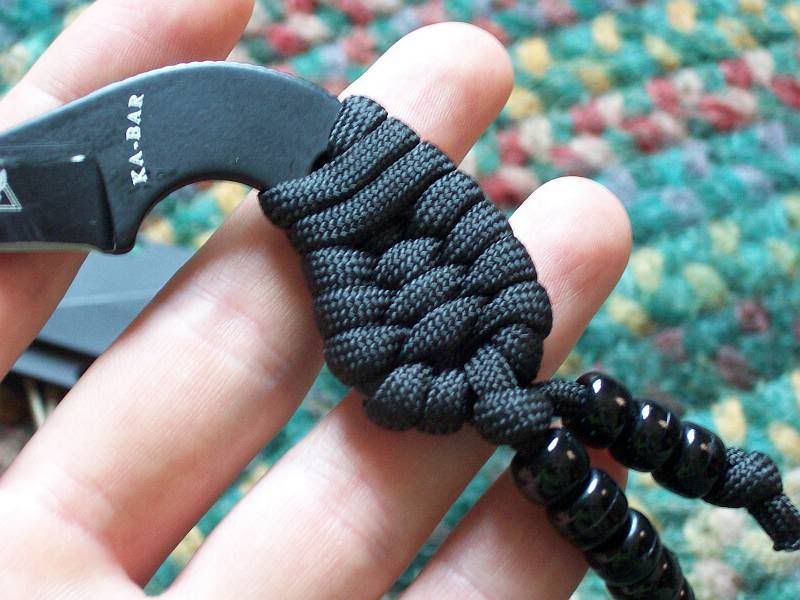
I've seen people put paracord around the hilt to give it a little more to hold on to and it's certainly an option if you aren't looking for deep concealment in a narrow or uncomfortable place--like the back of your shorts, for instance. It also might help those with large hands and less dexterity. And if you want to deep conceal it again, just take the cord off.

The sheath is very basic plastic that has continued to be tight for me despite lots of taking the knife in and out (and even putting it back in backwards a few times). I believe it comes with a stretch of paracord (you'll have to forgive my not remembering. I bought the thing four years ago). If in use as a neck knife, however, I use a bead chain (as shown above) for the slimmer profile and comfort.

A great little knife for a great little price. I can definitely see myself getting another. You should, too. If you want to.