Showing posts with label knives. Show all posts

Monday, August 5, 2013

Fight Like A Girl And Other Lessons From A Stabbing

Angela Champagne-From
A few weeks ago I saw this story on my Facebook feed. A woman, Angela Champagne-From, was assaulted in a Minneapolis parking garage. A man put a knife to her neck and told her to get in a car with him. She had no way of knowing he was a serial sexual predator. She chose to fight him. She used techniques she learned in a self defense class to defend herself and got stabbed in the process. Her attacker was later caught and she has since made it her mission to encourage more women to fight back.

The story is an amazing one and I encourage you to read it. But the lessons are so vast I couldn't help but reiterate them in this blog post. I was so inspired to learn all I could from her story I sought out further information and news reports that led me to her contact information. Angela agreed to talk to me and I had an hour and a half long phone conversation regarding the incident, her mindset, self defense and the like. She is an amazing woman and I hope one day to shake her hand and tell her in person how much I admire her spirit.

I am, in no way, condemning any of Angela's actions. She knows this and I want you to know it, too. She did what she could and she survived. She also uses her experience to empower others. She is a strong woman! But that doesn't mean we can't learn more from her experience to help prepare ourselves.

As I read her story and spoke with her the lessons kept rearing their heads and I found myself grouping them into categories. Though the incident itself was fluid it was not hard at all to breakdown into what could be considered the categories of any self defense situation.

The Mindset
Mindset is a huge bite to chew in a short blog post. A fighting mindset encompasses a variety of things including the awareness that bad things happen and can happen to you, the seeking of defensive training, the willingness to use that training in the time of need against your fellow man and the fortitude to continue training, preparing even through the lull of everyday life and variations therein.

When it comes to self defense most people fall into one of a few categories:
Unaware and unprepared.
Aware and unprepared.
Aware and marginally prepared.
Aware and prepared.

The problem with being aware and marginally prepared is that a lot of people don't know how much they don't know. They will take a self defense class, carry a defensive tool and believe themselves prepared. While they are better prepared than someone who has neither of those things there may be things lacking from their training. Most people will never need the defensive training they take and many are okay with that. Taking additional training becomes a balance between risk, reward, finances and time. But in the time of need the training they are lacking can become evident.

When I spoke to Angela on the phone I asked her about the details of the self defense class she took and why she took it. She kind of laughed. It was a high school class that spanned over the course of a semester and she thought it would be an easy A. She didn't take any further self defense classes after high school but was aware that bad things happened. It wasn't something she worried about but she knew it could happen.

That self defense class, though taken casually, had a huge impact on Angela's mindset. She said had she been attacked as a teen she wasn't sure she would have the fortitude to fight back but after graduating from high school (and subsequently that self defense class) she developed stronger boundaries and was more sure of herself. She had more confidence and more will to stand up for herself.
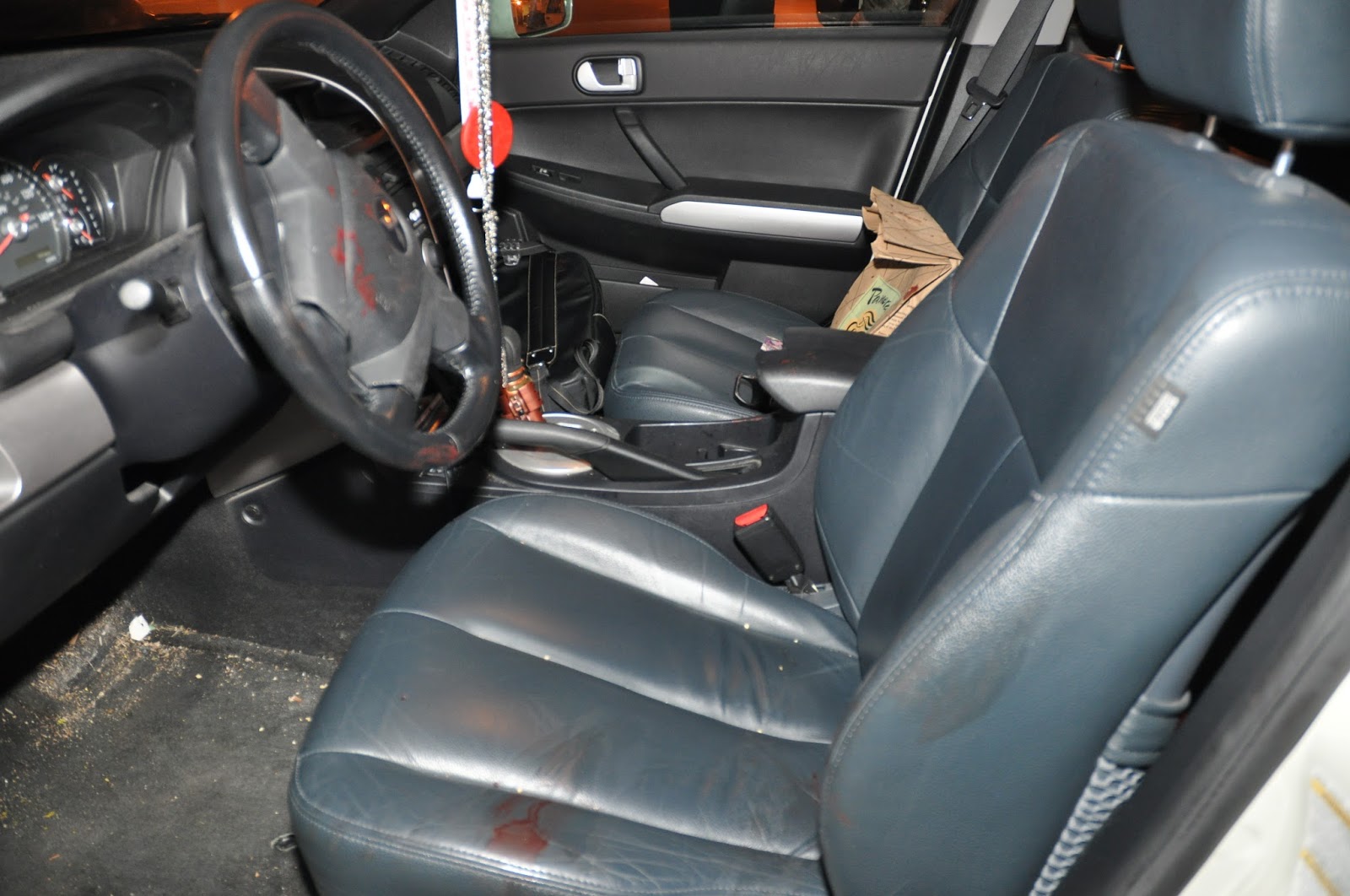
The inside of Angela's car.
That mindset did not protect her from being attacked. It only helped her make the decision to fight once the attack happened.

Even with that fighting mindset she was taken by surprise. Rushing from work to school she was emailing her boyfriend when she walked into the parking garage. She threw her bags in her car and was about to get in herself when she felt something at her neck. Thinking it was a joke she reached up and grabbed at the item and cut her hand on the knife. At that moment she knew it was no joke and immediately began to kick and scream and fight. Her attacker then stabbed her in the abdomen.

Jeff Cooper's color codes of awareness are as follows:
White: Unaware and unprepared.
Yellow: Aware and alert for potential danger.
Orange: Alerted to a specific, potential threat.
Red: Threat identified.
Black or Triggers: A fight is imminent unless circumstances change.

No matter what self defense blog you read or website you go on you will be bombarded with the reminder to live your life in condition yellow. To be alert and aware and to keep your head on a swivel. People are so passionate about condition yellow that I've even seen bracelets marketed to women with beads to remind them to be in condition yellow.

It's said that one can operate in condition yellow as long as he or she is conscious. I believe that to be more of a goal than an actual accomplishment. I don't care how aware you think you are, if you are honest with yourself you will admit that you slip into condition white from time to time. Whether it's an unexpected phone call, trying to remember when your kids next pediatrician appointment is or looking at the legs of the hot chick who just walked by you will occasionally find yourself slipping into condition white. Maybe you've gotten so comfortable in your routine that you live in condition white.

I will not criticize anyone who gets taken by surprise in an attack. Angela shared with me that she was sent a note telling her that if she hadn't been on her phone she probably wouldn't have gotten attacked. First, that couldn't be known. And that kind of blame shifting irritates me to no end. Checking your email does not mean you deserve a knife in your belly. Yes, you should be aware and alert but if you aren't and are caught by surprise that does not make you culpable.

That being said, of course one should try to remain aware or in that condition yellow. Look up and around. Be aware of who is near you and what is going on. And don't be in denial.

Angela had a brief moment of denial that what was happening was real.

A few weeks ago, Greg Ellifritz posted an article by Marc MacYoung titled Best Way to Get Attacked. One of the points was "Don't Deny It's Happening."
Violence is a rarity. Many people can go their entire lives without ever having been involved in a physical fight. ...
People from lifestyles where violence is common immediately recognize when it is happening and react accordingly. All other priorities fall away.
...
Whereas people for whom violence 'doesn't happen' or they haven't been in a physical conflict since they were kids, there is huge denial factor.
She was initially surprised by the attack but she soon recognized it for what it was and then adjusted accordingly. She set her boundaries by determining she was not going to get into a car with him and she acted on the training she had received. She had a mindset to fight. And fight she did.

The Pre-Attack
There are no details of the pre-attack in the article posted. When I spoke to Angela and asked her if she was aware of her attacker before the knife she said that she may or may not have seen him but if she did he did not register as a threat and she doesn't remember alerting to him.

Her first real indication that there was any threat was him putting the knife to her throat.

Because she did not see him we have no knowledge of pre-fight indicators in her case.

We don't know how he approached her or what his demeanor was like. We know that a man with a knife can often cover a quite a bit of space before an average individual with a gun can draw and fire and so we can't get too high and mighty about him being able to close distance and get a knife to her throat. However, we can't help but wonder what went on between her entering that parking garage and a knife being pressed to her throat.

If she had seen him approaching could she have been made aware an attack was imminent through pre-fight indicators? Would he have asked a question? Would her guard have been down because he was dressed nicely and it was the middle of the day? Would she have gotten a gut feeling that something was off? Would she have seen something in his hand? Perhaps his hands would have been hidden? What, if any, pre-fight indicators would he have been displaying?

Of course we can only speculate in this case because we don't know but we can be aware that pre-fight indicators exist and we should be aware of them. We should listen to our gut and watch for hands and weapons and not let our guard down for a nice suit.

Again, this isn't to shift blame onto Angela, but to learn from her experience.

There are not as many resources on pre-fight or pre-attack indicators as you'd think. Because I don't have a lot of experience with pre-fight/attack indicators, I did some searching and this is one article I found: Police One: Pre Attack Indicators: Conscious Recognition of Telegraphed Cues 

I plan to do more research into pre-fight/attack indicators in the future.

The Attack
Angela's attacker put a knife to her throat and said, "We're going for a ride."

The wound to Angela's hand.
Angela made a bold decision. With a knife to her throat she chose to fight. She wasn't some sort of martial arts master. She took a self defense class and she chose to use what she had learned. She set a boundary that she wasn't going to cross and she fought. It was that simple.

It did not, however, mean that she was going to get out unscathed.


I'd like to point out that many people have different opinions on what it means to be victorious or to win in self defense. Some think that you only win if you walk away unscathed with a dead bad guy at your feet. I believe that kind of mindset sets one up for failure--if not personally than legally.

I prefer to follow the examples of Rory Miller who said,
"It is better to avoid than to run; better to run than to de-escalate; better to de-escalate than to fight; better to fight than to die. The very essence of self-defense is a thin list of things that might get you out alive when you are already screwed."
Self defense is a lose/lose situation. Even if you win, you've lost. You have been attacked or victimized in some way. All of your attempts at avoidance, evasion and deescalation have failed. You've already lost your battle to some level and now the goal is to lose less and survive. Maybe you'll lose your wallet, some blood or a little pride. Accept that loss so that you do not get hung up on it.

People who get hung up on that loss die over their car or the twenty dollars in their wallets or their pride over something someone said about their girlfriend or mother. Maybe they die cowering in the back of a van because they were afraid they'd get hurt if they fought and it was better to just "go along" with it than possibly lose a little in a hand-to-hand fight. Yes, there may be a time to feign compliance but those are decisions you have to make in the moment. Don't get hung up on what you might lose lest you lose your life.

And, no, that doesn't mean you should think getting hurt or losing is no big deal. I have often heard people say, "Expect to get cut" (or hurt) in a fight. Yes, have a realistic viewpoint of what a fight for your life might be but don't accept it to the point where you don't work to defend against it or think it no big thing. Acknowledge that it can happen, defend against it as best you can, but don't stop fighting because you weren't able to prevent it.

Angela reached up and grabbed the knife at her throat and immediately cut her thumb. She could have defeated herself and given up at that moment and thought, "I'm cut. It's over. I lost." She didn't. She accepted that she lost a little but was determined to accept that loss in favor of saving her own life.

She fought!

The article says, "she stomped his feet, clawed at his face, bit his hand and jabbed at his crotch, kicking and screaming."

In the end she gained her life and her attacker walked away with the words, "You're lucky you're a fighter!"

What an amazing testament to her, her mindset and her effort! She didn't kill him. She didn't beat him. She did not overpower him and keep him from hurting her. While she inflicted at least some injuries to him there is no indication that they were anything severe or life-threatening. But she kept him from taking her and from killing her. She lost the battle but won the war for her life! That is self defense at its finest!

I asked her if at any time she felt that compliance was the better option. She said no. She told me that despite the injury her actions ultimately led to his capture and conviction and stopped him from attacking anyone else. Yes, she was injured but she stopped him and therefore it was worth it.

The Defensive Weapon
It bears mentioning that Angela had a self defense tool. She had pepper spray. She said that it was in the zipper pouch in her purse and she tried to get to it during the fight.

A self defense tool is only as good as your access to it and its state of readiness. If we know this we don't always practice it. Sometimes we think just having the tool means we will be able to use it in a time of need. We are often unaware that getting to a defensive tool can sometimes be the hardest part of a fight.

I don't care how many times you've practiced grabbing that little canister of spray out of your purse while you are comfortably standing in your living room or how many times you practiced getting that gun out of your bag or racking a round into an empty chamber.

When you're rolling around with a knife buried in your belly the situation changes quite a bit. The ability to use your self defense tool will directly relate to how accessible it is (i.e. on your body in an accessible location) and its state of readiness (loaded and ready to fire). If you cannot, for whatever reason (attire, personal preference, vocation, local legalities) have a weapon accessible and ready than you must accept the fact that you may not be able to use it and must plan accordingly.

I don't know how long she fought to get into her bag for her pepper spray. The fight lasted about three minutes from start to finish. That's a very long time in a fight. At some point it became clear to her that her pepper spray was not a viable option. I'm sure if the situation changed so that she could have used her pepper spray she would have used it.

Many people use the excuse of "well, I carry a gun (knife, pepper spray, taser, etc) everywhere I go" as an excuse as to why they will not take hand-to-hand training or train with other defensive systems. There may very well be a time when that tool is not available.

Angela had some hand-to-hand training. She used what she had and it may have saved her life. If you carry a self defense tool, have it accessible and have it ready to use but also be prepared for the possibility that that tool may not be available, or functioning.

If you choose to carry a defensive tool, get training with it. Run some scenarios with a trainer and a willing partner. Be realistic about its access and state of readiness and have a backup for it it's not available.

The Call
What stirred me to search out more information on Angela's story was the 911 tape. I wanted to hear it.

I found it in a radio interview with Angela and was shocked and enraged at what I heard.

Angela pleads for help and the dispatcher asks her where she is located. Angela tells the dispatcher and the dispatcher says, "I don't know where that is."

At that moment Angela ran. She was already starting to get a little delirious with blood loss but felt she needed to find help and that staying where she was would mean her death.

The toll booth at the bottom of the parking ramp
where Angela collapsed

She was attacked on the fourth level of a parking garage. Throughout the call you can hear Angela running down the ramp and giving the dispatcher her location and pleading for help. The dispatcher keeps saying she doesn't know where that is and doesn't know where to send help. At the end of the call you hear Angela speaking to someone else. She'd reached the bottom of the parking ramp and was speaking to the person in the toll booth. The dispatcher says, "I'm disconnecting now," and disconnects the call.

It was later discovered that a separate 911 call from someone else at the scene was what actually got responders moving. Even so she found out later that the ambulance drove right past her and had to double back. Had she stayed where she was and relied solely on her 911 call she probably would have died.

Be aware that while we have an amazing system of response it is not infallible. In this area the difference between saying 3rd avenue and 3rd street could be the difference between the north side of town and the south. Even if your phone is equipped with GPS the call center you are calling into may not have the capability of accessing that information.

Even if dispatched to the correct location road blocks, construction, street set up and so much more can complicate responders reaching you in a timely fashion.

Take stock of where you are and be prepared to have an address be the first thing you say when connected with 911 operators. At least you got that out there. Whether or not the responders know what to do with that information is entirely on them.

Which brings me to my next point.

The Injury
Angela's 10" deep stab wound and scar
from surgery.
Angela was lucky to survive that attack. Through the course of the fight she was cut in the hand and stabbed in the abdomen. She lost so much blood at the scene that a homicide unit was called to take pictures. She lost half of her blood volume. Most of it pooled in her abdomen due to internal bleeding. It is amazing that she survived.

The attack ended at 4:03 in the afternoon (according to time stamps on surveillance footage). She was rolled into the emergency room at 4:28.

Many people who are interested in self defense do not carry medical supplies. They operate under the assumption that in the unlikely event they will get attacked they will not only survive but if they suffer injuries the injuries will not be sufficient to kill them. Most people who run scenarios through their heads never postulate that they may be injured and if presented with a scenario that begins with an injury they often have no response or admit not having a good option.

A deep abdominal puncture wound like Angela's would be hard to treat outside of the hospital. You can't just put on a tourniquet and wait for paramedics. Applying a dressing on the top of the wound might be sufficient to keep some of the blood inside the body but the internal bleeding would continue. I searched high and low for advice on how to treat such a deep abdominal puncture wound and while one trauma doctor said he would not hesitate to try to pack the wound with something like QuikClot combat gauze, without being able to see the injured blood vessel it would likely not be as effective. Others I talked to reaffirmed his statement.

She needed surgery or she would have died. As it was it is a miracle she survived. But not all wounds are as severe as hers. And even if they are severe, many otherwise fatal wounds can be sufficiently treated outside of the hospital temporarily.

Do you have the skills and supplies to treat such wounds?

If not, why not?

If your interests really are in saving your own life, learn how to save a life. Get medical training and carry the equipment with you. You may not be able to treat everything but what you may be able to treat may save your life or the life of someone you love.

I asked Angela if she was aware of how severe her injury was. She said no. She said she knew she'd been stabbed only because she felt a warm sensation in her abdomen but did not know the extent of the injury and there was no pain. She was able to function and fight even while losing so much blood. While that should encourage us to fight even when injured be aware that the same is true of your attacker.

It's often said that stab wounds don't hurt. They feel like punches and many times people do not know they've been stabbed until they see blood. The pain does not come until later and even with severe injuries the ability to fight is not necessarily hindered. If you use a knife for self defense know how to target areas that will incapacitate not just cause pain or bleed. Get defensive knife training.

Fitness
Yes, fitness.

Take a look around at the fitness levels of people around you. Maybe even take a look in the mirror. We Americans are chronically out of shape and overweight. Middle-age and big-bellied has almost become the cliche image of gun totters. Many even cite the fact that they carry a gun as an excuse as to why they don't get in shape.

Angela fought for roughly three minutes (an eternity in a fight). She was stabbed and while bleeding internally she ran down four flights of a parking garage to help.

Many Americans would not have the physical stamina to make it through half of that.

I didn't have to ask Angela about her fitness level. She brought it up all on her own. She told me she was a runner and took her fitness seriously. She told me that she strongly believes her level of fitness helped her fight, survive and recover from her injury.

Take your fitness seriously. Stop making excuses. If you have a previous injury or ailment, acknowledge it but do what you can to improve the fighting condition of your body. Get out there and strength train, endurance train, it may very well be the difference between life and death.

The Conclusion
Angela's story is an amazing example to those of us in the self defense community. Her strength and determination to fight are inspiring. Take inspiration from her but also learn from her.

Be aware. Be aware of your surroundings and those around you. Be aware of pre-fight indicators.

If you carry a defensive tool train with it. Have it accessible, ready to use and in good working order.

If your defensive tool is not available or not functioning be prepared to fight without it.

Be prepared to give an exact location to responders but don't rely solely on that to save you. Run, move, treat, seek alternative sources of help at the scene.

Have the skills and tools to treat injuries to yourself and others.

Be fit enough to fight. 

Fight!

Fight and survive!

A special thanks to Angela for her willingness to speak with me and share her story and pictures with me. Thank you for the inspiration!

Angela's mission is to inspire women to fight. Check out her Facebook page at Angela's Story: Fight Like a Girl.

Friday, July 6, 2012

TDI Defensive Knife Class Review

This review is from TDI's Defensive Knife Class held on December 4-5, 2010


I have wanted to take a knife class for years. Just like I wanted to get quality gun training when I chose to start carrying a firearm for self-defense, it was a natural progression of my training to want quality knife training when I chose to carry a knife.
   
Through a series of force-on-force (FOF) scenarios and some research and careful thought I had chosen the Tactical Defense Institute (TDI) Law Enforcement knife made by Ka-Bar as the edged companion to my firearm for every-day carry. When I brought it home and showed my husband my newest acquisition he informed me that TDI was actually a training facility in Ohio that did defensive knife classes. I immediately became interested. After all, it made sense to take a class from the people who designed the knife I chose to carry.
   
It took another two plus years before I would be in a position, financially and logistically, to take a knife class and after hearing many wonderful things about TDI I finally signed up for their two day Defensive Knife class that took place on December fourth and fifth of this year.
   
The confirmation email I received said to bring any and all knives I wanted to train with but that if I had no knife it was not an issue as TDI would have several knives available for trial and plenty of trainers to work with. Even though I didn’t need to take my TDI trainer I stuck it, my Cold Steel Ti-Lite and my Ka-Bar TDI Law Enforcement knife in my suitcase and drove to southern Ohio for my class.
   
A look at the TDI website gives you a run down of the facility with multiple ranges, classrooms, force-on-force houses and everything else a defensive student could ask for.
   
In anticipation of getting lost (as I usually do) I left my hotel an hour and a half early to make what was reported to me to be only a half-hour long trip. The directions were not hard to follow and even though I arrived to class an hour early there was already instructors there with heaters cranked setting out equipment for the class.
   
The classroom was clean and neat with comfortable chairs, clean tables, a small kitchenette, two bathrooms, a case to display TDI products for sale, a large television and (blessedly) two heaters to combat the Ohio cold that had swept in for the weekend.
   
They weren’t kidding when they said they had plenty of knives and trainers. The table at the front of the class was covered with trainer knives and live knives that could be borrowed by students.
   
As the rest of the students arrived we mingled and got to know each other and it wasn’t a surprised to find that I would be the only woman in the class. I was delighted to find out that John Benner, the designer of the TDI knife, would be an assistant instructor for the class as I was eager to meet him after our wonderful chat on the phone when I had called to sign up for the class. When our head instructor, Greg Ellifritz, arrived with plenty of time to spare we all settled in, some finished paying for their class and it was time to start.
   
There was a ratio of three instructors for twelve students (I believe), which made for a very safe environment. With any kind of class featuring weapons safety is a main concern and when you have twelve people with knives working them and trying things they’ve never tried before it’s nice to know there’s more than one set of eyes making sure everyone is being responsible and safe. Two instructors walked around the perimeter of the class checking for safety and giving tips when needed as Greg taught. Even when we sparred or did our force-on-force there was someone there to check our pockets and waistbands to ensure we didn’t forget to remove any live weapons (which I had forgotten to do after lunch on the second day and the instructor caught it (thank goodness)). That, along with the continued safety reminders, made me feel very comfortable that no one was going to end up with a knife buried in their belly or their fingers chopped off.
I think the worst wound of the weekend was a student who cut the top of his finger on the hilt of his training knife during the final force-on-force exercise. A quick rinse and a bandaid and all was well again.
   
Before I went I really wondered what was going to be taught in this class. After all, how much instruction does it take to figure out how to use a knife? All of us have been using knives to cut our food since we were small children and most can figure out which side to point toward the enemy. I didn’t doubt there was going to be fighting techniques taught that I didn’t know but the rest was a complete and eager mystery. I was not disappointed.
   
Right away, on day one, we opened with a brief introduction of the class and instructors and dove right in to the types of knives available for self-defense and how to choose the right knife for you. There was even a short lecture on how to ensure the locking mechanism on folders would stay secure so as not to collapse on your figures mid-fight. Greg had a bag of knives he brought with him that were passed around for all to see what was available and how it worked.
   
John talked about the TDI knife and how and why it was designed and it was great to hear it from the designers own mouth. I also learned that my other favorite little knife, the TDI Last Ditch Knife (LDK), was designed by the instructor, Greg Ellifritz. Right about then I was feeling really glad I chose this class.
   
Then we all moved to the training area and went right into learning different opening methods for folders. We talked about the different grips available for knives and the stance to go along with fighting with a knife. We practiced deploying our knives from various positions such as kneeling, on our backs, sides and what not. Then we had to “earn” our lunch.
   
Greg wanted to prove that deploying a knife while exhausted was different than from standing and rested so he had us all get down and do twenty pushups and from the top of the pushup position we were to deploy a knife. When we thought we were done he had us do twenty more and try again. It was then we were beginning to see a number of fumbled and failed openings.
   
After lunch we talked about the rules for close quarter drawing of weapons in general which was either creating distance in order to draw or gaining control of the attacker long enough to draw so that your defensive tool of choice could not be taken from you or the draw interfered with. We did a number of exercises to create either distance or control through sparring with partners.
   
We learned a twelve-step slash and stab drill and practiced that extensively. We did live deploying and cutting drills to demonstrate the difference in speed between fixed blades and folders. We worked with our knives in our off hands and did the knife equivalent of the Tueller drill by having to draw our knives and deploy them against an advancing attacker. We talked about anatomy and targeting areas on the body that would either cause enough physical damage to end a conflict or cause rapid blood loss which meant that, naturally, we would have to practice them on our sparring partners. Then we talked about wound enhancement by maximizing trauma with the knife. We also talked about the legalities of using a knife for self-defense.
   
After working knife defense against common grabs and attacks we were given a demonstration on just how quickly one can be rendered unconscious from a choke hold by a volunteer being choked out (a sobering exercise to be sure).
   
It was a long first day but very educational and hands on.
   
Day two started with knife care and sharpening. We were fortunate enough to have a custom knife maker in our class who gave his professional opinion on knife sharpening techniques and products. It wasn’t long before we were back out on the training floor learning drills for an unarmed person defending against a knife attack and fighting a knife attack with a knife and some more techniques to thwart off multiple attackers.


Just before lunch we went outside where they had hung up a deer carcass and we all took our turn slashing, stabbing, hacking, coring and cutting this poor deer carcass until it looked like something out of a bad horror movie. I was amazed to personally feel how easy it was to stab right through ribs as I felt them crunch and crack under the force of a TDI wielded by my little hand.


On the other side of the deer we dressed it in clothes and got to try for ourselves how clothing can change the results of slashes and cuts. We even got to try stabbing with other tools like tactical pens and one student went to town with a tactical flashlight that buried itself into the neck of the deer making a very wicked little wound.


While we ate lunch we watched a video on how easily skin cuts and the demonstration of cutting a pig carcass dressed in various clothes (wonderful meal-time entertainment!).
   
After lunch we pulled out the mats and did fighting from the ground when an attacker already has you on the ground and mounted you. We talked about secretly getting your knife out and then it was time for the force-on-force.
   
Greg got dressed up in a training suit and laid down the rules. He would attack us in any way he saw fit and the fight would not be over until he felt he was dealt a fight-stopping blow or until we fought our way to the other side of the classroom (through him, of course). Those of us not fighting would play “jury” and decide whether or not the actions of the person fighting were justifiable. This I found to be most unique and interesting as each person fighting was forced to think more about their actions in regards to the law and how they would defend them.
   
When it was my turn I was very nervous (what 100 lbs woman going up against a 220-plus lbs instructor wouldn’t be?) but I didn’t back down. He confronted me and attacked. I fought open hand until I had the chance to draw my knife. A good cut to his inner leg and I escaped to “safety.”
   
It was a relief to hear my classmates say I was entirely justified in my actions.


Greg Ellifritz and John Benner were both excellent instructors that I would be happy to work with again and again. Greg, a police instructor with thousands of hours of training in everything from knives, firearms, hand-to-hand combat and even field medicine, was knowledgeable and confident in his teaching without being cocky or overly opinionated. He was humble enough to give credit where credit was due and not pushy with his techniques. He had a likeable sense of humor but didn’t let us get too far off topic before he reeled us in again. He promised he would never try to take away anything that someone had adopted to work for them and he was true to his word even praising those who had adapted different ways to accomplish a goal. We all teased him that at times he got a manically gleeful smile while sparring that indicated he had far too much fun with his job.
   
As a woman it’s sometimes intimidating to go to a male-dominated class as sexism can be very alive and well but I felt very respected, not feared or undermined. Greg and John both listened and responded to me as an equal student to my male counterparts. While some of the other students were gentler in their sparring with me Greg gave me the training I was seeking by apply a more forceful approach that I would have to repel. John was not far off giving tips and helping to drive home certain points. I was greatly impressed with their professionalism, knowledge, clarity, organization and teaching ability.
   
I learned more than I could have previously imagined and in the best way possible—by doing the work instead of just listening to a lecture or watching a video. Aside from the techniques of slashes and stabs some of the most important lessons I took away from the class have been the cardinal rules for drawing a weapon (distance or control), the speed of drawing and readiness of the fixed-blade vs the folder and how even the simplest of clothing items can frustrate the outcome of a slash but have little effect on the outcome of a stab. I was not the only one ditching my folder knife in favor of a fixed blade and many people purchased the TDI Law Enforcement knife before the end of the first day to replace their primary carry knife. Knife placement was always driven home as often you cannot draw your knife with your dominant hand and keeping your knife in a location where both hands have access to it is very important.
   
I like to vary my training by spreading it out amongst different trainers and schools but I am fairly certain I will be going back to TDI for another class or two or ten. I would recommend to others that they do the same.

Wednesday, June 27, 2012

TDI Last Ditch Knife (LDK)

Many moons ago, while working at a gun store where I could get 15% off of merchandise I decided it was a good time to buy a fixed-blade knife. I bought the Ka-Bar TDI Law Enforcement Knife and--just because I thought it was pretty cool, cheap and available--I also bought the Ka-Bar TDI Last Ditch Knife (LDK).

I wore it as a neck knife most of the time though I've seen it hailed as kind of an all-purpose SHTF knife: neck knife, boot knife, pocket knife, emergency scalpel, deep concealment knife, anti-terrorism, nuclear disarmament... okay, so maybe I got a little carried away although it does seem the possibilities for this little knife are endless.

Later, when I found out that TDI was actually a training facility that did knife training I decided to take my Law Enforcement knife (for clarification, I have not, nor have I ever been a member of law enforcement. It's just the name of the knife) on a pilgrimage to the place of its conceptual birth and get some good defensive knife training. There, I met the lead defensive knife instructor, Greg Ellifritz. Sometime on the first day of the class another student and I were discussing knives and I off-handedly said, "Oh, just put an LDK in your boot."

Ellifitz said, "I like your choice in knives."

I said, "Thank you."

He said, "You know I designed that knife, didn't you?"

"No!" I replied.

And thus began the discussion about the LDK.

Because I've been privileged enough to keep in contact with Ellifitz (a third-world traveling hobbyist, police training, I'll-beat-you-to-death-with-a-toothpick badass) since that knife class in 2010 I was able to ask him to share his thoughts on the LDK.

He wrote the following:
"I designed it primarily as a knife that could easily be missed on a cursory search if one was taken hostage. I had been traveling through South America a lot and was worried about kidnapping attempts. There just weren't any really good knives on the market that could be easily hidden.

 My initial thought was that I wanted something no larger than a credit card, so that I could carry it in a wallet if I wanted to. If I did that, it had to be exceptionally thin as well.

I wanted a blade design that would do a lot of damage for its small size. That's why I designed it with the straight edge and very sharp pint. It isn't designed as a general purpose cutting tool. It's designed to cut flesh like a bigger knife.

After I designed the knife, I wanted a sheath that could be hidden anywhere. I put multiple holes in it so that it can be laced in a boot or safety-pinned almost anywhere. I currently carry mine safety pinned inside and below the rear waistband of my pants when I travel in third world countries. That way I can cut myself free if my hands are tied or taped behind my back.

The hole in the handle is not designed for a finger. many people try to grip it by curling a finger through the hole. It doesn't work that well. I put the hole in the handle to save weight and provide an extra means to draw it. If the sheath is flat against a hard surface (like laced in a boot), it is difficult to get a full hand grip on the handle to draw. The hole allows you to catch a single finger inside to pull it from the sheath if you can't get a better grip.

That's about it. I sent in the design in 2006 and it went into production in 2007. It has been consistently in Ka-Bar's top 3 sellers since then. Right now they are selling about 1500 a month and demand has steadily increased over the years."

There's not a whole lot that I can add to that fine summery except to say that the LDK is still one of my favorite little knives. It has been a pretty constant companion for about four years. No matter what I did or didn't have I could almost always find a way to keep and carry the LDK.

It is wickedly sharp and pointy. And if you need a fine, sharp point to wield in tight places, this is the knife you are looking for. Something else I learned in the knife class was that the wharncliffe style blade (a blade that is flat on its sharp side), though a bit weak in the tip department because of the supper sharp point, is a nasty flesh cutter. It will give you a little deeper/longer cut for your effort because the cutting surface stays in contact with flesh longer and for its full length. Something you really want when your cutting surface is only 4cm long. The curved hilt allows you to really bury the thing in your hand and get a pretty good grip on it despite it being so small. Of course, I am a very small individual and people with larger hands have complained it is too small and they feel like they cannot get a grip on it but the design gives you the best it can afford so that you don't loose what makes it ultra light and concealable.

Though its intended purpose was not as a utility knife it has seen some light utility work from me. It has spent many nights hung from my bedpost, an immediate tool if needed. And it does excel at flesh cutting... just ask all of the hang-nails I have cut off over the years. I've given it as a gift and gone swimming with it. There is a security in knowing that it is always there and so easy to carry no matter what the occasion or the attire. I've pinned it into pockets, purses and my bra. And I've also used it to escape from restraints (I was practicing escaping after being zip-tied to one of our kitchen chairs... a couple of times). It also works wonders on tape.

And it certainly does excel as a tool of escape. It's small size does allow for easy maneuverability with your hands restrained (either in front of you, behind your back or individually). The only concern is cutting yourself but if you were actively trying to escape from hostile restraints a few nicks and cuts would probably be the least of your worries (although people with larger hands and poor dexterity might need to worry about dropping it and might want to practice). I know it sounds a bit "out-there" to be talking about how good a knife is at helping you escape restraints but, hey, it's why the knife was designed! What's even better is that if someone decides to check up on the prisoner/hostage/restraint-escaping-practicing-wife the knife can very easily be palmed or hidden between your fingers and, whella!--Knife? What knife?--It's advisable to keep your escape as clandestine as possible.

The TDI LDK laced in my size-4 boot
Just this week I decided it was time to actually try the LDK out as a boot knife.

Search though I may I could find almost no one who talked about actually putting the LDK in his or her boot (but, then again, my husband is constantly reminding me that my google-fu is not very strong).

While switching the laces of my boots from cloth to paracord I laced my LDK into the top of my left boot and there it has stayed. Because I'm not trying to actively hide it from cursory body-sweeping, dirty South American cops with itchy trigger fingers and shallow pockets, I did not bury it as deeply into my boot as I could have. As you can see by the photo the hilt protrudes above the top of my boot. But lacing it further down would and could it much better if that was the goal. A quick pat down would leave a searcher feeling nothing but laces, as he would expect.

For my purposes, squatting down in a confined space where getting into deep pockets might be a bit trying, I can slip the LDK out of my boot and cut what needs cutting.

Because this one now resides in my boot, I've talked about getting another in case I do want to pin it into my bra or pocket again and don't want to unlace my boots. And when you can find it on amazon.com for about $15, why not, right?

Google image
(My apologies for the theft)
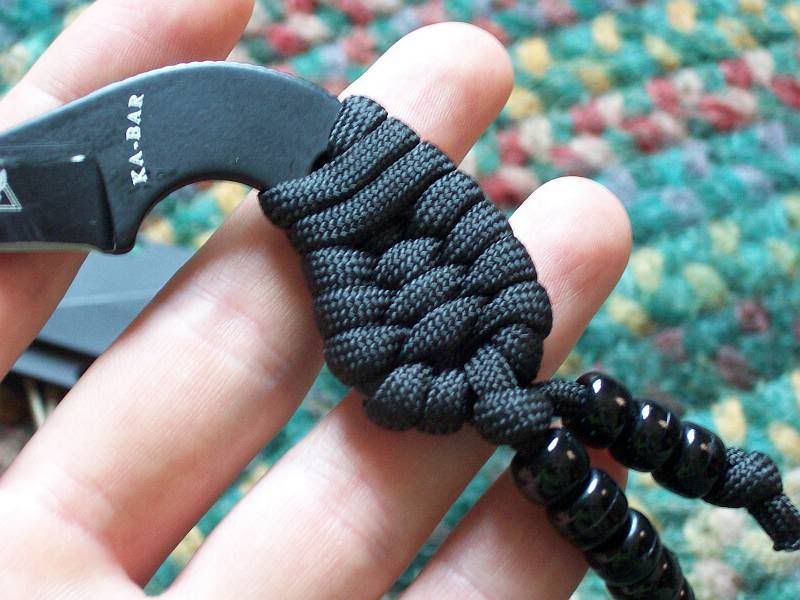
I've seen people put paracord around the hilt to give it a little more to hold on to and it's certainly an option if you aren't looking for deep concealment in a narrow or uncomfortable place--like the back of your shorts, for instance. It also might help those with large hands and less dexterity. And if you want to deep conceal it again, just take the cord off.

The sheath is very basic plastic that has continued to be tight for me despite lots of taking the knife in and out (and even putting it back in backwards a few times). I believe it comes with a stretch of paracord (you'll have to forgive my not remembering. I bought the thing four years ago). If in use as a neck knife, however, I use a bead chain (as shown above) for the slimmer profile and comfort.

A great little knife for a great little price. I can definitely see myself getting another. You should, too. If you want to.