Showing posts with label review. Show all posts
Showing posts with label review. Show all posts
Friday, February 28, 2014
Rangemaster Tactical Conference 2014
Every year Tom Givens puts on a conference in Memphis, TN, at his facility. It is called the Rangemaster Tactical Conference. It consists of three days of instruction by top instructors in the firearms and self defense community. At any given time there can be three to five instructors presenting on any number of topics related to self defense, particularly with a firearm. Most instruction blocks are two hours in length but from time to time and with an important enough topic it's not unheard of to see a whole four-hour block dedicated to one instructor and his information.
After years of hearing great things coming out of the conference we finally made it a priority to attend this year.
The Conference was held on Feb 21-23 and the hardest part was deciding which instruction blocks to attend vs the others.
My schedule started with Shane Gosa, instructor with CQB Services International, talking about The Mental Trigger. This entire two-hour block was largely centered around mindset. Shane had a unique perspective on Jeff Cooper's color codes of awareness, how they were intended to be used and how to apply them to daily life. We did one group visualization technique, discussed mental barriers and the aftermath of violent encounters and finished up with a training exercise on what Shane called, "Accessing State." The exercise is meant to train the mind and body to work together and to limit or completely eliminate the freeze response and allow for a faster and more efficient aggressive, defensive or offensive response. Not only did it address turning the aggression on, immediately, but also turning it off (often the hardest and most damning part of self defense). The lecture concluded with a discussion on winning vs survival, the importance of combat breathing and other tips on getting the most out of training sessions.
Next was Kathy Jackson, author and instructor for Cornered Cat. Her lecture was very bluntly titled "What Women Want" and centered around getting more women to attend professional firearms and self defense training. She opened with statistics about how many women were getting their carry permits and buying guns compared to men (hint, it's a lot more women than you think) and on the high note she dashed us down by showing the number of women who attend regular training past the basic carry class (hint, it's way less women than you'd hope). She drew parallels from other male-dominated fields and how they have fought to retain women. Her discussion on how women often feel in the firearms community (and other male-dominated fields) left my mouth agape in it's accuracy at how I have often felt. She then held back nothing as she talked about some of the common flaws in firearms training that set women up for failure or at least for being undermined in the industry. She slaughtered a few sacred cows (which I was gleeful to see butchered (there were at least two times I literally almost clapped)) and moved on to the best strategies for encouraging women. She was very frank that if you are going to teach women you have to be okay talking about and at least have a working idea of some women's issues like drawing around big breasts, discussing bra or thigh holsters, or even being able to address long fingernails and how it relates to shooting. In short, if you want women to come to your classes, you need to make them feel like they belong in a human space vs feeling like they are guests in a man's house.
After lunch I was off to Jim Higginbotham, a former instructor at Gunsite, from Riposte Training. His lecture was called "Fire for Effect" and entirely centered on how the body reacts to gunfire and how bullets may (or may not) physically stop a determined attacker. He discussed the factors that influence incapacitation, how one should train to maximize the effectiveness of their shots if they are needed and what physically needs to be achieved in order to stop a determined attacker instantly, rapidly or marginally. He addressed head-on the growing concept that it's better to spread your shots around vs making tight groups and how ineffective that can be. He addressed the issue of training scars developed through targets with poorly defined targeting zones and concluded with practice tips on improving ability to make better incapacitating shots.
My last class on Friday was Chuck Haggard, a former SWAT officer and current supervisory officer in Kansas. I had the privilege to meet Chuck at the Rangemaster Instructor Development class in September and we've kept in touch ever since. His block of instruction was on Active Shooters/Terrorist Events. Chuck has been personally involved in two active shooter events and his unique perspective was insightful when going through some of the information. A good majority of the class was going over many of the major active shooter events and discussing the tactics used by law enforcement and what worked and what didn't as far as slowing or stopping the events. He talked about what motivates active shooters and what civilians can do to better prepare for an active shooter event.
Saturday morning started with a four-hour block of instruction by John Hearne; a Rangemaster instructor, federal law enforcement officer and self-proclaimed research geek; called "Performance Under Fire." He gave the four-hour version of an eight-hour class and if I ever get the chance to take it in more depth you will find me there. A long-held belief is that humans are predestined to become quivering masses of unpredictable goo when confronted with traumatic events. John's lecture went over the brain, how it works and functions with other body systems to respond to emergencies, why it is conditioned to do what it does under stress and how it can be optimized to respond better or entirely differently. He explained the difference between the neocortex and limbic system and their roles in traumatic events and how to keep the neocortex in control. He defined what it meant to be untrained, to have learned a skill and what was an overlearned skill. My favorite part of his lecture was what he called the "Sacred Cow Slaughterhouse" that took on the concepts of heart-rate being a key factor in performance, the idea that a "natural" response is somehow superior vs an overlearned response, the famed "startle-response" we all train to start from, the supposed innate aversion we are said to have against killing other humans, and whether or not we really do loose our ability to perform fine motor skills and see something as small as a front sight when fighting for our lives. He concluded his lecture with training tips and tips for instructors on how to maximize student learning. All-in-all a very intensive and eye-opening block of instruction.
And from there I stood in line for twenty minutes waiting to attend Craig Douglas' workshop on Managing Unknown Contacts. Craig Douglas is often known through his former screen name "Southnarc." As his handle would suggest, he was an undercover narcotics officer who has since retired and started his own training company called shivworks. The man has a stellar reputation in the training community that is well-deserved. Many of his techniques were developed directly from his own experience interacting on a regular basis with the criminal element. The workshop was based around the simple premise that you are being approached by an unknown individual. You need to decide whether or not this individual is a potential threat with enough time and/or distance to do something about it if it turns out this individual means you harm. We spent most of the instruction block working his three-part interaction system of Verbalizing, Moving and preparing your Hands for action. He then went over four of the most common pre-fight indicators and we practiced identifying them in class. Lastly, we talked about what to do if we are still unsure of the genuine intent of an individual but decide we want to help them vs shutting them down. This was mostly a live-action class worked with other partners and a great exercise in staying relatively safe while deciding if someone is a legitimate threat or not.
My final Saturday class was Skip Gochenour, a retired police investigator who specialized in homicides and helped prepare cases for trial. Skip's lecture was titled "Problem Two: On Trial." In other words, you've survived a lethal encounter (problem one) but now you are being charged with a crime (typically some form of homicide). He opened his lecture with some pretty harsh facts about the law and legal system, the hardest to accept by your average gun-totter being that the truth has absolutely no relevance in a court of law. If a question cannot be clearly answered by the evidence it is what is considered "a jury question" at which point a prosecutor and defense attorney will both make a case on how they interpret the evidence and the jury makes a declaration and what they believe the evidence likely indicates what happened. He went over a lot of history of our legal system and broke down what four main questions a prosecutor will ask in order to determine whether or not someone acted in self defense. He then moved on to what criteria the jury will look at as to whether or not they will convict (or acquit) someone of the various degrees of murder. One of the quotes of the class that particularly resonated with me was, "When you decide you will take on problem one you agree to accept the bill and pay for problem two no matter what the cost." Be that emotional, financial, physical, legal or in prison. A sobering reminder of the responsibilities involved in carrying a firearm.
Sunday morning opened with Cecil Burch, a career martial artist and instructor. His block of instruction was titled Immediate Action in Extreme Close Quarters. In short, you've just been taken by surprise in a violent attack and you can't get to or don't have a gun. What do you do? This was another live-action workshop and we spent much of it on our feet working with partners to protect our most vital area (the head) and work on switching from a defensive posture to an offensive one and gaining ground to either fight, access tools or flee.
Next I attended Tom Givens' Active Shooter lecture. His lecture differed from Chuck's in that he did not spend a lot of time discussing individual cases but rather patterns across many active shooter events. He went over a lot of information that is already known in the community such as the fact that most active shooter events happen in gun-free zones, a large portion of them being schools, and that the shooters tend to be lone, white males with one gun. He went over the phases of an active shooter from fantasy all the way to the shooting and how the best time to stop an active shooting is in the planning or preparation stage. He discussed the difference in outcomes with civilian's have responded to active shooters vs law enforcement with the results being in favor of a civilian response. Lastly, he talked about what to do if caught up in an active shooter event and wrapped it up with an admonition to be armed and fight for abolition of gun-free zones.
After lunch was William Aprill's lecture titled, "Fatal Choices." William Aprill is a psychologist who works with criminals in a law enforcement capacity and a brilliant speaker. His lecture was primarily about what makes a criminal pick a particular individual to victimize. His initial task was to distinguish between those who are targeted and those who are victimized. Anyone can be targeted but only a portion of those are actually chosen to be victimized and that comes down to a criminal deciding whether or not that target is a "go" or "no go." How does he make the decision? William went into depth about what is called "thin-slicing" and it's connection to the intuitive mind that allows us to make instant and more-often accurate decisions about people based on very limited, external data. Facial expressions, gait, appearance, even the amount of multi-tasking we seem to be taking on in a particular moment, can all be factors in what makes a criminal decide whether or not to victimize a particular target. He talked about what we can do to lower our chances of being targeted in the first place or even "deselected" as a "go." Of all of the presentations at the conference, it was William's that fascinated me the most and has made me want to research much more into the topics of thin-slicing and how it relates to criminal choice.
Finally, when I thought I could cram no more into my little brain I sat down in Greg Ellifritz's "Armed Citizen Response to Terrorist Bombings." Anyone who has followed my blog for any length of time has seen Greg's name before. He's one of my favorite instructors and this is my third class with him. He's the author and lead instructor for Active Response Training. He holds more instructor certifications than I care to list at the moment and his topic of the day was bombs. He went over what they are, how they work, how we might be able to identify them and how they are being used by terrorists and active shooters. After pretty much letting us all in on the terrifying reality that there's not much you can do about a bomb he dampened the mood even further by alerting us to the fact that most active shooter/terrorist bombs are homemade and unstable and it's not even a safe bet to try to shoot someone, even if you are 100% sure he has a bomb. If you choose to do so you're doing so with the expectation that you're going to die and generally not going to stop the bomb from going off anyway given the instability of the device, handlers who will set it off anyway, timers, or a hit to the device that triggers it early. He did try to end it on an upbeat note by assuming if we were involved in a bombing we were far enough away or able to get to cover quickly enough to survive. He talked about steps to take to identify secondary devices, how to manage other survivors of the blast and then talked about relative safe distances and cover from certain sizes of devices (which can vary depending on device).
On that happy note we piled in our car, went for some good bbq and just about crashed in an information-overload coma.
These were only the classes I was able to attend. There were so many more I missed and am disappointed for it.
I got to meet some of my heroes and other top-name instructors, got to network with some great people and trainers, meet some of the people who have followed me for years and generally rub shoulders with some great, like-minded individuals.
In addition to the instruction, there is an ongoing pistol match which I shot on Saturday night and learned later that out of 129 shooters I came in 22. To say I was pleased would be an understatement.
I'm not done processing the information from the conference and I fully expect to write more in depth thoughts on several of the training blocks I attended, but for now, I'll leave you all with the admonition that if you can even remotely conceive of going to a Tactical Conference you should do so!
I plan on returning often! I hope to see you there!

Sunday, June 9, 2013
Maxpedition Gearslinger Lunada Review
 |
| PreSchool backpack, can of coke and Lunada for size. |
It took me a total of a week to pick out the products I wanted to review and around the middle of April I got a box in the mail from Maxpedition. The first bag I put into use was the Lunada.
I told my contact that I would take about a month to review a bag because I wanted time to play with the product, get to know it and see how it held up over time.
I've carried the Lunada for a little over a month now and I am thoroughly impressed with this little bag.
 |
| MOLLE on both sides, front and shoulder strap |
The bag has five main pockets: A large, open top pocket on the back of the bag filled with hook and loop wherein you can put anything from a gun to a notebook or random odds and ends; a main, large, zippered pouch with two smaller open top pouches and a small zipper pouch; a short and wide pocket on the top of the bag that can fit a pair of shooting glasses with a smaller open top pouch equipped with elastic loops for small items like lighters; a medium-size zipper pouch with more open top pouches and loops and a final zipper pocket on the front of the bag for narrow items.
The bag itself is covered in webbing for any MOLLE attachments you might want to make. My last Maxpedition bag had webbing for MOLLE attachments as well but not in any places I could see reasonable to attach anything. The Lunada is different. I have discovered a love for MOLLE I never had before and have a MOLLE pouch, a knife holder, my trauma sheers and my cell phone holster all
held to the bag with MOLLE. I have plenty of room for more if I want it, too.
 | ||
Carry Handle
|

The Lunada comes from the Gearslinger line of Maxpedition products which means that it has one shoulder strap and the bag is mean to be carried across the wearers body. But, unlike the Versipacks, the Gearslingers can be adjusted for either right or left shoulder carry with the switch of hook.
The strap itself is wide and padded and makes for very easy and comfortable all day carry (if you have healthy shoulders and don't weight the bag down too much). The strap also has MOLLE attachments on it and my love for MOLLE has spread to that region. I have attached a wrist watch and a knife and flashlight to the shoulder strap in a location I can easily access with the bag on my back.
 |
| Shoulder Strap |
The strap also had a few D-rings on it for things like keys or whatever else your imagination can foresee connecting to it.
The shoulder strap also has a quick release latch for those of us who may want to escape our bags quickly or run the strap through something for extra security.
For added security for on-body carry and for a little more support for long walks, a second strap can be secured to the back and shoulder strap to hold it more firmly to the body. There is also a belt-wrap on the back of the bag that allows a third attachment point to the wearer. Those who are into extreme adventuring or find themselves hanging upside down for any reason can be assured that their bag will stay on their back and around their waste and their items will be secure (provided they remembered to zip all of the pockets).
 |
| Additional Strap with whistle, belt loop and backing |
I chose the Lunada because it was the smallest Maxpedition bag said to be able to fit a tablet. I was not disappointed. While it won't fit securely in the back-most pocket (it will fit enough to make a quick get-a-way), my Samsung Galaxy Note 10.1, with case, fits perfectly in the main zippered compartment. With little stretching I can also fit my 11.5 inch bluetooth Logitech keyboard that I may take with the tablet for moments like this when I need the ability to do a lot of typing but don't want to lug around a laptop.
 |
| Lunada and tablet |
The bag itself can hold quite a lot of gear. If you are looking for an Every Day Carry (EDC) bag that has a lot of capacity you may love this bag but you might also think it doesn't have enough.
It is a very compact bag and stuffing some of the pockets may mean a little difficulty in putting things in other pockets.
I use this Lunada as a purse, diaper bag, blow-out bag and just a bit of a "get home" bag. For its size it fits its many rolls very well. I can fit my wallet, diaper and wipes in the bag with my cell phone MOLLE attached to the outside. I like this arrangement because it allows me to answer my phone without having to dig in my bag and I can finally hear my phone when it rings, too. Because I'm a chapstick junky I've also MOLLE attached my chapstick to the outside of the bag while I've put things like my sun/shooting glasses in the top pouch along with sun screen, a lighter, some hand wipes, hair ties and nail file (very useful for those moments when you get your nails broken in someone's face in Krav).
 |
| Tablet with Case in Lunada |
 |
| Tablet with case and 11.5" keyboard in Lunada |
 |
| Lunada Main Compartment Contents Tablet, Wallet, Diapers, Wipes, Bandanas, Crayons, Survival Tin, Lotion, Keyboard (occasionally) |
are particularly brutal. I also have a tin of crayons for the kids.
Also attached to the outside of the bag via MOLLE is a small med pouch specifically for my son. Because he is allergic to bandaids and has pretty severe reactions to some bug bites I carry paper tape and some 2x2 gauze, hand sanitation wipes and a tube of Cortisone10. I can take off the pouch and leave it with him without having to empty and repack my bag.
 |
| Lunada Main Compartment Zipper Pocket Contents Bandaids, Condoms, Feminine Hygiene, Medication |
weighing down myself. Some already think I carry way too much on a daily basis. Some would think I don't carry nearly enough. I feel the contents and bag are right on the "just right" line. Any more and I feel I would find myself leaving my bag in my car and opting to just take my wallet and cell phone with me when I needed to make stops which, consequently would make me feel lax in my preparedness as what good does a bag of supplies do you if you don't have them with you when you need them?
Because the bag carries high on the back instead of low around the hip it makes for much easy carry similar to a backpack with less fatigue on the shoulder and neck than with the bags that carry around the hips. The trade off is that it can make you feel as though you can't access the contents of the bag as quickly. With a little good organization, the use of MOLLE and the quick release latch on the strap I have yet to feel as though the bag where too slow to access. I've also developed my own way of quickly switching the bag from back to front carry without having to remove it from my body. I'm also very happy to have the contents of the bag with me vs left in the car. Having the bag on my back also makes me feel as though my arms and side are much more free to carry anything from my children to guns and magazines.
 | |||
| Lunada Right Med Pouch, Sharpie, Tape Measure Knife/Chapstick Holder |

While I've been loving the Lunada for it's very utilitarian design I was a bit bummed that it did not feature a water bottle holder. I am, after all, a mom on the go and water is an important resource and while I understood I could get a MOLLE water bottle holder for the side of the bag it wasn't until I carried around a water bottle in hand for a few weeks that I had my AH-HA moment and realized that the torch holder (the elastic drawstring on the front/top of the bag) actually made a phenomenal water bottle holder. Problem solved!
Also attached to the outside of that pocket is a sort of slip sleeve with some hook and loop I was a bit at a loss with what to do with (other than affix an American flag patch a friend of mine gave to me). Finally, while looking the bag over for places to hide weapons I discovered that would be a pretty good place to conceal a fixed-blade knife. Attaching the sheath to a dog-tag chain and securing it to the bag I now have a nicely concealed neck knife on hand.
To test the water resistance of the bag I decided to turn the hose loose on it on a rain setting. For about thirty seconds I simulated a pretty aggressive downpour. I put paper towels in the bag to see how wet they would get and the only parts of the towels that got wet were those closest or touching the zippers. The water resistance works well but it's certainly not water proof and more than a minute in solid rain may end with the contents of the bag getting wet.
Some people are also concerned that the bag looks too "tactical" giving them away as someone who might be a gun owner. While it's true that this bag is nothing you would take to the opera or even a date at a five-star restaurant it's not as "tactical" looking as people fear.
 |
| Hidden Knife |
 |
| Shooting Glasses in Top Zipper Pocket |
 |
| Top Zipper Pocket Contents Hand Wipes, Shooting Glasses, Sunblock, Lipstick, Hair Ties, Comb, Nail File, Lighter |
bag around. I said, "Since you brought it up, does this bag scream 'gun' to you?"
He said, "Oh, God, no! Wait. Is there a gun in there?" I told him there was not.
The only person who associated the Lunada with a gun was an off-duty police officer who asked me if the bag was a Maxpedition and wanted to know where within the bag they kept the hook and loop for the holster having owned Maxpedition products in the past.
 |
| Lunada Left with Cell Phone |
The Lunada will remain at the top of my list in terms of EDC bags and I don't believe I will find myself wanting to replace it any time soon.
While my first impression was to feel I made a mistake in that it might turn out to be a little small for my needs, I have discovered that this bag has perfectly fit my needs for what I should be carrying on a consistent basis. While I very well may end up with a larger bag for the car with more "get home" items like a change of clothes for myself and additional pairs of shoes, the Lunada is a perfect choice for the ins and outs of daily life, all that goes along with that and a little more.
If you (male or female) are interested in a good utilitarian bag for EDC carry, I would recommend giving the Lunada a look.
 |
| Alternate Use for Torch Hold |
Friday, July 6, 2012
TDI Defensive Knife Class Review
This review is from TDI's Defensive Knife Class held on December 4-5, 2010
I have wanted to take a knife class for years. Just like I wanted to get quality gun training when I chose to start carrying a firearm for self-defense, it was a natural progression of my training to want quality knife training when I chose to carry a knife.
Through a series of force-on-force (FOF) scenarios and some research and careful thought I had chosen the Tactical Defense Institute (TDI) Law Enforcement knife made by Ka-Bar as the edged companion to my firearm for every-day carry. When I brought it home and showed my husband my newest acquisition he informed me that TDI was actually a training facility in Ohio that did defensive knife classes. I immediately became interested. After all, it made sense to take a class from the people who designed the knife I chose to carry.
It took another two plus years before I would be in a position, financially and logistically, to take a knife class and after hearing many wonderful things about TDI I finally signed up for their two day Defensive Knife class that took place on December fourth and fifth of this year.
The confirmation email I received said to bring any and all knives I wanted to train with but that if I had no knife it was not an issue as TDI would have several knives available for trial and plenty of trainers to work with. Even though I didn’t need to take my TDI trainer I stuck it, my Cold Steel Ti-Lite and my Ka-Bar TDI Law Enforcement knife in my suitcase and drove to southern Ohio for my class.
A look at the TDI website gives you a run down of the facility with multiple ranges, classrooms, force-on-force houses and everything else a defensive student could ask for.
In anticipation of getting lost (as I usually do) I left my hotel an hour and a half early to make what was reported to me to be only a half-hour long trip. The directions were not hard to follow and even though I arrived to class an hour early there was already instructors there with heaters cranked setting out equipment for the class.
The classroom was clean and neat with comfortable chairs, clean tables, a small kitchenette, two bathrooms, a case to display TDI products for sale, a large television and (blessedly) two heaters to combat the Ohio cold that had swept in for the weekend.
They weren’t kidding when they said they had plenty of knives and trainers. The table at the front of the class was covered with trainer knives and live knives that could be borrowed by students.
As the rest of the students arrived we mingled and got to know each other and it wasn’t a surprised to find that I would be the only woman in the class. I was delighted to find out that John Benner, the designer of the TDI knife, would be an assistant instructor for the class as I was eager to meet him after our wonderful chat on the phone when I had called to sign up for the class. When our head instructor, Greg Ellifritz, arrived with plenty of time to spare we all settled in, some finished paying for their class and it was time to start.
There was a ratio of three instructors for twelve students (I believe), which made for a very safe environment. With any kind of class featuring weapons safety is a main concern and when you have twelve people with knives working them and trying things they’ve never tried before it’s nice to know there’s more than one set of eyes making sure everyone is being responsible and safe. Two instructors walked around the perimeter of the class checking for safety and giving tips when needed as Greg taught. Even when we sparred or did our force-on-force there was someone there to check our pockets and waistbands to ensure we didn’t forget to remove any live weapons (which I had forgotten to do after lunch on the second day and the instructor caught it (thank goodness)). That, along with the continued safety reminders, made me feel very comfortable that no one was going to end up with a knife buried in their belly or their fingers chopped off.
I think the worst wound of the weekend was a student who cut the top of his finger on the hilt of his training knife during the final force-on-force exercise. A quick rinse and a bandaid and all was well again.
Before I went I really wondered what was going to be taught in this class. After all, how much instruction does it take to figure out how to use a knife? All of us have been using knives to cut our food since we were small children and most can figure out which side to point toward the enemy. I didn’t doubt there was going to be fighting techniques taught that I didn’t know but the rest was a complete and eager mystery. I was not disappointed.
Right away, on day one, we opened with a brief introduction of the class and instructors and dove right in to the types of knives available for self-defense and how to choose the right knife for you. There was even a short lecture on how to ensure the locking mechanism on folders would stay secure so as not to collapse on your figures mid-fight. Greg had a bag of knives he brought with him that were passed around for all to see what was available and how it worked.
John talked about the TDI knife and how and why it was designed and it was great to hear it from the designers own mouth. I also learned that my other favorite little knife, the TDI Last Ditch Knife (LDK), was designed by the instructor, Greg Ellifritz. Right about then I was feeling really glad I chose this class.
Then we all moved to the training area and went right into learning different opening methods for folders. We talked about the different grips available for knives and the stance to go along with fighting with a knife. We practiced deploying our knives from various positions such as kneeling, on our backs, sides and what not. Then we had to “earn” our lunch.
Greg wanted to prove that deploying a knife while exhausted was different than from standing and rested so he had us all get down and do twenty pushups and from the top of the pushup position we were to deploy a knife. When we thought we were done he had us do twenty more and try again. It was then we were beginning to see a number of fumbled and failed openings.
After lunch we talked about the rules for close quarter drawing of weapons in general which was either creating distance in order to draw or gaining control of the attacker long enough to draw so that your defensive tool of choice could not be taken from you or the draw interfered with. We did a number of exercises to create either distance or control through sparring with partners.
We learned a twelve-step slash and stab drill and practiced that extensively. We did live deploying and cutting drills to demonstrate the difference in speed between fixed blades and folders. We worked with our knives in our off hands and did the knife equivalent of the Tueller drill by having to draw our knives and deploy them against an advancing attacker. We talked about anatomy and targeting areas on the body that would either cause enough physical damage to end a conflict or cause rapid blood loss which meant that, naturally, we would have to practice them on our sparring partners. Then we talked about wound enhancement by maximizing trauma with the knife. We also talked about the legalities of using a knife for self-defense.
After working knife defense against common grabs and attacks we were given a demonstration on just how quickly one can be rendered unconscious from a choke hold by a volunteer being choked out (a sobering exercise to be sure).
It was a long first day but very educational and hands on.
Day two started with knife care and sharpening. We were fortunate enough to have a custom knife maker in our class who gave his professional opinion on knife sharpening techniques and products. It wasn’t long before we were back out on the training floor learning drills for an unarmed person defending against a knife attack and fighting a knife attack with a knife and some more techniques to thwart off multiple attackers.
Just before lunch we went outside where they had hung up a deer carcass and we all took our turn slashing, stabbing, hacking, coring and cutting this poor deer carcass until it looked like something out of a bad horror movie. I was amazed to personally feel how easy it was to stab right through ribs as I felt them crunch and crack under the force of a TDI wielded by my little hand.
On the other side of the deer we dressed it in clothes and got to try for ourselves how clothing can change the results of slashes and cuts. We even got to try stabbing with other tools like tactical pens and one student went to town with a tactical flashlight that buried itself into the neck of the deer making a very wicked little wound.
While we ate lunch we watched a video on how easily skin cuts and the demonstration of cutting a pig carcass dressed in various clothes (wonderful meal-time entertainment!).
After lunch we pulled out the mats and did fighting from the ground when an attacker already has you on the ground and mounted you. We talked about secretly getting your knife out and then it was time for the force-on-force.
Greg got dressed up in a training suit and laid down the rules. He would attack us in any way he saw fit and the fight would not be over until he felt he was dealt a fight-stopping blow or until we fought our way to the other side of the classroom (through him, of course). Those of us not fighting would play “jury” and decide whether or not the actions of the person fighting were justifiable. This I found to be most unique and interesting as each person fighting was forced to think more about their actions in regards to the law and how they would defend them.
When it was my turn I was very nervous (what 100 lbs woman going up against a 220-plus lbs instructor wouldn’t be?) but I didn’t back down. He confronted me and attacked. I fought open hand until I had the chance to draw my knife. A good cut to his inner leg and I escaped to “safety.”
It was a relief to hear my classmates say I was entirely justified in my actions.
Greg Ellifritz and John Benner were both excellent instructors that I would be happy to work with again and again. Greg, a police instructor with thousands of hours of training in everything from knives, firearms, hand-to-hand combat and even field medicine, was knowledgeable and confident in his teaching without being cocky or overly opinionated. He was humble enough to give credit where credit was due and not pushy with his techniques. He had a likeable sense of humor but didn’t let us get too far off topic before he reeled us in again. He promised he would never try to take away anything that someone had adopted to work for them and he was true to his word even praising those who had adapted different ways to accomplish a goal. We all teased him that at times he got a manically gleeful smile while sparring that indicated he had far too much fun with his job.
As a woman it’s sometimes intimidating to go to a male-dominated class as sexism can be very alive and well but I felt very respected, not feared or undermined. Greg and John both listened and responded to me as an equal student to my male counterparts. While some of the other students were gentler in their sparring with me Greg gave me the training I was seeking by apply a more forceful approach that I would have to repel. John was not far off giving tips and helping to drive home certain points. I was greatly impressed with their professionalism, knowledge, clarity, organization and teaching ability.
I learned more than I could have previously imagined and in the best way possible—by doing the work instead of just listening to a lecture or watching a video. Aside from the techniques of slashes and stabs some of the most important lessons I took away from the class have been the cardinal rules for drawing a weapon (distance or control), the speed of drawing and readiness of the fixed-blade vs the folder and how even the simplest of clothing items can frustrate the outcome of a slash but have little effect on the outcome of a stab. I was not the only one ditching my folder knife in favor of a fixed blade and many people purchased the TDI Law Enforcement knife before the end of the first day to replace their primary carry knife. Knife placement was always driven home as often you cannot draw your knife with your dominant hand and keeping your knife in a location where both hands have access to it is very important.
I like to vary my training by spreading it out amongst different trainers and schools but I am fairly certain I will be going back to TDI for another class or two or ten. I would recommend to others that they do the same.
I have wanted to take a knife class for years. Just like I wanted to get quality gun training when I chose to start carrying a firearm for self-defense, it was a natural progression of my training to want quality knife training when I chose to carry a knife.
Through a series of force-on-force (FOF) scenarios and some research and careful thought I had chosen the Tactical Defense Institute (TDI) Law Enforcement knife made by Ka-Bar as the edged companion to my firearm for every-day carry. When I brought it home and showed my husband my newest acquisition he informed me that TDI was actually a training facility in Ohio that did defensive knife classes. I immediately became interested. After all, it made sense to take a class from the people who designed the knife I chose to carry.
It took another two plus years before I would be in a position, financially and logistically, to take a knife class and after hearing many wonderful things about TDI I finally signed up for their two day Defensive Knife class that took place on December fourth and fifth of this year.
The confirmation email I received said to bring any and all knives I wanted to train with but that if I had no knife it was not an issue as TDI would have several knives available for trial and plenty of trainers to work with. Even though I didn’t need to take my TDI trainer I stuck it, my Cold Steel Ti-Lite and my Ka-Bar TDI Law Enforcement knife in my suitcase and drove to southern Ohio for my class.
A look at the TDI website gives you a run down of the facility with multiple ranges, classrooms, force-on-force houses and everything else a defensive student could ask for.
In anticipation of getting lost (as I usually do) I left my hotel an hour and a half early to make what was reported to me to be only a half-hour long trip. The directions were not hard to follow and even though I arrived to class an hour early there was already instructors there with heaters cranked setting out equipment for the class.
The classroom was clean and neat with comfortable chairs, clean tables, a small kitchenette, two bathrooms, a case to display TDI products for sale, a large television and (blessedly) two heaters to combat the Ohio cold that had swept in for the weekend.
They weren’t kidding when they said they had plenty of knives and trainers. The table at the front of the class was covered with trainer knives and live knives that could be borrowed by students.
As the rest of the students arrived we mingled and got to know each other and it wasn’t a surprised to find that I would be the only woman in the class. I was delighted to find out that John Benner, the designer of the TDI knife, would be an assistant instructor for the class as I was eager to meet him after our wonderful chat on the phone when I had called to sign up for the class. When our head instructor, Greg Ellifritz, arrived with plenty of time to spare we all settled in, some finished paying for their class and it was time to start.
There was a ratio of three instructors for twelve students (I believe), which made for a very safe environment. With any kind of class featuring weapons safety is a main concern and when you have twelve people with knives working them and trying things they’ve never tried before it’s nice to know there’s more than one set of eyes making sure everyone is being responsible and safe. Two instructors walked around the perimeter of the class checking for safety and giving tips when needed as Greg taught. Even when we sparred or did our force-on-force there was someone there to check our pockets and waistbands to ensure we didn’t forget to remove any live weapons (which I had forgotten to do after lunch on the second day and the instructor caught it (thank goodness)). That, along with the continued safety reminders, made me feel very comfortable that no one was going to end up with a knife buried in their belly or their fingers chopped off.
I think the worst wound of the weekend was a student who cut the top of his finger on the hilt of his training knife during the final force-on-force exercise. A quick rinse and a bandaid and all was well again.
Before I went I really wondered what was going to be taught in this class. After all, how much instruction does it take to figure out how to use a knife? All of us have been using knives to cut our food since we were small children and most can figure out which side to point toward the enemy. I didn’t doubt there was going to be fighting techniques taught that I didn’t know but the rest was a complete and eager mystery. I was not disappointed.
Right away, on day one, we opened with a brief introduction of the class and instructors and dove right in to the types of knives available for self-defense and how to choose the right knife for you. There was even a short lecture on how to ensure the locking mechanism on folders would stay secure so as not to collapse on your figures mid-fight. Greg had a bag of knives he brought with him that were passed around for all to see what was available and how it worked.
John talked about the TDI knife and how and why it was designed and it was great to hear it from the designers own mouth. I also learned that my other favorite little knife, the TDI Last Ditch Knife (LDK), was designed by the instructor, Greg Ellifritz. Right about then I was feeling really glad I chose this class.
Then we all moved to the training area and went right into learning different opening methods for folders. We talked about the different grips available for knives and the stance to go along with fighting with a knife. We practiced deploying our knives from various positions such as kneeling, on our backs, sides and what not. Then we had to “earn” our lunch.
Greg wanted to prove that deploying a knife while exhausted was different than from standing and rested so he had us all get down and do twenty pushups and from the top of the pushup position we were to deploy a knife. When we thought we were done he had us do twenty more and try again. It was then we were beginning to see a number of fumbled and failed openings.
After lunch we talked about the rules for close quarter drawing of weapons in general which was either creating distance in order to draw or gaining control of the attacker long enough to draw so that your defensive tool of choice could not be taken from you or the draw interfered with. We did a number of exercises to create either distance or control through sparring with partners.
We learned a twelve-step slash and stab drill and practiced that extensively. We did live deploying and cutting drills to demonstrate the difference in speed between fixed blades and folders. We worked with our knives in our off hands and did the knife equivalent of the Tueller drill by having to draw our knives and deploy them against an advancing attacker. We talked about anatomy and targeting areas on the body that would either cause enough physical damage to end a conflict or cause rapid blood loss which meant that, naturally, we would have to practice them on our sparring partners. Then we talked about wound enhancement by maximizing trauma with the knife. We also talked about the legalities of using a knife for self-defense.
After working knife defense against common grabs and attacks we were given a demonstration on just how quickly one can be rendered unconscious from a choke hold by a volunteer being choked out (a sobering exercise to be sure).
It was a long first day but very educational and hands on.
Day two started with knife care and sharpening. We were fortunate enough to have a custom knife maker in our class who gave his professional opinion on knife sharpening techniques and products. It wasn’t long before we were back out on the training floor learning drills for an unarmed person defending against a knife attack and fighting a knife attack with a knife and some more techniques to thwart off multiple attackers.
Just before lunch we went outside where they had hung up a deer carcass and we all took our turn slashing, stabbing, hacking, coring and cutting this poor deer carcass until it looked like something out of a bad horror movie. I was amazed to personally feel how easy it was to stab right through ribs as I felt them crunch and crack under the force of a TDI wielded by my little hand.
On the other side of the deer we dressed it in clothes and got to try for ourselves how clothing can change the results of slashes and cuts. We even got to try stabbing with other tools like tactical pens and one student went to town with a tactical flashlight that buried itself into the neck of the deer making a very wicked little wound.
While we ate lunch we watched a video on how easily skin cuts and the demonstration of cutting a pig carcass dressed in various clothes (wonderful meal-time entertainment!).
After lunch we pulled out the mats and did fighting from the ground when an attacker already has you on the ground and mounted you. We talked about secretly getting your knife out and then it was time for the force-on-force.
Greg got dressed up in a training suit and laid down the rules. He would attack us in any way he saw fit and the fight would not be over until he felt he was dealt a fight-stopping blow or until we fought our way to the other side of the classroom (through him, of course). Those of us not fighting would play “jury” and decide whether or not the actions of the person fighting were justifiable. This I found to be most unique and interesting as each person fighting was forced to think more about their actions in regards to the law and how they would defend them.
When it was my turn I was very nervous (what 100 lbs woman going up against a 220-plus lbs instructor wouldn’t be?) but I didn’t back down. He confronted me and attacked. I fought open hand until I had the chance to draw my knife. A good cut to his inner leg and I escaped to “safety.”
It was a relief to hear my classmates say I was entirely justified in my actions.
Greg Ellifritz and John Benner were both excellent instructors that I would be happy to work with again and again. Greg, a police instructor with thousands of hours of training in everything from knives, firearms, hand-to-hand combat and even field medicine, was knowledgeable and confident in his teaching without being cocky or overly opinionated. He was humble enough to give credit where credit was due and not pushy with his techniques. He had a likeable sense of humor but didn’t let us get too far off topic before he reeled us in again. He promised he would never try to take away anything that someone had adopted to work for them and he was true to his word even praising those who had adapted different ways to accomplish a goal. We all teased him that at times he got a manically gleeful smile while sparring that indicated he had far too much fun with his job.
As a woman it’s sometimes intimidating to go to a male-dominated class as sexism can be very alive and well but I felt very respected, not feared or undermined. Greg and John both listened and responded to me as an equal student to my male counterparts. While some of the other students were gentler in their sparring with me Greg gave me the training I was seeking by apply a more forceful approach that I would have to repel. John was not far off giving tips and helping to drive home certain points. I was greatly impressed with their professionalism, knowledge, clarity, organization and teaching ability.
I learned more than I could have previously imagined and in the best way possible—by doing the work instead of just listening to a lecture or watching a video. Aside from the techniques of slashes and stabs some of the most important lessons I took away from the class have been the cardinal rules for drawing a weapon (distance or control), the speed of drawing and readiness of the fixed-blade vs the folder and how even the simplest of clothing items can frustrate the outcome of a slash but have little effect on the outcome of a stab. I was not the only one ditching my folder knife in favor of a fixed blade and many people purchased the TDI Law Enforcement knife before the end of the first day to replace their primary carry knife. Knife placement was always driven home as often you cannot draw your knife with your dominant hand and keeping your knife in a location where both hands have access to it is very important.
I like to vary my training by spreading it out amongst different trainers and schools but I am fairly certain I will be going back to TDI for another class or two or ten. I would recommend to others that they do the same.
Wednesday, June 27, 2012
TDI Last Ditch Knife (LDK)
Many moons ago, while working at a gun store where I could get 15% off of merchandise I decided it was a good time to buy a fixed-blade knife. I bought the Ka-Bar TDI Law Enforcement Knife and--just because I thought it was pretty cool, cheap and available--I also bought the Ka-Bar TDI Last Ditch Knife (LDK).
I wore it as a neck knife most of the time though I've seen it hailed as kind of an all-purpose SHTF knife: neck knife, boot knife, pocket knife, emergency scalpel, deep concealment knife, anti-terrorism, nuclear disarmament... okay, so maybe I got a little carried away although it does seem the possibilities for this little knife are endless.
Later, when I found out that TDI was actually a training facility that did knife training I decided to take my Law Enforcement knife (for clarification, I have not, nor have I ever been a member of law enforcement. It's just the name of the knife) on a pilgrimage to the place of its conceptual birth and get some good defensive knife training. There, I met the lead defensive knife instructor, Greg Ellifritz. Sometime on the first day of the class another student and I were discussing knives and I off-handedly said, "Oh, just put an LDK in your boot."
Ellifitz said, "I like your choice in knives."
I said, "Thank you."
He said, "You know I designed that knife, didn't you?"
"No!" I replied.
And thus began the discussion about the LDK.
Because I've been privileged enough to keep in contact with Ellifitz (a third-world traveling hobbyist, police training, I'll-beat-you-to-death-with-a-toothpick badass) since that knife class in 2010 I was able to ask him to share his thoughts on the LDK.
He wrote the following:
There's not a whole lot that I can add to that fine summery except to say that the LDK is still one of my favorite little knives. It has been a pretty constant companion for about four years. No matter what I did or didn't have I could almost always find a way to keep and carry the LDK.
 It is wickedly sharp and pointy. And if you need a fine, sharp point to wield in tight places, this is the knife you are looking for. Something else I learned in the knife class was that the wharncliffe style blade (a blade that is flat on its sharp side), though a bit weak in the tip department because of the supper sharp point, is a nasty flesh cutter. It will give you a little deeper/longer cut for your effort because the cutting surface stays in contact with flesh longer and for its full length. Something you really want when your cutting surface is only 4cm long. The curved hilt allows you to really bury the thing in your hand and get a pretty good grip on it despite it being so small. Of course, I am a very small individual and people with larger hands have complained it is too small and they feel like they cannot get a grip on it but the design gives you the best it can afford so that you don't loose what makes it ultra light and concealable.
Though its intended purpose was not as a utility knife it has seen some light utility work from me. It has spent many nights hung from my bedpost, an immediate tool if needed. And it does excel at flesh cutting... just ask all of the hang-nails I have cut off over the years. I've given it as a gift and gone swimming with it. There is a security in knowing that it is always there and so easy to carry no matter what the occasion or the attire. I've pinned it into pockets, purses and my bra. And I've also used it to escape from restraints (I was practicing escaping after being zip-tied to one of our kitchen chairs... a couple of times). It also works wonders on tape.
 And it certainly does excel as a tool of escape. It's small size does allow for easy maneuverability with your hands restrained (either in front of you, behind your back or individually). The only concern is cutting yourself but if you were actively trying to escape from hostile restraints a few nicks and cuts would probably be the least of your worries (although people with larger hands and poor dexterity might need to worry about dropping it and might want to practice). I know it sounds a bit "out-there" to be talking about how good a knife is at helping you escape restraints but, hey, it's why the knife was designed! What's even better is that if someone decides to check up on the prisoner/hostage/restraint-escaping-practicing-wife the knife can very easily be palmed or hidden between your fingers and, whella!--Knife? What knife?--It's advisable to keep your escape as clandestine as possible.
Just this week I decided it was time to actually try the LDK out as a boot knife.
Search though I may I could find almost no one who talked about actually putting the LDK in his or her boot (but, then again, my husband is constantly reminding me that my google-fu is not very strong).
While switching the laces of my boots from cloth to paracord I laced my LDK into the top of my left boot and there it has stayed. Because I'm not trying to actively hide it from cursory body-sweeping, dirty South American cops with itchy trigger fingers and shallow pockets, I did not bury it as deeply into my boot as I could have. As you can see by the photo the hilt protrudes above the top of my boot. But lacing it further down would and could it much better if that was the goal. A quick pat down would leave a searcher feeling nothing but laces, as he would expect.
For my purposes, squatting down in a confined space where getting into deep pockets might be a bit trying, I can slip the LDK out of my boot and cut what needs cutting.
Because this one now resides in my boot, I've talked about getting another in case I do want to pin it into my bra or pocket again and don't want to unlace my boots. And when you can find it on amazon.com for about $15, why not, right?
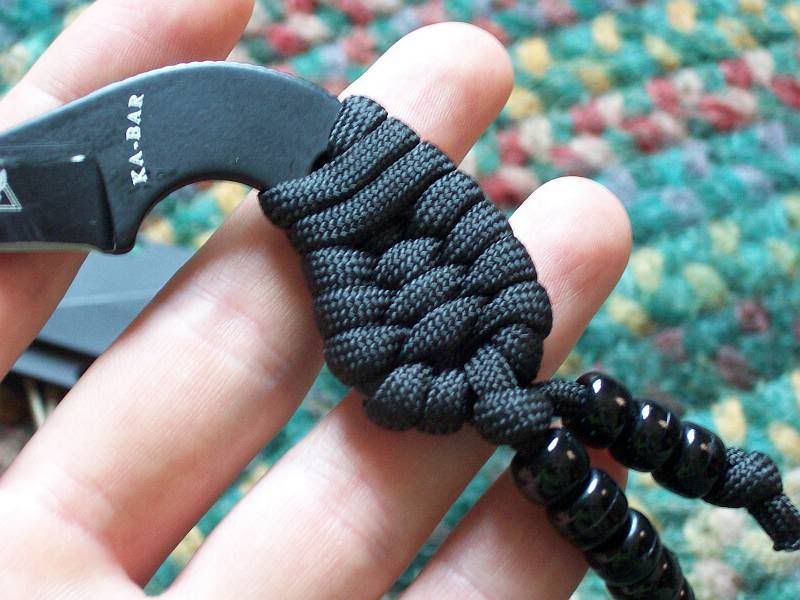
I've seen people put paracord around the hilt to give it a little more to hold on to and it's certainly an option if you aren't looking for deep concealment in a narrow or uncomfortable place--like the back of your shorts, for instance. It also might help those with large hands and less dexterity. And if you want to deep conceal it again, just take the cord off.
The sheath is very basic plastic that has continued to be tight for me despite lots of taking the knife in and out (and even putting it back in backwards a few times). I believe it comes with a stretch of paracord (you'll have to forgive my not remembering. I bought the thing four years ago). If in use as a neck knife, however, I use a bead chain (as shown above) for the slimmer profile and comfort.
A great little knife for a great little price. I can definitely see myself getting another. You should, too. If you want to.
I wore it as a neck knife most of the time though I've seen it hailed as kind of an all-purpose SHTF knife: neck knife, boot knife, pocket knife, emergency scalpel, deep concealment knife, anti-terrorism, nuclear disarmament... okay, so maybe I got a little carried away although it does seem the possibilities for this little knife are endless.
Later, when I found out that TDI was actually a training facility that did knife training I decided to take my Law Enforcement knife (for clarification, I have not, nor have I ever been a member of law enforcement. It's just the name of the knife) on a pilgrimage to the place of its conceptual birth and get some good defensive knife training. There, I met the lead defensive knife instructor, Greg Ellifritz. Sometime on the first day of the class another student and I were discussing knives and I off-handedly said, "Oh, just put an LDK in your boot."
Ellifitz said, "I like your choice in knives."
I said, "Thank you."
He said, "You know I designed that knife, didn't you?"
"No!" I replied.
And thus began the discussion about the LDK.
Because I've been privileged enough to keep in contact with Ellifitz (a third-world traveling hobbyist, police training, I'll-beat-you-to-death-with-a-toothpick badass) since that knife class in 2010 I was able to ask him to share his thoughts on the LDK.
He wrote the following:
"I designed it primarily as a knife that could easily be missed on a cursory search if one was taken hostage. I had been traveling through South America a lot and was worried about kidnapping attempts. There just weren't any really good knives on the market that could be easily hidden.
My initial thought was that I wanted something no larger than a credit card, so that I could carry it in a wallet if I wanted to. If I did that, it had to be exceptionally thin as well.
I wanted a blade design that would do a lot of damage for its small size. That's why I designed it with the straight edge and very sharp pint. It isn't designed as a general purpose cutting tool. It's designed to cut flesh like a bigger knife.
After I designed the knife, I wanted a sheath that could be hidden anywhere. I put multiple holes in it so that it can be laced in a boot or safety-pinned almost anywhere. I currently carry mine safety pinned inside and below the rear waistband of my pants when I travel in third world countries. That way I can cut myself free if my hands are tied or taped behind my back.
The hole in the handle is not designed for a finger. many people try to grip it by curling a finger through the hole. It doesn't work that well. I put the hole in the handle to save weight and provide an extra means to draw it. If the sheath is flat against a hard surface (like laced in a boot), it is difficult to get a full hand grip on the handle to draw. The hole allows you to catch a single finger inside to pull it from the sheath if you can't get a better grip.
That's about it. I sent in the design in 2006 and it went into production in 2007. It has been consistently in Ka-Bar's top 3 sellers since then. Right now they are selling about 1500 a month and demand has steadily increased over the years."

There's not a whole lot that I can add to that fine summery except to say that the LDK is still one of my favorite little knives. It has been a pretty constant companion for about four years. No matter what I did or didn't have I could almost always find a way to keep and carry the LDK.
 It is wickedly sharp and pointy. And if you need a fine, sharp point to wield in tight places, this is the knife you are looking for. Something else I learned in the knife class was that the wharncliffe style blade (a blade that is flat on its sharp side), though a bit weak in the tip department because of the supper sharp point, is a nasty flesh cutter. It will give you a little deeper/longer cut for your effort because the cutting surface stays in contact with flesh longer and for its full length. Something you really want when your cutting surface is only 4cm long. The curved hilt allows you to really bury the thing in your hand and get a pretty good grip on it despite it being so small. Of course, I am a very small individual and people with larger hands have complained it is too small and they feel like they cannot get a grip on it but the design gives you the best it can afford so that you don't loose what makes it ultra light and concealable.
 Though its intended purpose was not as a utility knife it has seen some light utility work from me. It has spent many nights hung from my bedpost, an immediate tool if needed. And it does excel at flesh cutting... just ask all of the hang-nails I have cut off over the years. I've given it as a gift and gone swimming with it. There is a security in knowing that it is always there and so easy to carry no matter what the occasion or the attire. I've pinned it into pockets, purses and my bra. And I've also used it to escape from restraints (I was practicing escaping after being zip-tied to one of our kitchen chairs... a couple of times). It also works wonders on tape.
 And it certainly does excel as a tool of escape. It's small size does allow for easy maneuverability with your hands restrained (either in front of you, behind your back or individually). The only concern is cutting yourself but if you were actively trying to escape from hostile restraints a few nicks and cuts would probably be the least of your worries (although people with larger hands and poor dexterity might need to worry about dropping it and might want to practice). I know it sounds a bit "out-there" to be talking about how good a knife is at helping you escape restraints but, hey, it's why the knife was designed! What's even better is that if someone decides to check up on the prisoner/hostage/restraint-escaping-practicing-wife the knife can very easily be palmed or hidden between your fingers and, whella!--Knife? What knife?--It's advisable to keep your escape as clandestine as possible.
 |
| The TDI LDK laced in my size-4 boot |
Search though I may I could find almost no one who talked about actually putting the LDK in his or her boot (but, then again, my husband is constantly reminding me that my google-fu is not very strong).
While switching the laces of my boots from cloth to paracord I laced my LDK into the top of my left boot and there it has stayed. Because I'm not trying to actively hide it from cursory body-sweeping, dirty South American cops with itchy trigger fingers and shallow pockets, I did not bury it as deeply into my boot as I could have. As you can see by the photo the hilt protrudes above the top of my boot. But lacing it further down would and could it much better if that was the goal. A quick pat down would leave a searcher feeling nothing but laces, as he would expect.
For my purposes, squatting down in a confined space where getting into deep pockets might be a bit trying, I can slip the LDK out of my boot and cut what needs cutting.
Because this one now resides in my boot, I've talked about getting another in case I do want to pin it into my bra or pocket again and don't want to unlace my boots. And when you can find it on amazon.com for about $15, why not, right?
 |
| Google image (My apologies for the theft) |
The sheath is very basic plastic that has continued to be tight for me despite lots of taking the knife in and out (and even putting it back in backwards a few times). I believe it comes with a stretch of paracord (you'll have to forgive my not remembering. I bought the thing four years ago). If in use as a neck knife, however, I use a bead chain (as shown above) for the slimmer profile and comfort.
A great little knife for a great little price. I can definitely see myself getting another. You should, too. If you want to.
Friday, May 18, 2012
Red Dot Sights on Combat Guns
Back in 2006 or so I took my very first two-day defensive pistol course with Greg Hamilton, founder of InSights Training Center. I was relatively new to the game and what he said about sights kind of surprised me.
He said, "Ideally, we'd all be running around with some kind of red dot sight (RDS) on our pistols. Just wait, give it a few years and you'll see red dot sights made for carry pistols."
At the time, RDSs were not "new" but they were long and scope like, usually reserved for rifles and getting rave reviews in combat for their fast sight acquisition, ease of use and adaptability to all types of shooters.
Enter 2012.
Greg's predictions are coming true. This technology has been made available and it's piquing interest and gaining popularity. It's raising questions and people are wondering if it's a viable option for them.
I'm always willing to try new technology (especially when it comes to guns) but sometimes it's hard to get a chance to play with this stuff unless you are deeply imbedded in the business or have very good connections .. or, in my case, take classes with some very generous and trusting people.
When I went to TDI's Handguns I - III this spring I saw the Leupold DeltaPoint Reflex Sight on many of the instructor's firearms which made me stand up and take notice. When I went back for Partner Tactics I was able to shoot one for a day and play around with it.
I asked the same questions that others have when they see this technology for the first time:
How does it work?
We always want to know how this stuff works. In lay person (that's me) terms. The sight is a glass window wherein a red dot (or triangle, depending on which reticle you opt for) is projected. This dot is aligned over or on your front sight so that where the dot lies the bullet will hit.
Unless you opt to physically remove your sights, the RDS can be mounted along with your physical sights so that they are only an addition to your sighting system rather than a replacement.
The sights do not need to be turned on physically (like a laser). They come on automatically when they sense movement. Yes, that means they are always on when you walk around but when you sit down for a time (I think they turn off after five minutes) or take your gun off at night they will automatically turn off until they sense movement. Those who have them on their carry guns never turn them off.
The dot also adjusts itself to ambient lighting conditions by itself so you don't have to be worried about being blinded by it at night or in low light or not seeing it in the day.
Battery life?
From those I have talked to, battery life depends a lot on how much you carry your firearm but even for those who carry (and even shoot) daily the battery can easily extend beyond six months though it's recommended to change it out every six months just to be safe.
What if the glass breaks?
According to those I've talked to, no one has ever heard of the glass actually breaking. There was one instance where it was told the glass cracked but the RDS continued to work without causing an obstruction.
What if it just stops working?
Well, if it stops working you do have your original sights to back you up. Line up the bumpy things like you always did and keep shooting.
What are the benefits?
Low light sight acquisition, fast acquisition, increased accuracy and speed are some of the biggies. But for those who are cross dominant shooters (aka, those who are right-handed and left-eye dominant or left-handed and right-eye dominant) there is a lot less head tilting and confusion when it comes to sight acquisition (according to my husband who is a cross-dominant shooter).
Improved sight picture is another big plus. Traditionally it is taught that you look at your target until you bring the firearm up and then you allow the front sight to interrupt your view of the target and squeeze the trigger. Because your front sight is much closer than your target (ideally) you will have a blurry rear sight, a blurry target and a crystal clear front sight. There is some dispute about whether or not that is ideal or even possible in a defensive scenario but with an RDS the two camps can stop quibbling. You can keep a crystal clear target, put a red dot over where you want the bullet to go and pull the trigger. Win/Win!
One of the additional benefits is that you do not have to have perfect sight alignment to get a good combat hit at your defensive distances. Once you are familiar with the sights, whenever the dot is over the target and inside the widow of the sight you will hit the target. No, it might not be pin-point accurate, but it will not be a "miss."
What are the drawbacks?
From what I hear and see and feel and shoot.... Nothing... except for price of the sight and having someone of repute install it on your firearm.
Will it fit in my holster?
Most of the time, yes. Because the sight sits back to where the rear sight normally sat it is usually out of the way of the holster. Where you start to see an issue is where the rear sight needs to be moved to (which is much closer to the ejection port) (check out the picture to the left). I tried it out in my UBG Regulator and it worked fine. Other holsters may need to be slightly modified to allow the rear sight access, but most holsters stop long before they get to the actual RDS.
How does it conceal?
This depends a lot on where and how you carry your firearm. For me, who carries it behind the strong-side hip, there was a very small bump where the RDS sat but it was not so prominent that it made the firearm more noticeable. For others who carried more forward or appendix, it concealed just as easily as any other firearm.
How was gun handling with it?
Business as usual. I was able to do everything I normally did with the gun with the RDS. I witnesses others with the RDS use it as a level to help them rack the slide. Personally, it did not get in the way and I didn't have time to see if there was any new way I could adapt using its physical presence on the gun to my advantage though others certainly seemed to do so.
Remember those one-handed racking drills? I could see how they would be MUCH easier with an RDS sticking out the top of the gun.
Those I talked to who made the switch swore they would never go back to plain sights again. They say it has improved their sight picture, helped with accuracy and was a great investment.
I found it very easy to shoot with the RDS. Those first shots were a little slow as I figured out how to mount the sight without searching around for the dot, but once I got it it is a little like riding a bike and it got easier every time.
When I switched back to traditional sights I lost nothing in the transfer because there were still traditional sights with the red dot that I was aligning. Switching back and forth was not a problem at all.
When I dropped my G19 off to Bowie for his reduction and trigger job I had the option of getting the RDS put on my gun but opted out of it for now.... especially since my husband was getting it put on his HK. I don't need it as much as he does. He was blown away by how much easier it was for him to shoot as a cross-dominant shooter and was immediately convinced that the RDS was something he wanted on his gun.
Will I eventually get it done?
I don't know. Maybe... probably? Perhaps as I continue to progress in my training I will find more and more scenarios where it could be helpful and decide it's time to make the switch. Already I can see it as a huge plus for low light and scenarios where you may not be able to get an ideal sight picture (clearing stair-ways comes to mind).
Sure there are those who resist change or are afraid of the added bulk or weight or whatever... everyone has the right to be a little skeptical especially when it means dropping a couple extra hundred bucks or so, but I really did not see much validity to those arguments... especially when we are talking about dedicated carriers and shooters. A casual, on-again-off-again carrier who doesn't train much or carry with regularity or with a good carry system may not see it being worth their money or time.
Would I recommend it?
Absolutely! Especially to cross-dominant shooters! Do I think it's necessary? I guess that depends on your definition of necessary. People have been getting along pretty well without them on their carry guns but if you can have an advantage or get something that helps you improve, why not.. right?
Take a look at them!
He said, "Ideally, we'd all be running around with some kind of red dot sight (RDS) on our pistols. Just wait, give it a few years and you'll see red dot sights made for carry pistols."
At the time, RDSs were not "new" but they were long and scope like, usually reserved for rifles and getting rave reviews in combat for their fast sight acquisition, ease of use and adaptability to all types of shooters.
Enter 2012.
Greg's predictions are coming true. This technology has been made available and it's piquing interest and gaining popularity. It's raising questions and people are wondering if it's a viable option for them.
I'm always willing to try new technology (especially when it comes to guns) but sometimes it's hard to get a chance to play with this stuff unless you are deeply imbedded in the business or have very good connections .. or, in my case, take classes with some very generous and trusting people.
When I went to TDI's Handguns I - III this spring I saw the Leupold DeltaPoint Reflex Sight on many of the instructor's firearms which made me stand up and take notice. When I went back for Partner Tactics I was able to shoot one for a day and play around with it.
I asked the same questions that others have when they see this technology for the first time:
How does it work?
We always want to know how this stuff works. In lay person (that's me) terms. The sight is a glass window wherein a red dot (or triangle, depending on which reticle you opt for) is projected. This dot is aligned over or on your front sight so that where the dot lies the bullet will hit.
 |
| Leupold DeltaPoint Reflex Sight |
The sights do not need to be turned on physically (like a laser). They come on automatically when they sense movement. Yes, that means they are always on when you walk around but when you sit down for a time (I think they turn off after five minutes) or take your gun off at night they will automatically turn off until they sense movement. Those who have them on their carry guns never turn them off.
The dot also adjusts itself to ambient lighting conditions by itself so you don't have to be worried about being blinded by it at night or in low light or not seeing it in the day.
Battery life?
From those I have talked to, battery life depends a lot on how much you carry your firearm but even for those who carry (and even shoot) daily the battery can easily extend beyond six months though it's recommended to change it out every six months just to be safe.
What if the glass breaks?
According to those I've talked to, no one has ever heard of the glass actually breaking. There was one instance where it was told the glass cracked but the RDS continued to work without causing an obstruction.
What if it just stops working?
Well, if it stops working you do have your original sights to back you up. Line up the bumpy things like you always did and keep shooting.
What are the benefits?
Low light sight acquisition, fast acquisition, increased accuracy and speed are some of the biggies. But for those who are cross dominant shooters (aka, those who are right-handed and left-eye dominant or left-handed and right-eye dominant) there is a lot less head tilting and confusion when it comes to sight acquisition (according to my husband who is a cross-dominant shooter).
Improved sight picture is another big plus. Traditionally it is taught that you look at your target until you bring the firearm up and then you allow the front sight to interrupt your view of the target and squeeze the trigger. Because your front sight is much closer than your target (ideally) you will have a blurry rear sight, a blurry target and a crystal clear front sight. There is some dispute about whether or not that is ideal or even possible in a defensive scenario but with an RDS the two camps can stop quibbling. You can keep a crystal clear target, put a red dot over where you want the bullet to go and pull the trigger. Win/Win!
One of the additional benefits is that you do not have to have perfect sight alignment to get a good combat hit at your defensive distances. Once you are familiar with the sights, whenever the dot is over the target and inside the widow of the sight you will hit the target. No, it might not be pin-point accurate, but it will not be a "miss."
What are the drawbacks?
From what I hear and see and feel and shoot.... Nothing... except for price of the sight and having someone of repute install it on your firearm.
 |
| Traditional Rear Sight relation to RDS |
Most of the time, yes. Because the sight sits back to where the rear sight normally sat it is usually out of the way of the holster. Where you start to see an issue is where the rear sight needs to be moved to (which is much closer to the ejection port) (check out the picture to the left). I tried it out in my UBG Regulator and it worked fine. Other holsters may need to be slightly modified to allow the rear sight access, but most holsters stop long before they get to the actual RDS.
How does it conceal?
This depends a lot on where and how you carry your firearm. For me, who carries it behind the strong-side hip, there was a very small bump where the RDS sat but it was not so prominent that it made the firearm more noticeable. For others who carried more forward or appendix, it concealed just as easily as any other firearm.
How was gun handling with it?
Business as usual. I was able to do everything I normally did with the gun with the RDS. I witnesses others with the RDS use it as a level to help them rack the slide. Personally, it did not get in the way and I didn't have time to see if there was any new way I could adapt using its physical presence on the gun to my advantage though others certainly seemed to do so.
Remember those one-handed racking drills? I could see how they would be MUCH easier with an RDS sticking out the top of the gun.
Those I talked to who made the switch swore they would never go back to plain sights again. They say it has improved their sight picture, helped with accuracy and was a great investment.
I found it very easy to shoot with the RDS. Those first shots were a little slow as I figured out how to mount the sight without searching around for the dot, but once I got it it is a little like riding a bike and it got easier every time.
When I switched back to traditional sights I lost nothing in the transfer because there were still traditional sights with the red dot that I was aligning. Switching back and forth was not a problem at all.
When I dropped my G19 off to Bowie for his reduction and trigger job I had the option of getting the RDS put on my gun but opted out of it for now.... especially since my husband was getting it put on his HK. I don't need it as much as he does. He was blown away by how much easier it was for him to shoot as a cross-dominant shooter and was immediately convinced that the RDS was something he wanted on his gun.
Will I eventually get it done?
I don't know. Maybe... probably? Perhaps as I continue to progress in my training I will find more and more scenarios where it could be helpful and decide it's time to make the switch. Already I can see it as a huge plus for low light and scenarios where you may not be able to get an ideal sight picture (clearing stair-ways comes to mind).
Sure there are those who resist change or are afraid of the added bulk or weight or whatever... everyone has the right to be a little skeptical especially when it means dropping a couple extra hundred bucks or so, but I really did not see much validity to those arguments... especially when we are talking about dedicated carriers and shooters. A casual, on-again-off-again carrier who doesn't train much or carry with regularity or with a good carry system may not see it being worth their money or time.
Would I recommend it?
Absolutely! Especially to cross-dominant shooters! Do I think it's necessary? I guess that depends on your definition of necessary. People have been getting along pretty well without them on their carry guns but if you can have an advantage or get something that helps you improve, why not.. right?
Take a look at them!
Subscribe to:
Posts (Atom)