Thursday, June 28, 2012

Should You Tell?

There is a question that every concealed carrier is going to face as he goes about carrying a gun and that is the question of “Do I tell that I’m carrying a gun?”
 
Now, there are many schools of thought on this question and sometimes the discussion between the pupils of said schools can be pretty heated.
 
For instance there is the “Don’t ask, don’t tell. EVER! To ANYONE!” club.
 
These people won’t even let their spouses know that they carry a concealed weapon and insist on the strictest of anonymity when it comes to guns. Oft times they will even shy away from gun conversation so that the discussion of concealed carry does not come up and they are faced with the question of “Do you carry a gun?”
 
But, not to worry, if they are asked the question they will lie and say that they do not or give some vague answer like, “I don’t know. Do I?”
 
I’ll say right here and now that I don’t agree with this philosophy for a couple of different reasons:
  1. I hate liars. It’s never right to do the wrong thing and that includes lying about your carry status.
  2. Something as big as carrying a gun for self defense should never be kept from someone as intimate as your spouse (unless, of course, you are separated from your spouse, have a restraining order out against him and are in fear of him). If ever in a situation that requires you to act and your spouse is unaware of whether or not you are carrying they may be more of a hindrance in that situation by stepping in the way or panicking at the sight of a gun (even if it is in your hands).
  3. Finally, I don’t think it would look good when the police come to question your spouse on the events that just unfolded and your spouse has no idea what to say or think and is shocked that you even had a gun to begin with.
 
At very least, I think the spouse of a healthy, happily married couple should know that you carry a gun.
 
The second group of people are those who say that only close friends and family know that they carry and no one else.
 
They will tell their spouse and their children (when they feel they are mature enough to handle the news and not to go around school bragging that Daddy carries a gun). They may also tell some good friends who understand and have similar views.
 
However, when it comes to people outside that circle, under no circumstances will they discuss the issue.
 
I am perfectly fine and support this way of thinking and acting. It is healthy to have the people who are most intimate with your life privy to the decisions that you have made in terms of your own defense. It also is no one else’s business what you do for your own self defense. If you fall within this group of people, good for you!
 
The third group of people will discuss the subject with anyone if the subject is to surface in a conversation and may admit that they carry.
 
These people do not go about bragging about their guns or their rights and to the casual observer it may never be known that they carry a gun.
 
I fall into this category. I use good judgement, but if the conversation presents itself I have no problem with talking to people about guns and why I carry one for my own self defense and the defense of my family. Working at a gun shop has brought this out of me more than anywhere else, but that’s to be expected. One can’t answer a question like, “What kind of holster would you recommend?” without giving good reason as to why he would recommend that holster and the experience he has had carrying himself. You can’t be shy about your life as a carrier when people are asking you for advice.
 
Where it gets sticky is when you are out in the world and people ask and you don’t know whether they are going to be receptive or not. I have been in a couple sticky conversations but I’ve found that the more I show myself to be a reasonable, stable, happy individual, the more people see that carrying a gun does not make you a monster.
 
There is a fourth and a fifth group of people as well. The fourth are those individuals who tactfully and respectfully pursue ways to show the general populace that we are good guys. They go on campaigns and rallies and make their carry status known to all who will listen. They are, as I said, tactful about it and try their hardest to not be offensive though some will be offended.
 
Finally, there is the fifth group of people who give us regular carriers bad names. They wear their carry status on their sleeve and shove it in the face of anyone and everyone. Usually they don’t have their permits for long as they are soon charged with brandishing, or some other offense that gets their permit taken away. Then they stand on the hillside and cry, “SECOND AMENDMENT!” without giving any consideration to the situation that got them in trouble in the first place.
 
BAD idea.
 
When we, as carriers of weapons, talk about politics and our right to carry a weapon in our own defense, we understand that in order for our rights to flourish and to abound, we need more people who believe and understand like we do. We need more people to cast the same kind of votes that we will cast that will keep good people in office that will protect our rights to carry in self defense.
 
The only way to do this is to share the word.
 
The people in the first group aren’t helping at all. No one, not even a spouse, will understand and pass on a positive word for the right to keep and bear arms.
 
The people in the second group are at least doing their part to ingrain in their children and in their family and friends the importance of our Second Amendment rights. Bless them for passing on that tradition to the second generation.
 
People in group three go a step or two beyond and do all they can to impress upon people they meet within their circles to be proactive towards our rights.
 
Group four takes it even further still and gets the word into the eye of the general public. Sure there will be those who will balk and protest and not understand, but they may reach some who would previously never have even considered the issue.
 
Those in the fifth group hurt our cause because of their abrasive, conflicting and in some ways illegal, means of shoving guns in other’s faces.
 
If you do choose to share the news, be careful of how you do it. Careful, and patient.
 
All too often I hear people calling your average citizens “sheep” or idiots or any number of condescending and rude comments.
 
I made an analogy in a post on a forum that I frequent and I compared the CCWer to a man in a watchtower looking at the weather. The rest of the people in the court are your average citizens who can’t see what we see.
 
We understand that their ideology can be flawed when it comes to self defense, but I believe it takes patience and tender probing to get people like this thinking they way that they should.
 
It can be VERY frustrating to see and hear the kinds of comments that people say about shooting for the leg because they don't want to kill anyone, or about bringing a knife to a knife fight to be "fair."
 
We (the general CCW population) see that as ridiculous because we have already considered those situations and see them in an entire different light than others do.
 
They still see the world as being a fair place. They go about their lives under the rule of "do unto others as you would have them do unto you" and believe that as long as they don't hurt anyone and are friendly and kind, no one will ever hurt them in return. When they think of confrontations (which they hardly ever do) they think of being able to discuss their way out of things and being fair. They think about confrontations like they think about fighting with a spouse or a dear friend. They would never pull cheap shots and they would try to be reasonable.
 
These are good rules to apply in a civil world, but there is a big wide world out there that is furthest from civil and takes advantage of just how fair one is trying to be.
 
Also, the people who go around in this condition white think of people who arm themselves as paranoid, perhaps a bit flaky, and they associate them with their weird uncle who came back from combat and always carried a knife with him because he was still afraid the enemy would get him.
 
It takes them meeting someone (like you or me) to show them that there are people who do have a balance. They are fair, polite and courteous in their civil dealings, but ruthless when it comes to their own self-defense.
 
They aren't crazy, weird, paranoid or jumping at shadows. They are just average people who look on life at a different angle.
 
The trick is showing other people our angle.
 
Before they can start to truly grasp why it is we arm ourselves the way we do, they have to stand in our shoes and see what we see. Until they do, they will continue to walk around, unaware and unprepared.
 
It's like a man in a watchtower over a court of people.
 
The man in the watchtower sees the storm clouds and gets his rain coat on early. The people in the court look up and all they see is clear skies. They think the guy in the watch tower is paranoid. Then the man in the watchtower invites the people in the court up to the tower. Those who go up and see the storm clouds go, "Wow. Yeah, we need to get ready."
 
Few get ready, and the rest of the people in the court learn the truth only when its pouring on their heads.
 
My goal was not to make people uncomfortable, it was to invite them up to the watchtower (so to speak), and show them what I see.
 
A man in the watchtower who's been doing it for awhile has more experience reading the clouds. He can pick up on things that someone else may not. Even if he invites someone up, they may not entirely understand what they are seeing and he has to explain.
 
The people you are trying to talk to may agreed to see what you are seeing, but they still don’t understand what it id you really see.
 
They didn't understand if you are seeing sprinkles, a heavy rain or a hurricane.
 
You can give them a scenario and ask them to interpret the situation in their own minds and tell you what they think the level of danger is and therefor the level of response. They may look at the clouds and say it looked like rain. And you may point out how it looked like a hurricane. They may still not see exactly what you are seeing, but they will go away with a better understanding.
 
It takes time and many trips up into the tower before someone can pinpoint exactly what situation calls for what kind of response. It takes experience. Experience that they don't have yet. Instead of them finding that experience through trial and error, I'd rather they had a gentle guide to point out some trouble spots and how they can be avoided.
 
And yet, when someone comes down from the watch tower and takes a look around and sees nothing but green fields and blue skies they look back at the person in the watchtower and think, "Man, he is way too obsessed with this. Those clouds are so far away I doubt they will ever make it here."
 
They saw a glimpse of the danger and they may have understood, but they don't see the threat to themselves yet.
 
It takes time, patience and understanding but with the right approach and gentle guidance, you might be surprised at the lives you can influence.

Wednesday, June 27, 2012

TDI Last Ditch Knife (LDK)

Many moons ago, while working at a gun store where I could get 15% off of merchandise I decided it was a good time to buy a fixed-blade knife. I bought the Ka-Bar TDI Law Enforcement Knife and--just because I thought it was pretty cool, cheap and available--I also bought the Ka-Bar TDI Last Ditch Knife (LDK).

I wore it as a neck knife most of the time though I've seen it hailed as kind of an all-purpose SHTF knife: neck knife, boot knife, pocket knife, emergency scalpel, deep concealment knife, anti-terrorism, nuclear disarmament... okay, so maybe I got a little carried away although it does seem the possibilities for this little knife are endless.

Later, when I found out that TDI was actually a training facility that did knife training I decided to take my Law Enforcement knife (for clarification, I have not, nor have I ever been a member of law enforcement. It's just the name of the knife) on a pilgrimage to the place of its conceptual birth and get some good defensive knife training. There, I met the lead defensive knife instructor, Greg Ellifritz. Sometime on the first day of the class another student and I were discussing knives and I off-handedly said, "Oh, just put an LDK in your boot."

Ellifitz said, "I like your choice in knives."

I said, "Thank you."

He said, "You know I designed that knife, didn't you?"

"No!" I replied.

And thus began the discussion about the LDK.

Because I've been privileged enough to keep in contact with Ellifitz (a third-world traveling hobbyist, police training, I'll-beat-you-to-death-with-a-toothpick badass) since that knife class in 2010 I was able to ask him to share his thoughts on the LDK.

He wrote the following:
"I designed it primarily as a knife that could easily be missed on a cursory search if one was taken hostage. I had been traveling through South America a lot and was worried about kidnapping attempts. There just weren't any really good knives on the market that could be easily hidden.

 My initial thought was that I wanted something no larger than a credit card, so that I could carry it in a wallet if I wanted to. If I did that, it had to be exceptionally thin as well.

I wanted a blade design that would do a lot of damage for its small size. That's why I designed it with the straight edge and very sharp pint. It isn't designed as a general purpose cutting tool. It's designed to cut flesh like a bigger knife.

After I designed the knife, I wanted a sheath that could be hidden anywhere. I put multiple holes in it so that it can be laced in a boot or safety-pinned almost anywhere. I currently carry mine safety pinned inside and below the rear waistband of my pants when I travel in third world countries. That way I can cut myself free if my hands are tied or taped behind my back.

The hole in the handle is not designed for a finger. many people try to grip it by curling a finger through the hole. It doesn't work that well. I put the hole in the handle to save weight and provide an extra means to draw it. If the sheath is flat against a hard surface (like laced in a boot), it is difficult to get a full hand grip on the handle to draw. The hole allows you to catch a single finger inside to pull it from the sheath if you can't get a better grip.

That's about it. I sent in the design in 2006 and it went into production in 2007. It has been consistently in Ka-Bar's top 3 sellers since then. Right now they are selling about 1500 a month and demand has steadily increased over the years."

There's not a whole lot that I can add to that fine summery except to say that the LDK is still one of my favorite little knives. It has been a pretty constant companion for about four years. No matter what I did or didn't have I could almost always find a way to keep and carry the LDK.

It is wickedly sharp and pointy. And if you need a fine, sharp point to wield in tight places, this is the knife you are looking for. Something else I learned in the knife class was that the wharncliffe style blade (a blade that is flat on its sharp side), though a bit weak in the tip department because of the supper sharp point, is a nasty flesh cutter. It will give you a little deeper/longer cut for your effort because the cutting surface stays in contact with flesh longer and for its full length. Something you really want when your cutting surface is only 4cm long. The curved hilt allows you to really bury the thing in your hand and get a pretty good grip on it despite it being so small. Of course, I am a very small individual and people with larger hands have complained it is too small and they feel like they cannot get a grip on it but the design gives you the best it can afford so that you don't loose what makes it ultra light and concealable.

Though its intended purpose was not as a utility knife it has seen some light utility work from me. It has spent many nights hung from my bedpost, an immediate tool if needed. And it does excel at flesh cutting... just ask all of the hang-nails I have cut off over the years. I've given it as a gift and gone swimming with it. There is a security in knowing that it is always there and so easy to carry no matter what the occasion or the attire. I've pinned it into pockets, purses and my bra. And I've also used it to escape from restraints (I was practicing escaping after being zip-tied to one of our kitchen chairs... a couple of times). It also works wonders on tape.

And it certainly does excel as a tool of escape. It's small size does allow for easy maneuverability with your hands restrained (either in front of you, behind your back or individually). The only concern is cutting yourself but if you were actively trying to escape from hostile restraints a few nicks and cuts would probably be the least of your worries (although people with larger hands and poor dexterity might need to worry about dropping it and might want to practice). I know it sounds a bit "out-there" to be talking about how good a knife is at helping you escape restraints but, hey, it's why the knife was designed! What's even better is that if someone decides to check up on the prisoner/hostage/restraint-escaping-practicing-wife the knife can very easily be palmed or hidden between your fingers and, whella!--Knife? What knife?--It's advisable to keep your escape as clandestine as possible.

The TDI LDK laced in my size-4 boot
Just this week I decided it was time to actually try the LDK out as a boot knife.

Search though I may I could find almost no one who talked about actually putting the LDK in his or her boot (but, then again, my husband is constantly reminding me that my google-fu is not very strong).

While switching the laces of my boots from cloth to paracord I laced my LDK into the top of my left boot and there it has stayed. Because I'm not trying to actively hide it from cursory body-sweeping, dirty South American cops with itchy trigger fingers and shallow pockets, I did not bury it as deeply into my boot as I could have. As you can see by the photo the hilt protrudes above the top of my boot. But lacing it further down would and could it much better if that was the goal. A quick pat down would leave a searcher feeling nothing but laces, as he would expect.

For my purposes, squatting down in a confined space where getting into deep pockets might be a bit trying, I can slip the LDK out of my boot and cut what needs cutting.

Because this one now resides in my boot, I've talked about getting another in case I do want to pin it into my bra or pocket again and don't want to unlace my boots. And when you can find it on amazon.com for about $15, why not, right?

Google image
(My apologies for the theft)
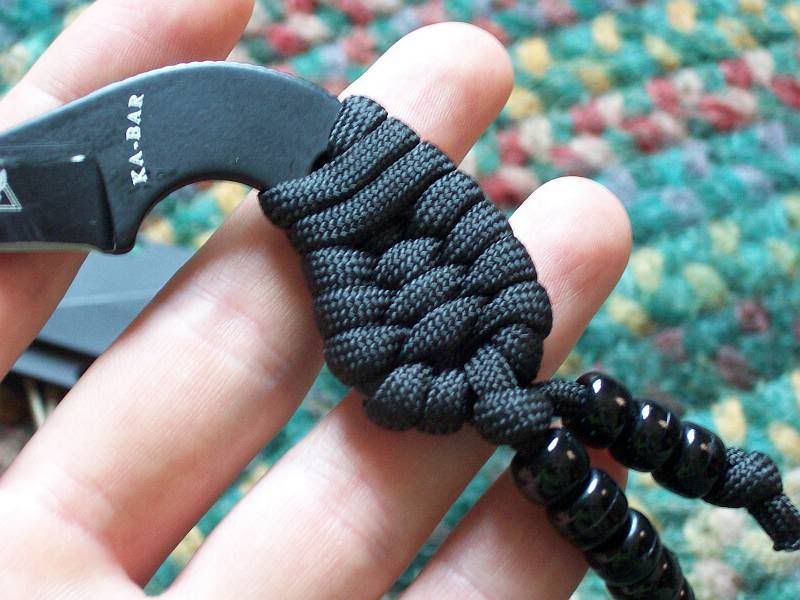
I've seen people put paracord around the hilt to give it a little more to hold on to and it's certainly an option if you aren't looking for deep concealment in a narrow or uncomfortable place--like the back of your shorts, for instance. It also might help those with large hands and less dexterity. And if you want to deep conceal it again, just take the cord off.

The sheath is very basic plastic that has continued to be tight for me despite lots of taking the knife in and out (and even putting it back in backwards a few times). I believe it comes with a stretch of paracord (you'll have to forgive my not remembering. I bought the thing four years ago). If in use as a neck knife, however, I use a bead chain (as shown above) for the slimmer profile and comfort.

A great little knife for a great little price. I can definitely see myself getting another. You should, too. If you want to.

Thursday, June 21, 2012

Improving Vulnerable

Yesterday, on my Facebook page, I asked when everyone felt most vulnerable during an average 24 hour day. Many people said sleeping or work when they are not allowed to carry.

As the bard would tell us, knowing is half the battle. Being able to identify vulnerability gives us the opportunity to examine how we can limit vulnerability during that time.

When it comes to vulnerability there are only three things you can examine and potentially make changes to that can take you from a state of feeling vulnerable to at least prepared:
1. The setting
2. Your practices
3. Yourself

Let's take the example of going to and from the car. My mother used to come home always complaining about where she had to park at work. The door to her building locked immediately upon exit. There was only one light above the door but none in the parking lot. There was a wooded area around the lot where anyone could be hiding. She couldn't always get the closest parking spot to the door either, no matter how much she tried. But all she ever did was complain and, as far as I know, she never changed anything about her setting, practices or herself to feel as though she was no longer as vulnerable. You may never be able to eliminate the vulnerability altogether but it can almost always be improved.


In my mother's case, let's look at some potential improvements.

Setting:
Could she have parked anywhere else? That should be the first and most obvious question. Sometimes there are better, secondary options worth considering. Could she have petitioned her work to install more lights or cut back the tree line (if it was their property, of course). Could she have petitioned her work to install keyless entry pads on the doors for quick and easy access back into the building? I know that no one likes to rock the boat, but if you are feeling particularly vulnerable and there is potential of danger you should speak up. Could there be a security guard who monitors that area at the end of shift?

Of course we all know that usually change in business setting does not always come easily so one might just have to deal with the card he's been dealt in that matter. So if you can't change your setting, change your...

Practices:
Can you ask someone to walk out to your car with you? Maybe you can't have a gun but can you have pepper spray? Can you carry it in your hand vs at the bottom of your purse so you are more prepared? Can you unlock your car remotely before you even approach? Can you approach your vehicle differently? Just changing a few things in practice can make a huge difference to the level of vulnerability you have and feel.


Yourself:
Lastly, however, are changes you can make to yourself to lower your vulnerability. Some places require business attire for work which include impractical shoes that are horrible for fighting and running. Could changing into a pair of sneakers just before you head out of the office make all of the difference as far as feeling more grounded and less vulnerable? Absolutely! Maybe ditching that 3 ton designer purse filled to the brim with stuff you never use and limit it to a small clutch with a few key items that you can toss. Or, better yet, a small clutch with something heavy in the bottom you can use as a sap in a time of need? Maybe take out those dangling, clinking earings that impair your hearing and are far too easy to grab in a fight and put those in your purse or pocket before you head out the door. That hairdo that flows around your face and cuts down on your peripheral vision could go up in a loose pony tail.

Be creative and think about those three areas in whatever vulnerable setting you find yourself.

Working at your desk at work.
Can you rearrange your office so you have a better advantage either via sight or sound? Can you rearrange your desk so that you don't have obstructions or perhaps have some cover or concealment? Could you change how you go about your day and what you do while you work? Change what you bring to work or what you take with you when you leave? If you can't be armed, do you have other defensive options? Could you take off your suit jacket and put on something more comfortable from time to time? Eat healthier, exercise and get enough sleep so that you are at your peak level of attention throughout the day? 

Going to bed.
If there is one place you have the most control over your setting it is at home. Could you arrange your bed in a way that you would be in a less vulnerable position within the room? Make sure you have good locks on your doors and the windows? Alarm system? Dog? Make sure the blinds are closed so that any potential peeping Tom can't see where you are? Could you lock your bedroom door at night giving you a few more seconds to wake up and respond? Could you put all of your defensive tools in something like a holster fanny pack by the bed so that if you need to grab the whole setup and go in the middle of the night you won't forget a vital piece like a cell phone or flash light? Could you sleep in pajamas instead of nude so if you are awoken in the middle of the night you don't feel so exposed (of that's even a concern of yours)?

What do you think? Pick a vulnerable moment (doesn't even have to be your own life) and think of ways that changing the setting, practices or self might make it less vulnerable. There are lots to choose from:
Shower
Getting into the car
Giving the kids a bath
Cleaning out the garage
Going for a run
Working out
Unloading the car

Let's hear your improvements!!

Monday, June 18, 2012

Abuse, Abduction, Self Defense

This article has stuck with me in a bad, can't-get-it-out-of-my-head sort of way: Plan For The Worst - Preparing for Abduction and Restraint.

It was posted almost two weeks ago and there hasn't been a day that's gone by that I haven't fought writing this. It's a great article and needs to be expounded upon and repeated.

Allow me to blunt with why it has affected me: I was restrained, abducted, beaten and raped.

I don't talk about it "publicly." Not because it's painful but because it is a closed chapter in my life. I'm not a victim. I don't even think of myself as a survivor. I don't reject the label if someone wants to categorize me that way but for some reason I feel the term isn't deserved. "Survivor" sounds pretty grand and I certainly didn't do anything grand. I didn't fight for my life. I didn't fight at all. I froze up in a ball of denial and fear, resigned myself to dying and in the end I was let go. Dropped off in a parking lot like a carpooler. A perfectly ordinary end to an extraordinary day. While I did survive (by the dictionary definition of the word) in that I am alive to talk about it, I did not escape unscathed. There were things that were taken from me and killed in me that day and therefore things I needed to mourn and do still find myself mourning. But there were also things that were born. Good things. Things that have lead me to become the woman I am. And so I may not have survived as much as I have adapted.

Either way, when I tell my story, I have many people who tell me how sorry they are for me. I appreciate their sympathy but I don't know what to do with it or respond to it. My story is not a pitiful one. I suppose it would be if my abduction, rape and following months and years were the entirety of it, if I hadn't adapted, but that's only the beginning. I got over it (as much as anyone could). I healed (to form beautiful scars). I have a fearless, wonderful, fulfilling life.

My story of adaptation starts with making mistakes but is ongoing in that I still learn from them and hope to help others learn from them as well. The things I have learned include lessons like the ones listed in the article above. So if you haven't read the article yet, I suggest you go and do so before you read on.

******

Now that you are back (or if you just kept reading) let's put on our rain boots and go slopping our way into my past.

I was seventeen and a pretty typical seventeen year-old at that. I was far more concerned with boys than anything else in life and was having a good time stringing a long line of them along. I was having fun and pretty sure I had everything under control.

Something the linked article doesn't go into is the fact that abductions very rarely happen out of the blue by strangers. Most abductions, from children to adults, are preformed by individuals who are close to the victim in some way. As it was in my case.

I got romantically involved with an older man. At first he was charming and seemingly caring and protective. He treated me gently but firmly and in a way that could be perceived as lovingly. He was a bit controlling and jealous but that was nothing I didn't feel I couldn't handle. 

Over time protective became obsessive and then abusive. He'd been patient with me and manipulated me well and by the time he hit me the first time I was sure I deserved it. But I was also sure I didn't want that kind of a relationship. I didn't love him but I feared him. I feared him enough to go along with his games to the point where I was believing I loved and respected him, even while I was desperately searching for a way to get away from him.

The more I pulled away the more he obsessed. He had me followed and stalked me. He would call to ask me about my day and when I left out certain parts he would accurately fill in the details. He would demand to see me and when I made excuses he would start to make threats and act unpredictably to humiliate me and manipulate me into doing what he wanted.

When I got the nerve to talk about leaving the threats started in earnest. Threats to humiliate me, harm me or harm my family. Finally, there came the threats to kill me.

Then, shortly after my eighteenth birthday, he became very reasonable. He asked me to meet him. He said I could choose the place and it could be as public as I wanted so I would know I was safe. He promised that as long as I met with him in person and answered some questions about why I wanted to leave he would let me go with no strings attached.

I was washed in relief, completely unaware of how many alarm bells should have been going off. Perhaps they were going off, but the screams of my optimism were drowning them out. I genuinely thought I was going to meet with him, talk, and walk away a free girl. Maybe I figured he might make a scene of some sorts to humiliate me or maybe hit me but nothing too bad--nothing I couldn't handle.

We met at a diner in the morning. I was late and he made a scene about it. He didn't ask me any questions, instead he lectured me on how I needed him and belonged to him. So many lies I'd heard again and again and couldn't believe. I didn't say much. I sat in my chair, a cowed silhouette of a young woman--head hung, not meeting his gaze, sitting how he expected me to sit, addressing him in a way he wanted to be addressed.

And then it all fell apart.

I did or said something to set him off. Or, maybe it was part of his plan all along. I seem to remember he said something to the effect that I had not dressed appropriately for him appropriately. He grabbed me by the hair and started to push/pull me from the restaurant.

I was frozen solid.

The only thought going through my head was, "This isn't happening to me. This isn't happening to me. Help me!" I was spending more time being astonished that he lied to me and was doing this than accepting that I was in deep trouble. I had absolutely no ability to think or act or call for help. Even if I had the ability I wouldn't have known what to do. I didn't know how to hit. I didn't know how to kick. I didn't even know how to think. There was no such thing as weapons of opportunity. Pepper spray? What was pepper spray? People used knives to cut food, not for defense. Guns? Only police officers carried guns. Self defense? That concept was alien to me.

As he escorted me through the patrons, I remember looking at them. If my face was pleading, I wouldn't have known it. If I had to guess I'd say it was as blank as my mind. Frozen solid in disbelief and fear. From the outside the incident may had been a bit odd but not so alarming as to make anyone suspect what was going to happen. I didn't even know what was about to happen. Maybe I thought he was going to tell me it was over and to go home.

I was still immobile in disbelief and fear when he got me to his van and got me inside. It wasn't until he put a chain around my neck and locked it with a padlock that the gravity of my situation fully engulfed me. Perhaps on some very deep subconscious level I was overly optimistic that it wouldn't go this direction or maybe I knew that prior to that moment I had options. But with a chain around my neck I got that sinking feeling in the pit of my stomach that whatever happened from that moment on (including my life or death) was entirely up to him. I no longer had any options. I also no longer had any optimism that this was going to be nothing.

I won't go into the details after that except to say that secondary crime scenes are as bad as you read about. He took me to a place he could have privacy and take all the time he wanted.

It was painful. It was humiliating. It was cold. It was terrifying.

Through it all, eventually two things happened almost simultaneously:

1. I became entirely convinced that I was going to die.
2. I stopped being afraid and got angry. Or maybe that's how I remember it. Something tells me that in the moment I wasn't as angry as I was giving up and knowing that now makes me angry. I did have anger though.

I was angry at myself for letting myself get in that situation. Angry at my helplessness. Angry at him for lying and myself for believing those lies. Angry at everyone who just watched as he dragged me out of that restaurant. Angry at my denial about what was really going on. Any at my naive optimism.

My only two desires were to see the sky again and to see my Mother's face. I remember trying to hold on to the image of her smile and only seeing tears. Tears when she'd learn that I'd gone missing. Tears of worry. Would they find my body? Would she have to identify it? More tears on her face. A funeral? More tears.

I was angry that he would get to hurt her through me. I was angry that I had let him do that. Angry that I'd taken her--taken everything--for granted and wouldn't be able to say goodbye. Angry that being choked to death in some pervert's garage was my end.

And then, inexplicably, it was over. He stopped choking me. He stopped beating me. He had a few more choice indignities to deliver to me once he cut me down from where I was hanging but it was over. I was dressed. I was back in his van and back at my car where he shoved me against it, kissed me and said his goodbyes.

He told me he didn't kill me because that would be letting me off too easy. He said he wanted me to live the rest of my life looking over my shoulder for him. He promised he'd come back for me some day and that I'd be his again. He said I didn't deserve him. He promised me that no matter where I went or what I did he would find me and that I'd live with that terror for the rest of my life. He threatened to kill me if I ever talked about it.

I only spent between six and seven hours in his company that day. But his threats held me hostage for years.

They don't anymore. Even if he made good on his threats the idea of him coming for me holds no terror for me now.

I never called the police. If you want to ask why I'd say it was because of all the reasons any battered woman doesn't. Fear. Of him, of the system, of people finding out. I didn't want to face him in court. I didn't want my life put on trial. I didn't want people I loved and respected to hear about my mistakes. I didn't want to see my mother's tears. I was still very afraid of him and I didn't believe I would win. Despite the bruises and welts and bodily fluids that covered my body from neck to knees I was convinced he would somehow come out triumphant in a court of law.

Instead I called in sick to work and spent a few days of blissful agony in bed, not sleeping but staring at the most beautiful sky outside of my window and welcoming every ache and pain because it meant I was alive.


The statute of limitations has long since run out on his crime. I've checked. But that's not the point of this post. The point of this is to learn from my mistakes. So, let's tally them, shall we?

First, I'd like to point out that it's not a mistake to fall for an abusive person. They are manipulative and skilled at their craft of catching victims like spiders are skilled at catching flies. They don't just walk up and introduce themselves as abusive predators so it's understandable if, at first, you find yourself falling for someone you think is a genuinely good guy.

My first mistake is staying with someone who was abusive. Definitions of abuse vary depending on who you talk to, but a man who lays a violent hand on me will not be long tolerated. I will also not tolerate financial, sexual, mental or emotional abuse. Chances are if an individual is okay will abusing you in one area he will be apt to let that abuse spill into the other areas as well.

My second mistake was letting my fear impede action. I was so afraid of what people would think when they found out I was with an abusive guy. I was afraid of leaving. I was afraid of him acting on his threats. I was afraid I wouldn't be believed or that it would turn into a "he said/she said" situation. I lived in a prison of fear but if I'd talked about it before hand and sought help I probably could have saved myself. This also includes the aftermath and not seeking legal justice for the crime.

My third mistake was missing the signs that a big event was coming. People don't go around threatening to kill people if they aren't considering that an option. Yes, some people do have dark senses of humor sometimes, but when someone threatens to kill you in anger it's something to note. And a history of physical abuse is a BIG clue that he doesn't have a problem acting on his violent impulses. But the biggest clue of all that I missed was his sudden willingness to be agreeable and compromise. He'd told me for weeks that if I left him he'd kill me and suddenly he promised he'd let me go if I merely agreed to meet with him to talk. It was too good to be true.

My fourth mistake was agreeing to and going to that meeting. I can't emphasis this enough. If someone with violent tendencies who has reason to be angry with you suddenly wants to meet to "talk" or give you something or just to see you one last time, DON'T GO! Arrange for anything to be said or given through an attorney or sent to a neutral location for pick up. Even legal documents that need to be signed can be done through third parties. Even if you have agreed to meet in a public location, if the individual has a plan to hurt you or abduct you or even kill you, the number of people who are witness to it won't really matter. Don't go. Period! If you do decide to go, at least take a third and fourth party with you (preferably armed and trained body guards). At VERY least, call a friend and tell them where you are going and that if they don't hear from you in x-amount of minutes to call the police. Give that friend all of the information you have on the person you are meeting (cell phone number, home address, full name, etc.). But, it's better not to go.

My fifth mistake was denying what was going on. I knew nothing good was coming from being dragged out of that diner. I chose to deny it until it was too late.

My sixth mistake was letting him restrain me and put me in that van. Once that chain went around my neck it cut off all options. As you have seen, there are some options when you are restrained with things like rope or zip-ties, but short of being a lock smith or having bolt cutters, I was not getting out of a padlocked chain.

My final mistake was not having any self defense preparation whatsoever. When the time came I froze solid because I had absolutely no preparation for that kind of a scenario. All my life I'd been taught that when in public bad guys don't attack, the public will step up and help you if something bad happens. I was taught wrong and I put my faith and safety in the unknown public. I paid dearly for it. I no longer blame or am angry at the patrons of the diner that day. I understand it was not their job to help me. Many of them probably had no idea anything bad was happening. I did not make a scene. Yeah, there was a man dragging a young woman out the door by her hair but their minds probably immediately started rationalizing what was going on. Many probably didn't want to get involved and I understand that. I don't blame them. That situation was not their fault, it wasn't even mine. While I admit that I made mistakes, he was the one committing the crime. But it wasn't their responsibility to save me.

Don't think abduction and restraint are things you don't have to think about. You may be able to avoid it by being conscious of the signs but the fact of the matter is, we humans are masters at deceiving ourselves into thinking we have control of uncontrollable situations or that we are more aware than we are. We always look back and say, "I should have seen the signs." So, when we don't, it stands to reason we should have plans in place for those worst-case scenarios. We should teach them to our sons and daughters and wives and friends.

I often wonder if there was a time after I was restrained where I could have made my escape. Could I have seen what the chain around my neck was attached to and seen if I could have broken it? When he transferred me from the van to the garage could I have gotten away? I don't agonize over it but I see no reason not to learn from it and pass that learning on.

In closing, I'd like to reiterate that while I did make some mistakes that got me into a bad situation I do not feel responsible for what happened to me. There were times I did and that can be one of the hardest distinctions rape survivors have to wrestle with. It's part of the shame that drives so many of us underground to not talk about what happened to us or seek help or justice. We feel we are to blame somehow which is part of the ongoing rape to make one feel helpless, ashamed, foolish, guilty, stupid and powerless. Of course, the truth of the matter is that making a bad judgment call is not justification for kidnapping, assault and rape. The ONLY one at fault for rape is the rapist.

It took me a long time to stop blaming myself and even to forgive myself. My goal here is not to open old wounds (though, I'll admit to shedding a few tears while I wrote this) but to help others learn from my mistakes. And to warn people not to take anything they may learn about self defense for granted. Even something as improbable as being abducted and restrained is something to be prepared for.

Wednesday, May 23, 2012

Breaking Into the Gun Community

Yesterday, I got this message:

I am currently a sophmore in high school. i started shooting at a relatively young age, and at that age found it quickly to be an easy fitting niche for me. I found myself to be a capable shooter and was even able to win small local shooting competitions. as i grew, i became more interested in the function of the guns from a physics standpoint, and quickly attempted to learn as much as i could about firearms. the problem however, is that because I'm young, older shhoters tend to completely write off my knowledge about firearms, to the extent where people here on youtube have told me that my opinions are not valid because of my age. My question i suppose is why do you think people are so unwilling to accept young shooters, even if they have demonstrated skill and knowledge, when in most other sports younger players tend to be valued higher than older ones? Also why would an older shooter be so discouraging to a younger shooter trying to learn the craft?

I was about to construct a personal reply when I had the sudden urge to share my thoughts on this matter with the whole.

I feel this young man's pain and I understand it from both sides. When I started down the "gun road" (I shall call it) I was both young (and still am) and a woman. I had people refuse to work with me behind a counter because of my sex. I had lots of people tell me I didn't know what I was talking about because I was young. I still have people telling me I don't know what I'm talking about and that's okay.

I put myself out there because I love to talk guns, learn about guns and share information about guns and carry. If I had advice for anyone trying to "break into the gun community" this would be it..

Don't Let The Internet Get You Down
For every great gun person on the internet there are 100 idiots who don't know what they don't know. Sure, they may have been shooting for 30 years but through a series of bad habits, pride, stubbornness and ego they refuse to evolve, grow, accept the new and the happening and embrace anyone who comes behind them with more skill or (worse) more information and new skills. They are cranky, they are morons. Ignore them.

Instead of worrying about their bad and limited opinions, get yourself under the tutelage of those who are knowledgeable, skilled, helpful, encouraging and wise.

Find those people and appreciate them for everything they pass on to you!

Know What You Know 
If you know your stuff, don't back down but don't be too haughty about it either. If you said something that you know to be correct and someone tries to tell you that you're wrong, don't start a pissing match, just show them why you are right.

Which leads me to my next point.

Have Backup For What You Know 
No one is going to take your word on the matter unless you have made a strong name for yourself for being reliable, wise and experienced. No matter which way you cut that, it means you have to be older and doing it for a long time (usually at least 10 years or so). So, in the meantime, while you are making that name for yourself, you are going to have to back up your opinions/ideas/thoughts.

If you say something about a Glock and someone says that you are wrong, you'd better be able to provide the link to the Glock manual, website, page and paragraph of a recognized book on the subject, etc.

Nothing slaps down the nay-sayers like, "Hey, check our your owners manual on page 23, paragraph 6, sentence 2."

Like I said, you don't have to be cocky or arrogant. Backed up fact alone will help you build that reputation for being someone "in-the-know." 


Don't Say You Know What You Don't Know
If you don't know about some holster for some obscure gun that someone found in their grandfather's garage, don't pretend you do. Someone smarter will come along and make you look like the idiot you are.

Making up statistics will also get you discredited REALLY FAST! If you say, 1 in 2 people carry a gun, you better have a source for that data. If you say 90% of people will do this or that, again, I want to see the source material for that number. If you can't provide it you will not get far.

Don't Advise On Something You Can't Know
If there is one thing that gets people in the gun community cranky it's a youngin' telling them how they should carry or deal with certain situations when they have zero experience or training on that matter..

If you've been carrying a gun for less than six months (or can't carry due to age or state restrictions) and start giving advice on carry then you are going to start ticking off people very quickly.

The next question you are going to be asked is about training and experience. A few years shooting (even in a shooting sport) and a couple of NRA basic pistol classes is not going to do it and you are going to be discounted and discredited. You may be right, but you lack the experience to back up your theories. Far better to let someone more experienced weigh in and stay quiet or, at most, encourage thinking by presenting your opposition in the form of a question.

"Why do you carry your firearm that way? I can't carry yet but I'm curious as to this setup and how it works, it looks to me like it might be dangerous. Can you explain it?"

You've got people thinking and you don't look like a know-it-all. Win/Win!


Don't Be Afraid To Ask So You Can Know More 
When you want to be accepted as someone of knowledge it's easy to try to shy away from asking questions that might make you look ignorant. In truth, however, that's the best way to get knowledge, experience and be looked upon as someone who is willing to be honest with everyone, including himself. 

Admit When You're Wrong
Stoically defending your wrong opinion will not make it any more right. Admit you were wrong and move on.

Of course, there are things that are opinion only and can neither be right or wrong only smart or dumb. Tactics is a good example. Go ahead and give your opinion but if you aren't sure if what you suggest will work or not, say so. Better yet, get together with a few buddies and try it out with some dummy guns or airsoft and report back your results. Ask other, more experienced people what they think of your data and to critique it. You will get props for doing the work and will probably learn a lot.

Yet, sometimes you just have to agree to disagree with some people.


I find it very humbling that someone would contact me asking for advice on how to get people to accept them in the gun community as I do not feel like a "big name."

Yes, I have some experience carrying and in some classes and trainings but I have no background in law enforcement or military. I've never had to put anything I've learned into real-world practice (okay, that's not true.. I use what I've learned in avoidance and confidence and carry, every day but I've never had to draw my gun or defend myself from an attack ... lately) and, as stated before, I am, myself, still young and figuring things out as I go and learn.

For some reason still unknown to me I've amassed a small following. I don't think I've done anything too special to warrant people looking to me for advice but I will do my best to pass on valid information as I learn it and answer the questions I do know.

Friday, May 18, 2012

Red Dot Sights on Combat Guns

Back in 2006 or so I took my very first two-day defensive pistol course with Greg Hamilton, founder of InSights Training Center. I was relatively new to the game and what he said about sights kind of surprised me.

He said, "Ideally, we'd all be running around with some kind of red dot sight (RDS) on our pistols. Just wait, give it a few years and you'll see red dot sights made for carry pistols."

At the time, RDSs were not "new" but they were long and scope like, usually reserved for rifles and getting rave reviews in combat for their fast sight acquisition, ease of use and adaptability to all types of shooters.

Enter 2012.

Greg's predictions are coming true. This technology has been made available and it's piquing interest and gaining popularity. It's raising questions and people are wondering if it's a viable option for them.

I'm always willing to try new technology (especially when it comes to guns) but sometimes it's hard to get a chance to play with this stuff unless you are deeply imbedded in the business or have very good connections .. or, in my case, take classes with some very generous and trusting people. 

When I went to TDI's Handguns I - III this spring I  saw the Leupold DeltaPoint Reflex Sight on many of the instructor's firearms which made me stand up and take notice. When I went back for Partner Tactics I was able to shoot one for a day and play around with it.

I asked the same questions that others have when they see this technology for the first time:

How does it work?
We always want to know how this stuff works. In lay person (that's me) terms. The sight is a glass window wherein a red dot (or triangle, depending on which reticle you opt for) is projected. This dot is aligned over or on your front sight so that where the dot lies the bullet will hit.

Leupold DeltaPoint Reflex Sight
Unless you opt to physically remove your sights, the RDS can be mounted along with your physical sights so that they are only an addition to your sighting system rather than a replacement.

The sights do not need to be turned on physically (like a laser). They come on automatically when they sense movement. Yes, that means they are always on when you walk around but when you sit down for a time (I think they turn off after five minutes) or take your gun off at night they will automatically turn off until they sense movement. Those who have them on their carry guns never turn them off.

The dot also adjusts itself to ambient lighting conditions by itself so you don't have to be worried about being blinded by it at night or in low light or not seeing it in the day.

Battery life?
From those I have talked to, battery life depends a lot on how much you carry your firearm but even for those who carry (and even shoot) daily the battery can easily extend beyond six months though it's recommended to change it out every six months just to be safe.

What if the glass breaks?
According to those I've talked to, no one has ever heard of the glass actually breaking. There was one instance where it was told the glass cracked but the RDS continued to work without causing an obstruction.

What if it just stops working?
Well, if it stops working you do have your original sights to back you up. Line up the bumpy things like you always did and keep shooting.

What are the benefits?
Low light sight acquisition, fast acquisition, increased accuracy and speed are some of the biggies. But for those who are cross dominant shooters (aka, those who are right-handed and left-eye dominant or left-handed and right-eye dominant) there is a lot less head tilting and confusion when it comes to sight acquisition (according to my husband who is a cross-dominant shooter).

Improved sight picture is another big plus. Traditionally it is taught that you look at your target until you bring the firearm up and then you allow the front sight to interrupt your view of the target and squeeze the trigger. Because your front sight is much closer than your target (ideally) you will have a blurry rear sight, a blurry target and a crystal clear front sight. There is some dispute about whether or not that is ideal or even possible in a defensive scenario but with an RDS the two camps can stop quibbling. You can keep a crystal clear target, put a red dot over where you want the bullet to go and pull the trigger. Win/Win!

One of the additional benefits is that you do not have to have perfect sight alignment to get a good combat hit at your defensive distances. Once you are familiar with the sights, whenever the dot is over the target and inside the widow of the sight you will hit the target. No, it might not be pin-point accurate, but it will not be a "miss."

What are the drawbacks?
From what I hear and see and feel and shoot.... Nothing... except for price of the sight and having someone of repute install it on your firearm.

Traditional Rear Sight relation to RDS
Will it fit in my holster?
Most of the time, yes. Because the sight sits back to where the rear sight normally sat it is usually out of the way of the holster. Where you start to see an issue is where the rear sight needs to be moved to (which is much closer to the ejection port) (check out the picture to the left). I tried it out in my UBG Regulator and it worked fine. Other holsters may need to be slightly modified to allow the rear sight access, but most holsters stop long before they get to the actual RDS.

How does it conceal?
This depends a lot on where and how you carry your firearm. For me, who carries it behind the strong-side hip, there was a very small bump where the RDS sat but it was not so prominent that it made the firearm more noticeable. For others who carried more forward or appendix, it concealed just as easily as any other firearm.

How was gun handling with it?
Business as usual. I was able to do everything I normally did with the gun with the RDS. I witnesses others with the RDS use it as a level to help them rack the slide. Personally, it did not get in the way and I didn't have time to see if there was any new way I could adapt using its physical presence on the gun to my advantage though others certainly seemed to do so.

Remember those one-handed racking drills? I could see how they would be MUCH easier with an RDS sticking out the top of the gun.

Those I talked to who made the switch swore they would never go back to plain sights again. They say it has improved their sight picture, helped with accuracy and was a great investment.

I found it very easy to shoot with the RDS. Those first shots were a little slow as I figured out how to mount the sight without searching around for the dot, but once I got it it is a little like riding a bike and it got easier every time.

When I switched back to traditional sights I lost nothing in the transfer because there were still traditional sights with the red dot that I was aligning. Switching back and forth was not a problem at all. 


When I dropped my G19 off to Bowie for his reduction and trigger job I had the option of getting the RDS put on my gun but opted out of it for now.... especially since my husband was getting it put on his HK. I don't need it as much as he does. He was blown away by how much easier it was for him to shoot as a cross-dominant shooter and was immediately convinced that the RDS was something he wanted on his gun.

Will I eventually get it done?
I don't know. Maybe... probably? Perhaps as I continue to progress in my training I will find more and more scenarios where it could be helpful and decide it's time to make the switch. Already I can see it as a huge plus for low light and scenarios where you may not be able to get an ideal sight picture (clearing stair-ways comes to mind).

Sure there are those who resist change or are afraid of the added bulk or weight or whatever... everyone has the right to be a little skeptical especially when it means dropping a couple extra hundred bucks or so, but I really did not see much validity to those arguments... especially when we are talking about dedicated carriers and shooters. A casual, on-again-off-again carrier who doesn't train much or carry with regularity or with a good carry system may not see it being worth their money or time.


Would I recommend it? 
Absolutely! Especially to cross-dominant shooters! Do I think it's necessary? I guess that depends on your definition of necessary. People have been getting along pretty well without them on their carry guns but if you can have an advantage or get something that helps you improve, why not.. right?

Take a look at them!

Sunday, April 22, 2012

I Can't Help Your Wife

I get a lot of messages asking for advice on how to get wives/girlfriends/significant others/daughters/females into guns, shooting, carry or self defense in general. In the past I have tried to give advice. Invariably, I would get responses like, "I did that," or "I tried that," and a follow up story or excuses on why said wife or girlfriend completely rejected the advice.

Then the individual (usually a male) either sends me back a message asking what else he can try or  stands there staring at me like surely I have some kind of direct line to God that will some how allow me to pull down the magic phrase that will make his woman go, "AH HA!! I GET IT! Honey, let's go to the range, buy me a brand new $2,000 1911 and enroll me in this weekend's IDPA match. Oh, on the way, let's stop off and file my paperwork for my concealed carry permit."

Let's face it, guys, women are as individual as anyone else. Just like she might have a really hard time getting you to come to Yoga with her every Tuesday night or sit in on her book club dedicated to romance novels, you might have trouble getting her involved in something she is just not into.

I understand that it is hard, especially when we aren't talking about getting into guns as a sport but as a means of self defense. I understand that a man wants to protect his woman or at least provide her with the means to defend herself and it can be exceptionally frustrating when the person you care about does not see firearms as a viable option of self defense. All you want is for that individual to be safe and do her best to protect herself.

But truth be told, even if I had a magic phrase that would get a woman to carry a firearm for self defense I wouldn't use it. Carrying a firearm is an extremely personal decision that comes with many consequences--mental, training, lifestyle, responsibility. Pushing a firearm on someone who is not ready for the responsibility of lethal defense is something I never want to be accused of or a party to.

But there is light at the end of the tunnel for those who are looking for clues that a woman (or anyone, for that matter) might be ready to pick up a firearm for sport if not for self defense.

After so many individuals have approached me asking for my advice I looked back at my own experience and figured out what it was that made me willing to start looking at firearms from a perspective that was different from merely hunting or home defense. 

1. An Open Mind
In order for anyone (especially an adult) to be willing to accept anything new into his or her life that individual must be willing to open his or her mind to the idea.

I was a legal adult before I even knew that handguns could be carried by civilians. I found out when my boyfriend at the time (now husband) told me that he was going to a weekend firearms class in order to get his carry permit. After expressing my surprise that such a thing was legal and asking why he wanted to carry a gun I sat back and thought about the practice as a whole. I decided I could understand why someone would carry a gun.

If you are trying to convince a woman (or anyone) to take up shooting as a sport she has to be open to the idea that firearms can be used in a sporting manner. If you want to convince her to carry a firearm as a means of self defense she has to be open to the idea that a firearm is a viable means of self defense. Without that open mind on those matters you might as well be beating your head against a brick wall. You certainly aren't going to get her into guns without it.

2. A Willingness to Try New Things
There is one thing I do not have a willingness to try: skydiving. I have an open mind enough to understand why people could get a thrill from it or even enjoy it. I've even accepted its necessity to certain vocations. For myself, however, unless required to do so as a means to save myself from a fireball crash, I prefer to keep my feet planted firmly on the ground or my butt on the seat of a well-maintained airplane and not free falling between the two.

Because of this unwillingness to even try launching myself from an airplane, it's exceptionally doubtful that you will see me with a parachute on my back any time soon. It stands to reason, then that someone with a similar unwillingness to try firearms might have a higher resistance to entering shooting sports or carrying a firearm as a means of self defense. One has to be willing to try something before they can decide whether or not they will adopt it into his or her lifestyle. In absence of that willingness, you cannot expect a sudden change.

That doesn't mean that someone's unwillingness cannot change, of course, but it's a hurtle that must be overcome. And even if someone is willing to try, it certainly doesn't mean they will jump head first into that new way of life.

I have tried roller coasters at least three separate times. I have now decided it's pointless to try again. Roller coasters are not for me. And sometimes, guns just aren't for some people.

3. A Grip On Reality
No, someone doesn't need a good grip on reality to get into shooting sports. In fact, there are a lot of people who are into shooting sports who have a completely fantastical reality. There are championship shooters or avid hunters who do not believe people should be allowed to carry guns on their persons for self defense. This can be the case for many women as well.

We hear about it from people all the time. You can't read or listen to a debate on gun control without someone, somewhere, saying, "I'm a hunter..." or "I'm a shooter..." or "I own guns but I still don't see why you'd want to carry one."

The reality, of course, is that firearms are a viable means of self defense. There are bad people out there who do bad things to good people for no good reason. They are violent and they are ugly and the only thing that can stop them is a skilled and violent defense. Guns have and continue to be used to save lives and those who cannot accept that do not have an exceptional grip on reality.

But having a grip on reality doesn't just mean accepting firearms as a self defense tool. It also means accepting one's own personal reality.

There are many people who have an open mind, are willing to try new things, understand a firearms viability as a self defense tool but are realistic enough about their own limitations to know the firearm is not for them. These people should be respected for their honesty. Instead of spending additional time trying to convince them they have misjudged themselves they should be encouraged down different avenues of self defense.

I can't make a woman carry a gun or get into shooting sports. I have no magic wand or words that makes a woman more willing to pick up a gun. Sure, there are times when all it takes is a woman seeing a female example to open their mind up to at least trying a shooting sport but that is where my influence ends.

If, after she opens her mind, is willing to give firearms a try, accepts the reality of firearms and their place in her life and then wants some more information.... send her my way. We got something to talk about.